Let’s try to imagine together what the next generation of household robots will look like and what they will do.
What kind of service robot do we dream of?
Robots have long been part of our everyday lives. They exist in almost every home. Not everyone simply realizes this fact. Just to remind you: a robot is a device programmed to perform some task independently. Now look around, walk through your house or apartment. You will probably agree that modern washing machines and dishwashers, multicookers and programmable ovens, autonomous vacuum cleaners, and smart speakers fit this definition quite well.
The difference is that these are specialized machines designed for only one specific type of activity. Besides, they are not particularly intelligent. What we dream about are universal, multitasking devices. At the same time, they should be equipped with enough intelligence so that we can give them instructions in a free-form way. This image has long been shaped by science fiction, and many people, when they hear the word “robot,” imagine something similar to what is described above. At the same time, it is usually taken for granted that such robots should be humanoid.
What service robots already exist today?
Judging by the latest achievements of robotics engineers and developers of artificial intelligence models, we are already standing on the threshold of realizing the dream of a universal robot. Or perhaps we have already taken the first step beyond that threshold. To see this, let us look at several examples of models that have already taken physical form.

Resembling an advanced shopping cart, this “sidewalk” robot is designed to deliver small loads. These can include packages, letters, food, and similar items. In the future, such a robot could easily take on the role of a household assistant who goes shopping, freeing its owners from the need to spend time on offline shopping. Moreover, it is easy to imagine the evolution of such robots into a kind of robot rickshaw.
Office messengers, waiters, and cleaners from KEENON

This constantly expanding series of robots originally had a simple function — delivering small documents and similarly sized objects within office spaces. Over time, the lineup expanded to include waiters who can advise customers and serve food and drinks at tables, sales assistants capable of accompanying customers and delivering goods to the checkout or exit, cleaning robots, and others. It is important to note that, despite the absence of hands or manipulators, many KEENON robots can, at first approximation, be described as anthropomorphic. It is also worth noting that the developer mentioned is not the only one working in this direction of robotics. For example, the CLOi ServeBot from LG can also be mentioned.
An assistant with hands from AEOLUS
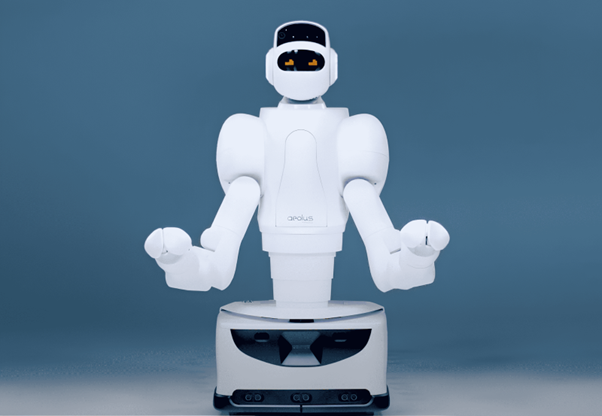
AEO is an excellent example of a modern service robot striving for universality. Thanks to its manipulators, it resembles a human much more than “smart carts.” But the main point, of course, is the capabilities provided by its mechanical arms. It can carry bags, packages, baskets, buckets, various containers, and other items. In addition, it can use various tools, press buttons (for example, an elevator call button), and “communicate” with its owners. AEO has already found its place in medical institutions, performing the duties of junior staff.
Almost like humans, or What service robots will appear tomorrow?

Of course, the future of universal service robots lies with humanoid models. Examples close to realizing this idea include, Tesla Bot Optimus and Figure. Based on everything said above and taking into account the direction in which progress is moving, let us try to describe the “portrait” of the universal service robot of the future.
It will be an anthropomorphic device, approximately the height of an average human, equipped with a computer, with two legs, two arms, and a head, capable of moving at the speed of a pedestrian. The main materials used to build such a robot will most likely be plastic, silicone, and metal. To expand its capabilities, it will maintain communication with a central control system shared by its model and possibly, to a limited extent, with the internet. At the same time, a fully autonomous mode will also be available. Operators (or simply owners) will be able to communicate with it in a free form. Its main functions will include household work (including using home appliances), caring for pets and plants, shopping, cleaning indoors and outdoors, gardening and landscaping tasks, delivering manageable items, carrying loads, working as a caregiver, and similar tasks. At the same time, it will quite possibly handle the role of an interesting conversational partner and, in general, a companion.
Here we arrive at the most important “detail of the portrait” of the universal service robot of the future. The foundation of its software will be artificial intelligence. In essence, the complexity of robot functionality will largely depend on the level of AI development. The more advanced the AI becomes, the more complex the tasks a robot will be able to handle. And the more significant a role robots will play in our lives.
At the same time, it should be noted that the majority of robots, just like today, will actually be virtual digital agents designed to work with information and on the internet. For example, our Pitch Avatar.