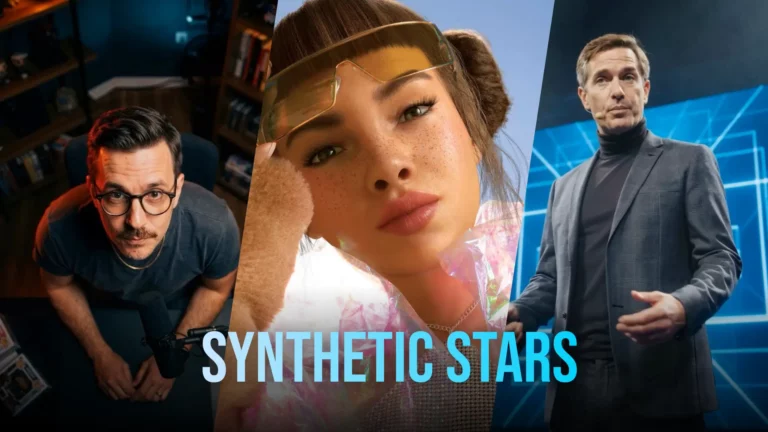
TL;DR: AI avatars have moved from behind-the-scenes recommendation systems to starring on-screen.They enable 24/7 newsrooms, virtual influencers with millions of followers, the rejuvenation of film actors, and interactive projects for fans – reducing production time by up to 80% in some cases. The technology brings real opportunities (creative freedom, dramatic cost savings, 24/7 availability) and creates real challenges (job losses, copyright disputes, the risk of deepfakes, audience trust). The future of AI avatars in media depends on how the industry ensures transparency, publicity rights, and the human-AI partnership that underpins synthetic storytelling.
Artificial Intelligence has long been present in the media industry. Until recently, though, it mostly played the role of a “behind-the-scenes expert”. For instance, AI has been responsible for suggesting what to watch on Netflix, personalizing playlists on Spotify, and adding flexibility to video game storylines. Today, the situation has changed: AI has stepped out of the shadows and is increasingly taking on “leading roles” – while still performing its backstage functions.
A new wave of technology has given rise to a whole class of digital on-screen characters: AI Avatars. These are no longer just special effects, like cartoonish CGI figures bound by a pre-written script. AI Avatars can act as “digital twins” of real people, hosts of shows and presentations, social media influencers, or actors capable of captivating audiences no less effectively than their biological counterparts.
It is no exaggeration to say that the media and entertainment industry is at a turning point – and AI Avatars are at the center of this revolution. Their emergence has transformed everything: from how media is produced to what audiences expect and demand. According to forecasts, the application of AI in media and entertainment is set to grow at an average annual rate of 26.9%. In other words, AI Avatars give companies the ability to compete successfully with those still relying on traditional production and post-production methods.
4 Transformative Use Cases in Media and Entertainment
From social networks and digital media to television and cinema, AI avatars have found their place in virtually every corner of the media landscape. Artificial intelligence is driving the creation of new types of content and boosting production efficiency – whether it’s 24/7 newsrooms, influencers with millions of followers, or the world’s leading film studios, broadcasters, and streaming platforms. Below, we highlight four illustrative use cases of AI avatars within today’s media industry.

24/7 Newsroom: Virtual Anchors and Presenters
Modern newsrooms operate at an unprecedented pace and under constant pressure. For multi-platform media outlets, the challenge is especially tough: it’s not enough to publish stories quickly – they also need to adapt them to multiple formats. Here, AI avatars prove invaluable. Within minutes, a simple text report can be transformed into a fully produced video segment – without the need for a human presenter, camera crew, or studio.
A striking example comes from STUDIO 47, a regional German broadcaster. By using AI avatars, the company cut production time by 80% and reduced costs by 60%. AI can also help instantly generate content for different social media platforms and localize news for global audiences. This levels the playing field: the 24/7, multi-platform news cycle, once possible only for industry giants, is now accessible even to small newsroom teams.
Perfect Spokesperson: AI-Powered Virtual Influencers
Fully digital, AI-driven personalities have already transformed influencer marketing. A virtual influencer with a massive global following is now one of the most powerful and cost-effective tools available. Consider Lil Miquela: she doesn’t exist as a person, yet she has millions of Instagram followers and brand deals with Prada and Calvin Klein. Her influence – and her revenue – are entirely real. The same goes for her peers, such as CodeMiko, Kizuna AI, and Noonoouri, who have become established names in the influencer space.
For brands, the advantages are clear. Virtual influencers offer complete control over image and messaging, constant 24/7 availability, and the ability to run parallel campaigns across different platforms and markets. And unlike their human counterparts, they are immune to scandals and reputational risks. No wonder the global virtual influencer market, valued at $6 billion in 2024, is growing at a staggering 40% CAGR. Synthetic digital stars are quickly becoming a new driving force in digital marketing.

Digital Actor: De-Aging and Virtual Performances
It’s no secret that AI is now widely used to alter the appearance of film and TV actors – making them younger or older, changing hairstyles, eye colors, or even “dressing” them in digital costumes of fantastical creatures, all with stunning realism. Think of the cinematic universes created by directors like Peter Jackson or James Cameron.
But some proposals go much further – for example, plans to “resurrect” James Dean, who died in 1955, for a new film, or to produce a sequel to “Gone with the Wind” featuring the original cast, but entirely in digital form. Not surprisingly, ideas like these ignited heated debates.
For filmmakers, though, the opportunities are nearly limitless: stories spanning decades, the return of iconic actors, and even the recreation of real historical figures. At the same time, profound questions arise. Who owns the likeness of a deceased person? What counts as “acting” if an algorithm generates the performance? Can a digital replica of a real person be made to do things they never did in life?
These debates are far from settled, but AI Avatars are already appearing in films and TV series – and their presence is only likely to grow as directors and producers embrace the creative possibilities.
Interactive Fan Experience: Personalized Media
With AI video avatars, fans can now do more than just watch their favorite characters on screen – they can actually interact with them. A great example is Paramount’s promotional campaign for the Scream movie: the studio launched a website where fans could receive a personalized phone call from Ghostface, generated by AI. Instead of passively watching an ad, fans were pulled directly into the film’s universe.
And it doesn’t stop with cinema or video games. This kind of immersive, AI-driven interaction can be applied in virtually any industry, helping brands and organizations build stronger, more emotional connections with their audiences and customers.
The Production Revolution: Streamlining Media Workflows
As we noted earlier, the rise of AI avatars as on-screen characters has by no means left artificial intelligence “behind the scenes” without work. On the contrary, AI’s role in content production has only grown. Traditionally, media production is a complex, linear, and expensive process. AI automates routine tasks, optimizes resource allocation, and significantly accelerates production cycles. In other words, AI tools make it possible to streamline workflows and eliminate unnecessary steps.
For example, with AI, an editor can automatically generate several social media versions of an interview – tailored for TikTok, Instagram, or YouTube Shorts. A marketing team, using an AI Avatar, can quickly and cost-effectively localize promotional videos without the need for actors or translators. Screenwriters now find it much easier to draft multiple versions of a script with AI’s help. And designers can create virtually unlimited variations of AI characters’ looks. This kind of automation frees creative teams from exhausting routine work, allowing them to focus on strategy, storytelling, and innovation.
Inside the Uncanny Valley: Ethical and Legal Frontiers
Copyright, Likeness, and the Hollywood Strikes
The ability to create photorealistic digital replicas of actors has sparked heated debates over the “right of publicity”. Who should control the commercial or other uses of a person’s appearance and voice, and under what terms? This was one of the central issues in the recent Hollywood labor strikes by the SAG-AFTRA and WGA unions. Actors and voice-over artists fear that studios could exploit their “digital twins” indefinitely – without consent or fair compensation. Studios counter that they are using the voices and likenesses of fictional characters they “own”, not the real people behind them. The legal framework around this issue is still incomplete and evolving (the 2025 SAG-AFTRA Interactive Media Agreement introduced AI replica consent requirements), but it is already clear to all stakeholders that this is one of the most pressing challenges at the intersection of labor rights and intellectual property. Establishing clear, consistent, and fair rules for the use of digital likenesses is critical for the ethical adoption of this technology.
Deepfakes, Misinformation, and Audience Trust
It is equally clear that the same AI tools capable of creating virtual influencers, news anchors, or hyper-realistic scenes can also be misused to generate unethical or malicious content – such as deepfakes intended to spread disinformation or damage reputations. The danger goes far beyond individual cases (only 0.1% of participants identified all deepfakes), the broader threat is the erosion of public trust in the media.
Since laws are often slow to catch up with bad actors, the responsibility for creating strict ethical guidelines and robust moderation systems falls on media corporations, news agencies, broadcasters, digital platforms, professional associations, and other industry stakeholders.
The use of AI Avatars must be guided by the principle of transparency. Audiences should clearly understand when they are seeing a virtual AI presenter or a scene reconstructed with digital characters. This requirement is especially important for news reporting and documentaries. Clear labeling to indicate the use of AI Avatars and related technologies seems both logical and necessary – the EU AI Act requires it by August 2026. But the issue runs deeper than any single rule: responsible AI adoption and the advancement of media literacy will require significant effort. Without such measures, trust in the media cannot be preserved in the era dominated by synthetic content.
| Pros (Opportunities) | Cons (Challenges & Risks) |
|---|---|
| Creative Freedom: Create any character, de-age actors, or bring historical figures to life. | Job Displacement: Potential to replace human actors, voice artists, and stunt performers. |
| Radical Cost Savings: Eliminates travel, on-set costs, and reduces the need for large crews. | Copyright & Likeness: Unclear legal landscape around using an actor's digital replica without consent/compensation. |
| 24/7 Availability: Virtual influencers and actors are always "on-brand" and available for campaigns. | Potential for Misuse: Technology can be used to create convincing deepfakes and spread misinformation. |
| Risk Mitigation: Eliminates risks associated with celebrity scandals or scheduling conflicts. | Audience Trust & Authenticity: Risk of the "uncanny valley" and audience rejection of synthetic performances. |
Conclusion: A New Era of Synthetic Storytelling
Since their emergence, AI Avatars have rapidly become one of the most popular tools in the media industry. They enable faster content creation at lower cost, while offering global audiences entirely new formats of interaction. Beyond that, AI Avatars make it possible to bring the boldest and most imaginative ideas to life. Yet with these opportunities comes greater responsibility: the more powerful the tool, the more carefully it must be applied.
At the foundation of the new media landscape should be built on one key principle: AI is not a competitor to humans, but an ally and assistant. The key to success is a harmonious combination of human emotion, boundless creativity, and artistic intuition with the computational power, tireless efficiency, and versatility of AI. The future belongs to the companies and media organizations that can effectively balance the contributions of human and artificial intelligence, while ensuring transparency and safety in their work.
Frequently Asked Questions (FAQ)
Yes, for certain brands and demographics. Virtual influencers like Lil Miquela have cultivated millions of followers and have secured major brand deals with companies like Prada and Calvin Klein. Their effectiveness stems from their novelty, relevance to adigitally native audiences, and the complete creative control that brands have over their persona and messaging.
The main legal issue concerns the “right of publicity,” that is, the right of an individual to control the commercial use of his or her name, image, and likeness. Using an AI-generated version of an actor without their explicit consent and fair compensation can be a violation of this right. This has become one of the main contentious issues in the negotiations between trade unions in the entertainment industry.
Transparency is the key to success. News outlets that use AI avatars should clearly and prominently disclose that the presenter is a digital creation. The focus should be on using the technology to deliver factual information more efficiently (e.g., for breaking news alerts or multilingual broadcasts) rather than for opinion pieces or investigative journalism, where human credibility and accountability are paramount.
Technologies in this area are developing rapidly. The most advanced AI avatars can display a range of nuanced facial expressions and gestures to convey emotion, though they may not yet match the full range of capabilities of a talented human actor. The quality of the vocal performance, which is often generated by a separate text-to-speech AI, is also crucial to creating an emotional and compelling image.