As global digital consumption accelerates, video content has emerged as the universal language of the internet. However, the actual spoken language within that video remains a formidable barrier to true global expansion. As of 2026, content localization has become a critically important source of competitive advantage, directly impacting revenue. Therefore, treating the relevant functionality merely as another convenient add-on or approaching it as a matter of formal regulatory compliance is a serious mistake.
This comprehensive guide provides a definitive overview of video dubbing, moving beyond surface-level definitions to explore the complex technical workflows, economic imperatives, and the transformative AI-driven future of multilingual audio.
What is Video Dubbing?
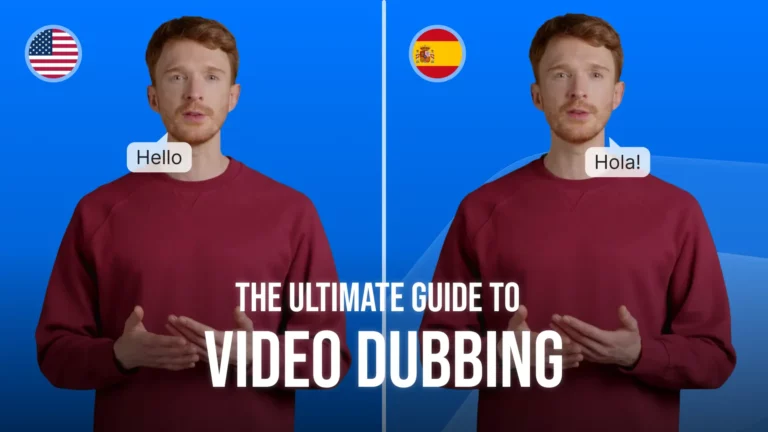
Video dubbing, technically known as language replacement or re-voicing, is a post-production process where the original vocal performance of a video is replaced by a new recording in a different language. Unlike subtitling, which requires the viewer to read text at the bottom of the screen (dividing their visual attention and increasing cognitive load), dubbing aims for total immersion. The primary objective is to create a seamless experience where the viewer can suspend disbelief and engage with the content as if it were originally created in their native tongue.
Crucially, modern dubbing distinguishes itself from voice-over by its rigorous adherence to synchronization. While a voice-over (often utilized in documentaries or news segments) might leave the original audio audible in the background or pay little heed to the speaker’s lip movements, dubbing strives for lip-sync and isochrony. Isochrony involves matching the timing, phrasing, and mouth movements of the on-screen speaker to the new audio track, ensuring that the auditory and visual inputs are congruent,
Historically, this level of synchronization was achieved in soundproof studios using the “loop” method or ADR (automatic dialogue replacement). This labor-intensive and costly work required special equipment, professional skills, and a significant amount of time. Today, the landscape is shifting radically toward AI dubbing. In this new paradigm, neural networks and large language models (LLMs) analyze the original audio’s prosody (its rhythm, stress, and intonation) and generate synthetic speech that mimics the original speaker’s voice characteristics in dozens of languages instantly.
Business Case: Why Dub Your Content?
The strategic imperative for video dubbing is grounded in measurable business outcomes rather than purely aesthetic preferences. As markets saturate, expansion requires crossing linguistic borders. The “Business Case” for dubbing rests on three pillars: Market Penetration, Viewer Retention, and Accessibility.
Market Penetration and ROI
Data from CSA Research and other industry bodies consistently indicates a strong preference for native-language content. Approximately 72% of global consumers prefer to spend most of their time on websites in their own language, and a significant portion creates a “trust barrier” against content that is not localized. When a B2B company dubs its product demos or sales enablement materials, it effectively unlocks a Total Addressable Market (TAM) that was previously inaccessible. For instance, a US-based SaaS company ignoring the Spanish-speaking market ignores over 500 million potential users.
Viewer Retention Statistics
Subtitles impose a cognitive load. The viewer must process visual data (the action) and textual data (the subtitle) simultaneously. This “split-attention effect” often leads to lower retention rates, particularly in educational or complex B2B content. Dubbing removes this friction. By delivering information through the auditory channel in the viewer’s native tongue, comprehension and retention rates improve significantly.
Accessibility and Inclusivity
Beyond market reach, dubbing is an accessibility tool. It serves populations with dyslexia, visual impairments, or lower literacy rates who may struggle with rapid subtitles. By utilizing AI tools like Pitch Avatar to generate audible dialogue, brands ensure their message is inclusive, adhering to broader ESG (Environmental, Social, and Governance) goals while simultaneously widening their funnel.
The Professional Dubbing Workflow (Step-by-Step)
To understand the value of modern automation, one must first dissect the complexity of the traditional professional workflow. This process is linear, rigid, and historically expensive.
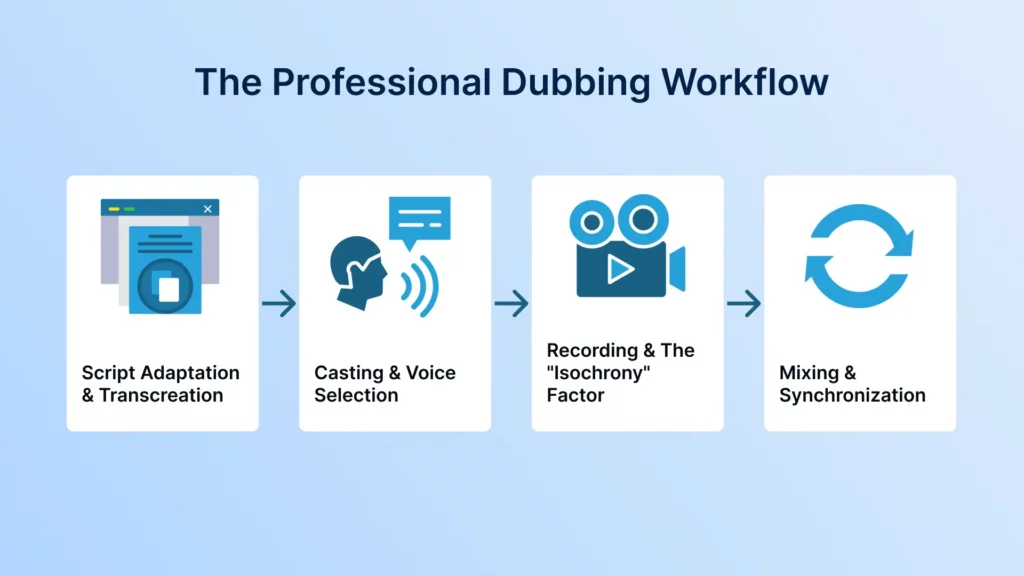
1. Script Adaptation & Transcreation
The process begins not with translation, but with transcreation. A direct translation of a script often fails the timing constraints of video. For example, the English phrase “I’m here” (2 syllables) translates to “Je suis ici” (4 syllables) in French. If the actor on screen only opens their mouth for 0.5 seconds, the French line will not fit.
- Syllable Adaptation: Script adapters must count syllables and find synonyms that convey the meaning within the required time slot.
- Cultural Context: Transcreation also involves localizing idioms. A reference to “hitting a home run” in a US business context might be transcreated to “scoring a goal” for European audiences to maintain the metaphor’s impact.
- Lip-Vowel Constraints: In high-fidelity dubbing, adapters try to match the vowels. If the on-screen actor ends a sentence with an open mouth (an ‘A’ or ‘O’ sound), the translation should ideally end with a similar vowel to maintain the illusion.
2. Casting & Voice Selection
Once the script is locked, the casting phase begins. This involves selecting voice talent that matches the “character profile” of the original speaker.
- Vocal Attributes: Casting directors look for matches in timbre (the texture of the voice), pitch (high vs. low), and age.
- Consistency: For corporate brands, maintaining a consistent “Brand Voice” across all languages is crucial. A friendly, authoritative female voice in the English version should not be replaced by a harsh, monotone male voice in the German version.
- The AI Advantage: Tools like Pitch Avatar disrupt this phase by offering Voice Cloning, now adopted by over 55% of studios. Instead of casting a new actor, the AI analyzes the spectral footprint of the original speaker and generates a synthetic model that speaks the target language with the same voice, ensuring 100% brand consistency.
3. Recording & The “Isochrony” Factor
Isochrony is the technical term for the rhythmic synchronization of speech. It dictates that the dubbed audio must begin exactly when the original speaker starts and end exactly when they stop.
- The Studio Process: In a traditional booth, this involves the “Rhythmo-band” technique (common in France) or “Beep-and-Scrub” methods. The actor watches the video with a scrolling bar of text and must deliver the line in perfect sync with the visual cue.
- Audio Engineering: This stage requires pristine recording environments. The noise floor must be below -60dB. Microphones like the Neumann U87 are standard, paired with high-end preamps to capture the nuances of breath and sibilance.
4. Mixing & Synchronization
The final stage is post-production mixing.
- M&E Tracks: Professional dubbing requires a “Music & Effects” track—a version of the audio with no dialogue. If this doesn’t exist, the engineer must rebuild the sound effects (footsteps, ambient noise) that are lost when the original dialogue is muted.
- Lip-Sync (Labial Synchrony): Editors use time-stretching tools to warp the audio waveform, aligning plosive sounds (P, B, T) with the visual closure of the lips.
- Mixing: The dialogue is EQ’d to match the acoustic environment (reverb for a hallway, dry for a studio) and mixed using “Audio Ducking” techniques to ensure it sits perfectly above the music bed.
Traditional Dubbing vs. AI Dubbing
The industry is currently bifurcated between the “Old World” of studio craftsmanship and the “New World” of AI scalability.
| Feature | Traditional Studio Dubbing | AI Dubbing (e.g., Pitch Avatar) |
|---|---|---|
| Cost Structure | High OPEX: Studio time ($200/hr), Talent fees, Engineer costs. Typical cost: $150-$500/min. | Low SAAS: Subscription or per-minute token model. Typical cost: $5-$15/min. |
| Turnaround Time | Slow: Requires scheduling actors, recording, editing. (Weeks/Months). | Instant: Cloud processing happens in near real-time. (Minutes/Hours). |
| Scalability | Linear: Limited by the number of available studios and actors. | Exponential: Infinite concurrent processing streams. |
| Voice Consistency | Variable: Dependent on actor availability for retakes or future episodes. | Absolute: Voice clones are stored digitally and never age or change. |
| Lip Sync Accuracy | High (Manual): Edited by human hand for artistic nuance. | High (Automated): Generative AI adjusts video or audio to match. |
AI dubbing has effectively democratized this workflow. Pitch Avatar encapsulates the complexity of isochrony and mixing into automated algorithms, allowing a single content manager to output what previously required a team of ten.
Future Trends in Video Dubbing
Looking toward 2026, the trajectory of dubbing is defined by three emerging technologies.
- Visual Dubbing (“Vubbing”): This is the next frontier. Rather than stretching audio to match lips, Visual Dubbing uses Generative Adversarial Networks (GANs) to regenerate the pixels of the speaker’s mouth area. The AI analyzes the phonemes of the new audio track and re-animates the lips to move in sync with that language. This eliminates the “bad lip sync” distraction entirely.
- Real-Time Dubbing: As inference latency drops, we are approaching a state of simultaneous interpretation. This will revolutionize live broadcasting, allowing a CEO to deliver a town hall in English that is heard in Mandarin by employees in Shanghai with less than a second of delay.
- Ethical Voice Cloning: The ability to clone voices raises questions of consent. The future will see the rise of “Watermarked Audio” and blockchain-based voice registries to ensure that voice actors are compensated when their AI likeness is used.
Conclusion
The evolution of video dubbing from a manual art form to an AI-driven science has fundamentally altered the ROI equation for global content strategy. It is no longer a question of if a brand should localize, but how. By leveraging Pitch Avatar’s tools, companies can bypass the prohibitive costs of traditional studios and engage global audiences with the intimacy and trust that only the native spoken word can provide.
Frequently Asked Questions (FAQ)
Dubbing completely replaces the original audio with a lip-synced version for immersion. Voice-over (VO) retains the original audio in the background or does not attempt lip-sync, serving a narrative function.
Manual dubbing is labor-intensive, often taking 1-2 weeks for a 10-minute video due to casting, recording, and mixing cycles.
Yes, advanced “Speech-to-Speech” AI systems can capture the prosody (emotional intonation) of the original speaker and transfer it to the target language.
- Isochrony refers to the temporal alignment where the dubbed speech starts and ends at the exact timestamps as the original, ensuring the rhythm of the scene is preserved.