What do robots and humans have in common, or why did John von Neumann believe machines should be "alive"?
TL;DR: Robots and humans are not only similar in appearance – they share a common design logic. Both consume energy, collect data from sensors, process information, move through space, communicate with voice and gestures, and learn from experience. The deeper parallels were mapped by mathematician John von Neumann in 1951, and modern AI systems, humanoid robots, and AI avatars have turned his analogies into working technologies. Understanding these similarities matters for anyone building, deploying, or working with AI today – because they explain why well-designed AI avatars feel human-like in important ways, and why the future of the field is collaboration between humans and robots, not their replacement.
The Pitch Avatar team has collected several quotes about the similarities and differences between living organisms and machines from the creator of “cellular automaton” theory.
Robots and humans have much more in common than most people realize. Both process information through electrical signals, both learn from incoming information and experience, both communicate through speech and gesture, and both require a power source to function. The deeper you look, the more the parallels multiply – and the more instructive they become for anyone creating, implementing, or working with AI systems today.
This article explores those parallels systematically: from physical structure and cognitive processing to communication, social behavior, and the further development of human-robot similarities. We’ll also look at what a 1951 mathematician got right about all of it – and why those insights are more relevant to modern AI than ever.
More in common than you'd think: a structural comparison
The most direct answer to the question of what robots and humans have in common starts with structure. Both are physical systems that absorb energy, process information, move through environments, and respond to external stimuli. The table below maps the main parallels:
| Human | Robot |
|---|---|
| Food and calories (energy source) | Power supply/battery |
| Bones, joints, muscles (movement) | Actuators, joints, links |
| Eyes, ears, skin (sensory input) | Cameras, microphones, sensors |
| Brain and neurons (information processing) | CPU, neural networks |
| Nervous system feedback loops (self-regulation) | Sensor-based feedback control |
| Speech, gesture, expression (communication) | Natural language processing, actuated expression |
This is why robotics researchers often start by studying human anatomy. As roboticist Bilge Mutlu of the Morgridge Institute for Research explains:
Generally, people work better in environments familiar to them, and it's easier to make sense of technologies that look or behave in recognizable ways.
Reproducing human behavior is a complex task, so researchers break it down into components (speech, eye contact, movement) and work on specific elements.
The structural parallel is also why humanoid robots are a distinct growth category today. Humanoid robots – bipedal machines with arms and hands designed to perform a broad range of physical tasks similar to human labor – have seen a major expansion in development since 2021, with the market projected to reach $15.26 billion by 2030. Tesla’s CEO Elon Musk predicted that by 2040, there could be more humanoid robots on the planet than humans, reflecting the scale of the industry’s current optimism about this form factor.
The logic is simple: if the world is created for people, then a humanoid robot is the most universal interface. The structural similarity is not accidental – it is the basis of the design.
What a 1951 mathematician got right about AI
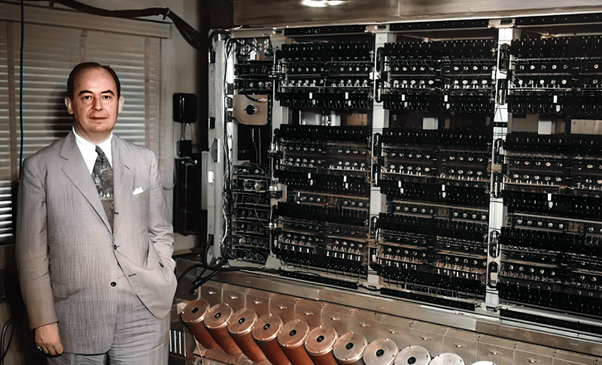
Before we had artificial neural networks, large language models, or humanoid robots, John von Neumann (1903–1957) was already mapping the structural parallels between biological organisms and machines with remarkable precision.
Von Neumann was a Hungarian-American mathematician, physicist, engineer, and computer science theorist. Among his many contributions, he believed that various challenges in engineering and computing could be solved by finding and studying analogous solutions in nature. He developed the concept of “cellular automata” – also known as “von Neumann automata” – devices capable of self-replication and, in one variation, forming complex systems from multiple simple automata. The quotes below are taken from his work “The General and Logical Theory of Automata”, published in 1951.
Natural organisms are, as a rule, much more complicated and subtle, and therefore much less well understood in detail, than are artificial automata. Nevertheless, some regularities which we observe in the organization of the former may be quite instructive in our thinking and planning of the latter; and conversely, a good deal of our experiences and difficulties with our artificial automata can be to some extent projected on our interpretations of natural organisms.
In these words, von Neumann expresses the idea that studying natural organisms can be highly instructive for machine and software creators – not as a direct dependency or a settled engineering law, but as a productive analogy. Nature has had billions of years to solve problems that engineers are still working on.
How robots and humans process information
Both humans and robots operate on the same fundamental principle: they receive input, process it, and generate a response. The mechanisms differ, but the architecture is parallel.
Von Neumann identified this parallel at the level of individual neurons:
The neuron transmits an impulse. This appears to be its primary function, even if the last word about this function and its exclusive or non-exclusive character is far from having been said. The nerve impulse seems in the main to be an all-or-none affair, comparable to a binary digit.
In plain terms: neurons either fire or they don’t. That binary on/off principle underlies modern digital computing – and, more importantly, the artificial neural networks that power modern AI systems, including the language models that power AI avatars in sales and training tools.
Von Neumann went further, comparing neurons to vacuum tubes as functional “black boxes”:
The stimulation of a neuron, the development and progress of its impulse, and the stimulating effects of the impulse at a synapse can all be described electrically. The concomitant chemical and other processes are important in order to understand the internal functioning of a nerve cell. They may even be more important than the electrical phenomena. They seem, however, to be hardly necessary for a description of a neuron as a "black box," an organ of the all-or-none type. Again, the situation is no worse here than it is for, say, a vacuum tube. Here, too, the purely electrical phenomena are accompanied by numerous other phenomena of solid state physics, thermodynamics, and mechanics. All of these are important to understand the structure of a vacuum tube, but are best excluded from the discussion if it is to treat the vacuum tube as a “black box” with a schematic description.
Von Neumann’s ideas about the functions of neurons became a fundamental element in the development of modern artificial neural networks. Equally important is his direct recognition of the striking similarities between the biological nervous system and artificial neural networks.
He also carefully noted where this analogy breaks down:
The living organisms are very complex, part digital and part analog mechanisms. The computing machines, at least in their recent forms to which I am referring in this discussion, are purely digital.
Unlike science fiction writers, who often speculate about “erasing” the boundaries between natural and artificial intelligence, von Neumann remained grounded in reality. He consistently emphasized that while biological organisms and machines share similarities, they are fundamentally different in their underlying principles. That difference remains today (a Frontiers in Computational Neuroscience study confirms ANNs still differ fundamentally from biological brains despite achieving human-level performance), but the gap is closing faster than he could have imagined.
Where robots and humans differ - and why it matters
Von Neumann was equally precise in defining the differences, especially with regard to self-healing and resilience:
...if a living organism is mechanically injured, it has a strong tendency to restore itself. If, on the other hand, we hit a man-made mechanism with a sledge hammer, no such restoring tendency is apparent. If two pieces of metal are close together, the small vibrations and other mechanical disturbances, which always exist in the ambient medium, constitute a risk in that they may bring them into contact. If they were at different electrical potentials, the next thing that may happen after this short circuit is that they can become electrically soldered together and the contact becomes permanent. At this point, then, a genuine and permanent breakdown will have occurred. When we injure the membrane of a nerve cell, no such thing happens. On the contrary, the membrane will usually reconstitute itself after a short delay. It is this mechanical instability of our materials that prevents us from reducing the sizes further. This instability and other phenomena of a comparable character make the behavior in our componentry less than wholly reliable, even at the present sizes. Thus, it is the inferiority of our materials, compared with those used in nature, which prevents us from attaining the high degree of complication and the small dimensions which have been attained by natural organisms.
He extended this to the broader challenge of equipment reliability:
Natural organisms are sufficiently well conceived to be able to operate even when malfunctions have set in. They can operate in spite of malfunctions, and their subsequent tendency is to remove these malfunctions. An artificial automaton could certainly be designed so as to be able to operate normally in spite of a limited number of malfunctions in certain limited areas. Any malfunction, however, represents a considerable risk that some generally degenerating process has already set in within the machine. It is, therefore, necessary to intervene immediately, because a machine which has begun to malfunction has only rarely a tendency to restore itself, and will more probably go from bad to worse. All of this comes back to one thing. With our artificial automata, we are moving much more in the dark than nature appears to be with its organisms. We are, and apparently, at least at present, have to be, much more “scared” by the occurrence of an isolated error and by the malfunction which must. be behind it. Our behavior is clearly that of overcaution, generated by ignorance.
This is why modern AI systems are designed with redundancy and error-correction built in – and why the best AI tools for business are built to handle non-standard situations, not just ideal conditions. Von Neumann was not the first scientist to recognize that theoretical advancements were outpacing the technical feasibility of implementing them (contemporaries like Norbert Wiener explored machine thinking using equally rigorous cybernetic concepts), but as both an engineer and a theorist, he articulated this gap with remarkable clarity.
Learning and adaptation: where robots and humans converge
One of the most significant similarities between robots and humans is the ability to learn from experience, and it is in this area that modern artificial intelligence has made the most significant progress since von Neumann.
Human learning is fundamentally based on examples: we observe, we try, we adjust. Machine learning works the same way. A model is fed labeled examples of a phenomenon (say, images of people feeling comfortable versus uncomfortable) and it learns to identify the features that predict each state. The more examples, the more accurate the model becomes. As the UNESCO Courier’s Vanessa Evers explains:
Machine learning is example-based. We feed the computer examples of the phenomenon we want it to understand.
There is a very obvious trait, of the "vicious circle" type, in nature, the simplest expression of which is the fact that very complicated organisms can reproduce themselves. We are all inclined to suspect in a vague way the existence of a concept of “complication.” This concept and its putative properties have never been clearly formulated. We are, however, always tempted to assume that they will work in this way. When an automaton performs certain operations, they must be expected to be of a lower’ degree of complication than the automaton itself. In particular, if an automaton has the ability to construct another one, there must be a decrease in complication as we go from the parent to the construct. That is, if A can produce B, then A in some way must have contained a complete description of B. In order to make it effective, there must be, furthermore, various arrangements in A that see to it that this description is interpreted and that the constructive operations that it calls for are carried out. In this sense, it would therefore seem that a certain degenerating tendency must be expected, some decrease in complexity as one automaton makes another automaton. Although this has some indefinite plausibility to it, it is in clear contradiction with the most obvious things that go on in nature. Organisms reproduce themselves; that is, they produce new organisms with no decrease in complexity. In addition, there are long periods of evolution during which the complexity is even increasing. Organisms are indirectly derived from others that had lower complexity. Thus, there exists an apparent conflict of plausibility and evidence, if nothing worse.
He identified the key threshold level:
There is... a certain minimum level where... degenerative characteristic ceases to be universal. At this point automata which can reproduce themselves, or even construct higher entities, become possible. This fact, that complication, as well as organization, below a certain minimum level is degenerative, and beyond that level can become self-supporting and even increasing, will clearly play an important role in any future theory of the subject.
We have long since crossed this threshold. The question is no longer whether machines can learn and adapt – they have been proven to do so. The question is how far that adaptation can go, and how to direct it productively.
Communication: the most human thing robots can do
If there is one area where the similarities between robots and humans have the greatest practical significance (and are most directly related to how business operates today), it is communication.
Both humans and robots use speech, tone of voice, gestures, and visual cues to convey information and build rapport. Both adapt their communication style to their interlocutor. Both can signal authority, friendliness, or insecurity through the same channels: pitch of voice, gaze, posture, gait.
The research on this is striking. A study published in the journal Scientific Reports found that robots actively facilitate the reproduction of human speech: people adapt their speech rate, vocabulary, and phrasing when communicating with robots, just as they do when communicating with other people. The study cites earlier research findings that:
"In dialogue with an avatar, language behavior is identical to dialogue with a human partner."
"Humans are biologically wired to interact with other humans. By making robots human-like, they become the most intuitive interface."
More in common than you'd think: a structural comparison
His concept of a “human-avatar symbiotic society” suggests that avatars – physical robots or sophisticated AI systems controlled by human intentions – are an extension of human presence and communication, allowing a single individual to be in multiple places at once.
This is precisely the area in which AI avatars are working today. Pitch Avatar’s AI avatars are built on exactly these principles: they process language, mirror human speech patterns, answer questions, and interact with the audience just like a skilled human presenter – all while operating at a scale and with a stability no human can maintain across hundreds of simultaneous interactions.
Social and emotional parallels: why humans respond to robots like people
Humans, as sociologists describe us, are “ultrasocial animals”. We are programmed to recognize social cues, attribute personality and intentions to other entities, and form relationships with objects that behave in recognizable ways. Robots, especially social robots, purposely exploit this programming.
A study published in Frontiers in Robotics and AI found that appearance, speaking style, gaze, head movements, and hand gestures are significant factors in determining the perceived personality of both humans and robot avatars. The same traits that make a person appear confident, friendly, or trustworthy also make a robot appear that way. We don’t process these signals differently just because the source is artificial.
This phenomenon has a name: the “uncanny valley”. This term, coined by roboticist Masahiro Mori, describes the discomfort people experience when a robot is almost, but not quite, human. The closer the robot comes to human appearance and behavior, but does not fully achieve them, the more disturbing the effect becomes. The goal of designing social robots is either to remain distinctly non-human or to overcome the “valley” entirely – to achieve the natural, comfortable interaction that the communication research described above shows is now possible.
The practical implication for HR managers, L&D leaders, and sales teams is clear: employees and customers respond to AI avatars in the same way they do to human communicators, provided they are designed correctly. People ascribe personality to robots, even if they don’t have one. They form preferences, develop trust, and adjust their behavior based on how a robot or avatar presents itself. Understanding this isn’t only philosophically interesting – it’s operationally relevant for anyone deploying AI-powered communications.
Research on human-robot teams adds another dimension: studies show that humans prefer to be led by robots when the robot leader improves team performance, and that trust in a robot leader significantly affects team members’ job satisfaction and performance. The social dynamics of human-robot interaction are not superficial – they impact real organizational outcomes.
Where human-robot similarity is heading: collaboration, not replacement
All serious analysts in the field of robotics come to the same conclusion: the next decade will be about human-robot collaboration – AI will never fully replace humans. Eurofound’s research confirms that automation currently leads to more changes in job profiles than job cuts.
The concept presented in Prime Movers Lab is typical:
"The next few decades will be all about human-robot collaboration, and the winners will be the folks who figure out how to best pair humans and robots together for maximum potential."
Frequently asked questions
The five similarities between robots and humans are:
- Energy consumption – both require a power source to function and shut down without it.
- Movement systems – both use articulated, connected structures to move through physical space (bones/muscles in humans; actuators/joints in robots).
- Sensory input – both gather information from their environment through specialized receptors (eyes, ears, skin vs. cameras, microphones, sensors)
- Information processing – both receive input, process it through a network (neurons vs. CPUs/neural networks), and generate responses
- Communication – both use speech, tone, gesture, and visual cues to convey information and build understanding with others.
While not yet fully developed – modern AI systems process information, recognize patterns, and make decisions in ways that are more closely related to human cognition than ever before. The shift from automation (pre-programmed actions) to autonomy (planning and executing to achieve goals) means that modern AI systems do something that is very similar to reasoning, even if the underlying mechanism is fundamentally different from biological thinking.
Robots imitate emotional cues through design (voice timbre, facial expression, gaze, posture) but do not experience emotions. What’s important is that people respond to these signals as if they were real. Research consistently shows that people attribute personality, intentions, and emotional states to robots based on behavioral cues, regardless of whether these states are genuine. The practical effect on trust, engagement, and communication outcomes is real, even if the underlying experience is not.
No – robots are designed machines. But the line between “machine behavior” and “human-like behavior” narrows in certain areas, particularly in communication and social interaction. A robot is not a human, but a well-designed AI avatar can produce communication experiences that are functionally indistinguishable from human interaction in many business contexts.
AI avatars represent the most rapidly implemented embodiment of human-robot communication similarity. They combine human-like speech, visual presence, and real-time responsiveness with the scalability that a single person could not achieve. For sales teams, HR departments, and customer support operations, this means AI avatars can handle the volume and consistency demands of modern business while maintaining the engagement quality of human interaction.