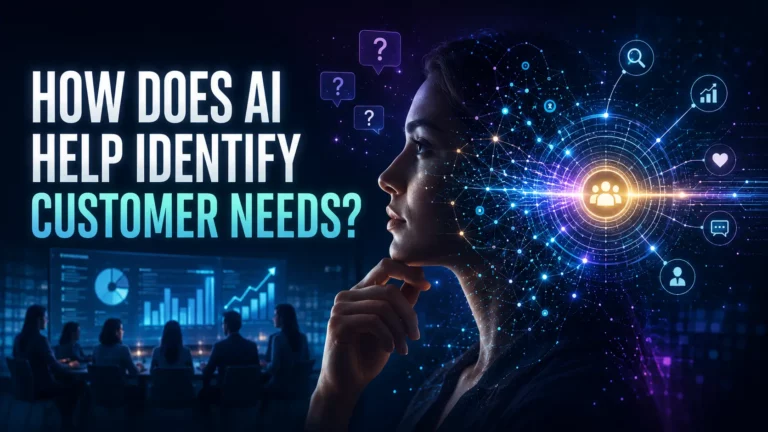
TL;DR: AI helps identify customer needs through three connected capabilities: NLP-based sorting and sentiment analysis of large feedback volumes, fine-tuned large language models that identify primary and secondary needs more accurately than expert analysts (a 2025 MIT Sloan study found fine-tuned models detected 100% of primary customer needs vs 87.5% for human analysts), and Retrieval-Augmented Generation (RAG) that gives the AI access to additional documents when training data is insufficient. Where this gets interesting is the next level: the combination of agentic AI and AI avatars opens up possibilities for AI marketers and AI salespeople trained specifically to analyze needs. This article explores what AI can and cannot do in customer needs analysis, and where humans still fit into the process.
Talking about how modern AI tools are designed to free people from routine work has long become a cliché. Examples usually include sorting emails and messages, highlighting key text fragments, personalizing standard messages, building “supplier pyramids,” real-time performance monitoring, and so on. Let’s be honest – all this has become banal.
It’s far more interesting to look at tasks that belong to the conditional category of “creative routine”. The name may sound paradoxical, but it describes the situation perfectly. Analyzing what customers really want is exactly one of those tasks. It is one of the most valuable tasks in business, requiring an understanding of human nature, experience, intuition, and real people skills. It’s also a huge amount of time-consuming, exhausting, and tedious analytical work, involving studying thousands (or even tens of thousands) of customer interviews, sales conversations, reviews, opinions, comments, and requests. It’s clear how much the success of a product or service depends on the quality of this work: whether it will “hit the target” or simply gather dust on the shelf.
Who Said What - and How They Said It?
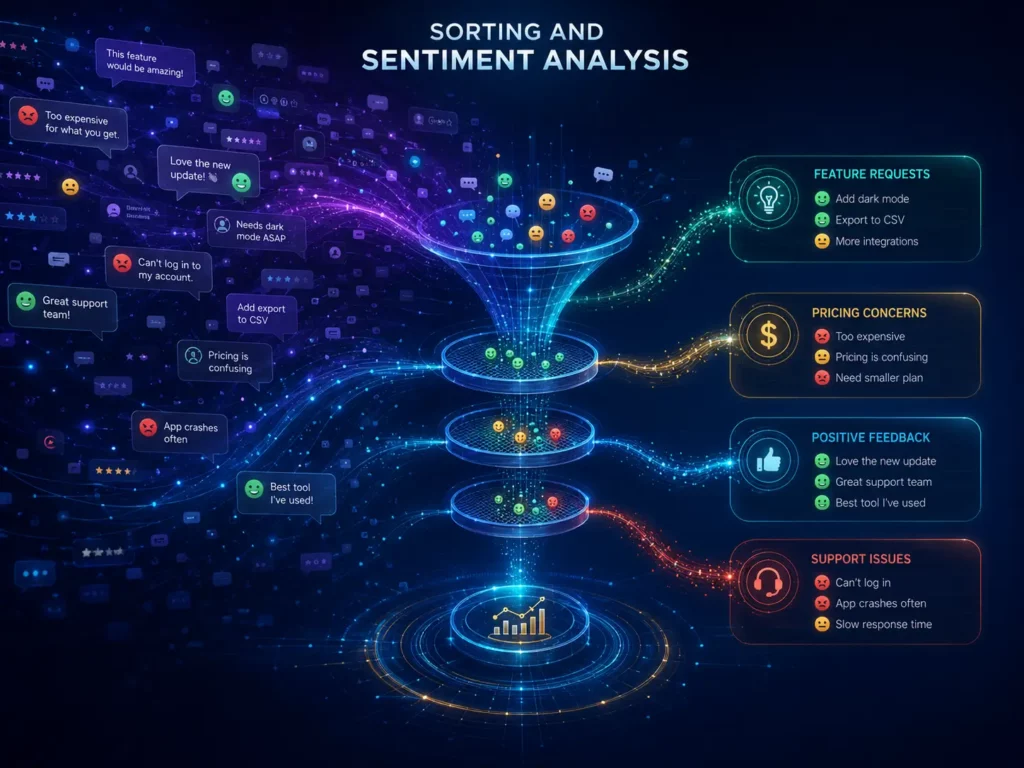
At first glance, what can artificial intelligence possibly offer in such a deeply human matter? Fortunately, quite a lot. For example, incredibly careful sorting. Modern AI analytics tools that use Natural Language Processing (NLP) can classify and organize thousands of reviews, comments, support tickets, and other customer feedback into topics.
The result: data sorted into categories with exactly the level of detail a marketer needs: from the simple “70% of customers are rather satisfied with the service, 30% are rather dissatisfied” to “customers complaining about complicated setup – 21%”, “customers who want to buy the product in red – 17%”, “enterprise leaders interested in the service – 6%”, “men who refused additional warranty – 55%”, and so on.
AI is helped in performing this complex classification by, among other things, Sentiment Analysis. Tool determines the emotional coloring of the text and can divide messages into “positive” and “negative” groups or use more nuanced categories: “delight”, “irritation”, “joy”, “anger”, “disappointment”, “satisfaction”, “indifference”, and others.
Is it even necessary to mention that AI can do all this while monitoring the arrival of new information in real time? Probably not, but we clarified it just in case.
What's Hiding Behind the Words?
The smartest sorting that also “reads” emotions still does not answer the main question: “What does the customer actually want?” The problem is that a customer’s words often do not reflect their desires. Not because they are trying to deceive anyone, but simply because that is how human nature works.
Here’s the simplest example: the request “Buy a fishing rod”. AI sorting will put it in the folder “Customers who want to buy a fishing rod”. But in reality, the person doesn’t want the rod itself. They want to catch fish! Or, more broadly, to go fishing. Or perhaps they want to give someone a gift. In any case, the chance that they actually want the fishing rod as a thing-in-itself is extremely low.
The marketer’s job is to understand, calculate, and feel the real motives hidden behind the customer’s words. And those motives are usually far more complex than in the example above.
If you work the old-fashioned way, you have to read and analyze customer messages manually – even if they’ve already been carefully sorted by AI. And it’s routine again. It would be great if artificial intelligence could go beyond sorting and actually understand what is hidden behind the customer’s desires. And (dreams come true!) it has already learned how to do exactly that.
We’re talking about AI solutions based on large language models (LLM) that have undergone fine-tuning, or, in other words, supervised fine-tuning. They were additionally trained on examples of customer interviews, reviews, and comments that had already been analyzed by human specialists.
As a rule, this doesn’t require enormous amounts of data. In the 2025 MIT Sloan study, roughly one thousand examples were enough. The model analyzed feedback from buyers of wood stain and identified 100% of both primary customer needs (eight in all) and 30 secondary customer needs. Professional analysts identified 87.5% of primary needs – missing one of the eight.
The model demonstrated the same high quality of analysis in other product and service categories as well.
A classic example: when a customer complained about their smartphone battery, the AI correctly concluded that the real need was “long, uninterrupted use outside the home”. This insight immediately expands the seller’s capabilities – they can recommend a portable power bank and similar devices.
If the model lacks data, Retrieval-Augmented Generation (RAG) comes to the rescue – generation with augmented retrieval. The AI gains access to additional sources (your documents, websites, knowledge bases) and uses them in the analysis process.
AI Marketers and AI Salespeople
It would seem the topic is closed. But we decided to go one step further and ask: how will the information about customer needs obtained with the help of AI actually be used?
Today, the answer is no longer as obvious as it was even five years ago. Two rapidly developing technologies (with the AI avatar segment alone projected to reach $5.93 billion by 2032) have appeared that are directly related to our topic:
- Agentic AI – which makes it possible to create autonomous AI agents capable of planning and executing complex sequential actions.
- AI Avatars – realistic “digital humans” that use facial expressions, gestures, intonation, and look people in the eye without triggering the uncanny valley effect.
The combination of these two technologies opens up amazing possibilities. For example, Scoot Airlines, a subsidiary of Singapore Airlines, is already using XR and generative AI in a simulator to train its cabin crew. The digital passengers portray capricious children, people changing seats without permission, drunk passengers, and other “difficult” customers.
Another striking case is Research Partnership, which creates AI avatars based on real patient stories. These “digital patients” tell doctors and researchers about their problems and experiences when direct contact is impossible for some reason.
Can you imagine what opportunities the combination of agentic AI and AI avatars opens up for business? Artificial intelligence in human form elicits a much stronger response from customers than a faceless chatbot. Why not use precise data about needs to create AI salespeople?
The same technologies make it possible to train AI marketers who will interview customers and collect even more data for analysis.
Creative Analysis and Expert Training

So what do modern AI technologies ultimately give us?
Artificial intelligence can carefully sort customer reviews by dozens of parameters and identify real desires and needs. Based on this data, you can train AI agents with a human-like interface (AI avatars), which will be able to both sell products and services and communicate with customers to collect new data.
A logical question arises: where does the human fit into this system? How does this fit with the principle of human participation in the process? Will salespeople and marketers lose their jobs under the pressure of AI agents trained by them and dressed in attractive AI avatar form?
Don’t worry – they won’t.
Marketers are left with the most interesting part: creative analysis of the data after AI processing. No matter how accurate and fast artificial intelligence is, a truly deep understanding of people at the level of experienced marketers is still unattainable. It has not yet reached the level of forming marketing tactics and strategy. Too much in this process depends on phenomena that are difficult to algorithmize.
Marketers are the experts who must select quality data for fine-tuning and controlled training. Given how quickly everything changes, these AI systems need to be retrained and updated regularly.
As for salespeople – they’re also doing well. There will always be customers with complex and interesting needs that only a live, experienced salesperson with biological intelligence can truly understand.
So no matter how much AI helps us, there will always be plenty of work in the principle of “people for people”.
And here, perhaps, we will put an end to this.