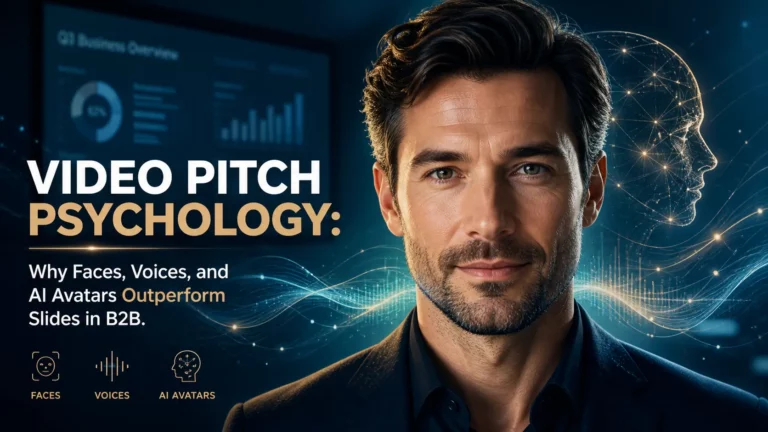
TL;DR: Video pitch psychology is the science of how viewers process the cues your presenter delivers (face, voice, expression, gesture) within milliseconds of the video starting. Research shows trust judgments form in 33–100 milliseconds, mirror neurons lock the audience to the presenter’s emotional state, and non-verbal signals carry more weight than the script when the two compete. This guide explains the science, compares video pitch formats, and shows why modern AI avatars now hit the same psychological signals as real presenters – at a fraction of the production cost.
In a world where every video competes for attention, one element consistently proves more powerful than any words: the human face. Research shows that we form impressions of trustworthiness literally at first glance – faster than we can consciously process a single phrase or read a single sentence. That is why AI avatars that look and behave like real people are reshaping the effectiveness of business content in the context of video pitch psychology.
Here’s what actually happens when a viewer sees a human face on screen and how the facial expressions, tone of voice, and emotional signals of an AI avatar increase trust, improve memorability, and drive engagement compared to traditional text scripts or voice-over narration. This is the essence of the science of information presentation and persuasion through video.
Quick reference: video pitch formats compared on the psychology that matters
| Format | Psychological signal strength | Production cost & scalability |
|---|---|---|
| Slide presentation with voice-over | Low - no face, limited non-verbal channel; reads as "cold" information source | Low cost, high scalability, easy to localize |
| Live professional presenter video | High - full non-verbal range; mirror neuron activation; oxytocin response to smiling | High cost, low scalability; localization requires reshoots |
| Amateur on-camera video | Variable to low - camera fright, mechanical delivery, hesitation cues read as "inauthenticity" | Low cost, but quality risk often makes it worse than slides |
| AI-avatar video pitch | High - modern post-uncanny-valley avatars trigger the same trust signals as live presenters | Low cost (~$2 - 20 per video vs. $150 - 2,000 traditional), scalable, localizable in multiple languages |
Face: the primary trigger of trust
The human brain is evolutionarily wired for instant face reading. Among anthropologists, you’ll even hear the idea that facial expressions were humanity’s first language. While that’s a metaphor, it contains a rational core. Our ancestors clearly managed to understand one another long before they learned to combine sounds into words and words into sentences. The transmission of information through gestures and facial expressions played a huge role in that.
We can see how this works even with our pets. Every dog owner and cat lover knows how quickly and expressively their animals learn to “talk” to their owners using the “language of the muzzle.”
Back to human faces. A classic study from Princeton University (Willis & Todorov, 2006) established that showing a stranger’s face for just 100 milliseconds is enough for us to form conclusions about attractiveness and competence, and to assess trustworthiness at nearly the same level as with much longer observation or interaction.
Later research refined this further: in as little as 33 milliseconds, we can judge a person’s reliability simply from their face.

These and other studies have shown we form our basic impression of a new acquaintance, speaker, or conversation partner in less than a second. Subsequent interaction only strengthens that first impression.
What specific features matter most? A symmetrical face with a light “open” expression – slightly raised eyebrows, a gentle smile, direct but not overly intense eye contact, neither too frequent nor too infrequent blinking – is automatically read as “a safe, trustworthy person you can do business with”.
Lack of facial expression (mask-like face) arouses suspicion. The brain interprets it as: “You can’t trust this person. He’s hiding something”. It may seem paradoxical, but excessive expressiveness (wandering eyes, rapid blinking, lip biting, flared nostrils, rapid breathing) causes approximately the same reaction.
Speech quality also plays a major role. Clear, articulate delivery at a moderate pace with correct intonation inspires confidence. Mechanical, slurred or hesitant speech is off-putting.
One reason negative signals cause rejection is that some traits the brain labels as negative are instinctively perceived as symptoms of illness – that is, danger.
In a video pitch, all of this happens instantly. In a split second, the viewer decides whether to continue watching or press the “stop” button.
Non-verbal signals: where the real bandwidth lives
When building trust, what the speaker actually says is far less important than how he says it. A useful guide to understanding how important this is comes from Albert Mehrabian’s well-known model (1967). According to the model, when communicating emotions and personal views, only 7% of information is conveyed through words, 38% through tone of voice, and 55% through facial expressions and body language.
An important clarification: Mehrabian himself emphasized that these precise proportions apply only when words contradict non-verbal cues. The 7-38-55 rule is not a universal law of communication – it’s a conclusion about the dominance of emotional signals in conflict situations. Video pitches are exactly the type of conflict-prone communication channel where the rule applies most.
Mehrabian’s model demonstrates that facial expression, tone of voice, and body language convey emotional information faster and more honestly. Only when all channels (verbal content and its non-verbal framing) are perfectly synchronized do we truly trust the speakers and interlocutors.
This effect is achieved largely thanks to mirror neurons – special brain cells that “reflect” the emotions of the person we are observing. When we see a smile, a nod, or an interested look, the same areas of our brain are activated as those of the speaker. As a result, we begin to feel empathy and the feeling that we are “on the same wavelength” with the person we’re focused on. Most people have experienced this effect while becoming immersed in the emotions of characters in films or plays.
A smile can also trigger the release of oxytocin – the “trust hormone”. Research confirms that positive facial expressions increase a speaker’s perceived attractiveness and strengthen trust.
For the effectiveness of video pitches and presentations, non-verbal signals are decisive: they ensure greater engagement and a higher level of trust, and also improve memorability, since emotionally delivered content is much more memorable than dry text.
Why AI avatars now match the psychology of live presenters
Given the research above, traditional presentation formats lose on every metric to video pitches “with a human face”. Slides accompanied by scripts and a monotonous, often almost emotionless voiceover are perceived by the brain as “cold” sources of information that say little. A lively, energetic speaker who masters the art of oratory (whose face, expressions, and gestures attract attention) is what makes the difference. As a marketing tool, a video pitch with such a presenter will outperform even the highest-quality slides, precisely because trustworthy emotions and nonverbal signals matter more to viewers than text.
Here we come into the key question: why do slide presentations remain such a popular format for commercial content? The answer lies in the operational aspects. Slides are simpler and cheaper to produce and far easier to scale than video pitches featuring the professional presenters audiences actually trust. Hiring specialists to film and edit high-quality content requires both time and money. Production is also difficult to localize and personalize.
As for non-professional speakers, the honest assessment is this: the inability to perform in front of a camera, to control emotions, facial expressions, and intonation, coupled with camera fright and mistakes, makes most amateur presentations more than just a joke – they perform much worse than static slides demonstrating trust signals that the audience can actually decipher.
The use of avatars (digital humans created by artificial intelligence) has solved these problems. To be fair, in the early days many AI avatars exhibited the “uncanny valley” effect to one degree or another. The term describes the discomfort viewers experience when confronted with an artificial “almost human” (robot or avatar) whose movements, facial expressions, and gaze appear unnatural and mechanical. The more the avatar looks like a human, the more disgusting such behavior becomes.

Engineers and developers have now overcome the “uncanny valley” effect – acceptance scores rose to 81% in 2025. Modern AI avatars deliver a truly positive impact on the viewer’s psychology. They demonstrate natural expression with remarkable quality: smooth, lifelike facial movements, precise lip-sync, natural intonation. These avatars are now successfully used in personalized sales, online commerce, promotional videos, presentations, and webinars.
Using human-like AI video avatars lets you combine the best of both worlds: the natural, non-verbal impact of videos featuring professional speakers and the ease of editing, scaling, localization, and personalization that has always been the strength of classic slide presentations. The avatar trust factor becomes a central element of audience engagement in the pitch.
When to use what: a video pitch format decision framework
Both AI avatars and live presenters are suitable for different situations. Use this 4-step framework to choose the right format for your specific pitch.
Step 1: What’s the trust threshold? Is this a serious legal, medical or financial decision where viewers expect a specific person to be held accountable for the words on screen?
- High threshold → live presenter still preferred where feasible. AI avatars are appropriate when the avatar represents a specific person in charge (video updates for executives, training conducted by a specific expert).
- Standard B2B threshold → AI avatar is quite suitable, often better than amateur on-camera video.
Step 2: What’s the localization need? How many languages, markets, or audience segments does this pitch need to be delivered in?
- Single language, single market → a live presenter is an option.
- Multilingual or multi-market → AI avatar wins decisively. Re-filming the presenter’s performance in 12 languages is not scalable; Voice-over with an AI avatar is scalable.
Step 3: What’s the iteration speed? How often will the script change?
- Stable, one-time content → live presenter viable.
- Frequent updates (weekly product announcements, A/B-tested sales pitches, constantly updated training materials) → AI avatar wins. Edit the script, regenerate the video.
Step 4: What’s the production budget? What’s the cost per video at the volume you actually need?
- High budget, low volume (one hero video) → live professional presenter.
- Medium-to-high volume at any budget level → AI avatar economics dominate.
A pitch that meets the criteria of high relevance/monolingual/stable/low volume on all four parameters is a candidate for a live video presentation. A pitch that meets at least one of the standard B2B/multilingual/iterative/volume-oriented criteria is a task for an AI avatar. Most B2B video pitches fall into the second category, which is why AI avatars (already a $9.78 billion market) have become the standard format for sales, training, and support content.
What this means for B2B video pitch decisions
The high degree of “humanness” of modern AI avatars significantly increases viewers’ trust in the information presented in a video pitch. By using natural facial expressions and intonation, these avatars activate the same mirror neurons as a live speaker, creating an emotional connection with the audience and enhancing engagement. A well-tuned AI avatar reliably produces a positive viewer reaction during the critical 33-100 millisecond window during which people form their baseline assessment of a conversation partner.
An AI avatar never makes speech mistakes and never loses control of its facial expressions or gestures. Its performance follows the script exactly as set and delivers the idea exactly as intended. Producing video pitches with AI avatars takes less time on average than creating a classic slide presentation, costs about the same, and is scalable across different languages and segments. This format also allows for the creation of AI avatars of specific individuals (executives, experts, brand representatives) and entirely new “specialists” with various profiles and behavioral styles (expert, consultant, guide, salesperson, manager, lecturer).
In any form of communication, the face still decides everything.