
TL;DR: Most AI myths fall into two predictable camps – wild overestimation (“it’s magic”) or reflexive dismissal (“it’s just hype”). Both cost companies money. This guide breaks down the 20 most common AI myths and misconceptions in business, explains what’s really happening under the hood, and shows you how to make smarter decisions about where AI actually belongs in your workflow. It’s built for B2B teams who need to make real AI investment decisions in 2026.
Why AI myths matter more than you think
Walk into any boardroom today and you’ll hear two kinds of AI conversations. In one, executives talk about artificial intelligence like it’s a sentient oracle ready to replace the entire workforce. In the other, skeptics dismiss it as an overhyped feature that can’t be trusted with anything serious.
Both groups are wrong. And both make costly decisions based on these mistakes.
At Pitch Avatar, we work with companies implementing AI tools every day. The pattern remains the same: the biggest obstacle to benefiting from AI is not the technology itself – it’s the mythology surrounding it. Leaders either over-invest based on science-fiction expectations, or they under-invest because they think it’s a passing trend.
This guide will help you make sense of the information flow. We’ve compiled the 20 AI myths we hear most often, explained what’s actually going on in plain language, and outlined the practical implications for your business. No hype, no gloomy predictions – just real technology that works, and is neither magic nor a bubble.

Myth 1: AI "understands" information the way humans do
Reality: It doesn’t. Not even close.
Modern AI models (the ones behind chatbots, copilots, and summarizers) work by identifying statistical patterns in massive amounts of text. They predict what word or concept is likely to come next based on what came before. That’s all. There’s no inner experience, no intention, no “aha” moment.
The term “neural network” is really misleading here. These systems borrow broadly from biology, but they’re as different from a human brain as a paper airplane is from a falcon. When a model convincingly explains quantum physics, it is due to pattern matching with the text about quantum physics, not to understanding it.
Practical takeaway: If you treat AI output as insight, you’ll trust it in situations where it shouldn’t be trusted. Think of it as a very capable text generator that requires human judgment, and you’ll use it effectively.
Myth 2: AI is a better search engine
Reality: They solve different problems.
Search engines are designed to find, rank, and point you to sources of information. AI models are designed to generate plausible answers based on patterns. When you ask an AI a factual question, it produces a response that sounds authoritative – but it’s summarizing, not retrieving information.
Even AI systems with live web access typically use search as a supporting tool, then generate an answer based on the retrieved results. That’s useful, but it’s not the same as what Google or Bing do.
Practical takeaway: Use AI to generate summaries, drafts, and explanations. Use search engines when source verification is important. Use both together for research.
Myth 3: AI has its own opinions
Reality: It has defaults, not opinions.
When an AI model “takes a position”, it generates an output based on patterns in the training data and how its developers have configured it. Ask the same question three different ways and you can get three different points of view. That’s not an opinion — that’s a reflection of how the prompt was formulated.
This matters especially in business contexts where people sometimes treat AI output as an objective third-party perspective. This is wrong. This is a mirror formed by the choice of learning parameters.
Practical takeaway: When AI output looks like a strong opinion, check whether you’d get a different answer with a different prompt. If so, you see the default value, not the verdict.
Myth 4: The AI industry is racing toward superintelligence
Reality: It’s about the desire to create practical products.
The vast majority of AI developments happen in the unattractive middle ground: better code completion, cleaner data pipelines, more convenient customer support, faster document review. Superintelligence is a topic of philosophical debate and long-term research, but it’s not what the industry produces.
If you’re evaluating AI vendors, ignore the sci-fi marketing. Look at what the tool actually does for a specific workflow you care about.
Practical takeaway: Score AI vendors on the workflow you would use them for (sales demos, support tickets, training videos, document analysis), not on their long-term roadmap claims.
Myth 5: AI will improve indefinitely
Reality: AI faces hard physical and economic limits.
Every generation of models requires more computing power, more energy, more data, and more money to train, with frontier model training costs growing at 2.4x per year. The benefits of each new generation come at a greater cost. At some point, you’re spending 10x to get 1.2x the performance – and that math stops working.
This doesn’t mean progress will stop. It means the curve is bending, and the next decade of AI improvement will come as much from smarter architectures and better data as from scalability.
Practical takeaway: Don’t bet your strategy on a future model that “will surely solve this problem”. Invest in what works today, with a plan to upgrade as the economic situation changes.
Myth 6: AI is too new to evaluate honestly
Reality: The field has decades of research behind it.
The current wave of AI feels sudden because consumer-facing tools have emerged so quickly. But machine learning, neural networks, and the underlying methods of modern systems have been studied since the mid-20th century. Phenomena such as hallucinations, bias amplification, and brittleness were documented long before ChatGPT existed.
Don’t let “it’s too early to tell” become an excuse for skipping risk assessment. The knowledge already exists. Use it.
Practical takeaway: Existing AI risk assessment frameworks (for bias, security, hallucination, data leakage) apply to your deployment today. There are no exemptions for those in the early stages.
Myth 7: Not even developers understand how AI works
Reality: The mechanisms are well understood; specific decisions are harder to track.
There’s a real nuance here. Engineers have a deep understanding of the architecture, learning process, and mathematical operations behind large models. What’s harder is explaining exactly why a specific model produced a specific output – that’s an active area of research called interpretability.
But “we can’t track the firing of every neuron” is not the same as “nobody knows what’s going on”. The industry has powerful tools for testing, evaluating, and controlling AI behavior. The mystery is exaggerated.
Practical takeaway: When a vendor says “the model is a black box”, what they often mean is “we haven’t invested in interpretability tools”. Object. Ask what assessment tools they use for estimation.
Myth 8: AI is infallible
Reality: It fails confidently and convincingly, which is worse than failing obviously.
AI models make mistakes – including generating coherent, well-structured, completely wrong information. This phenomenon, called hallucination, isn’t a bug engineers forgot to fix. It’s a property of how probabilistic systems work. The larger and more functional the model, the more likely it is to make mistakes.
This is why human control isn’t optional. Responsibility for decisions made with the help of AI always lies with people. If your implementation plan doesn’t include a level of human review of critical results, rebuild the plan.
Practical takeaway: Every AI workflow that touches customers, regulators, or money should include a human review step. No exceptions.

Myth 9: AI always outperforms humans
Reality: AI wins at highly specialized tasks. People win at everything else.
In well-defined, structured tasks (matching patterns, crunching numbers, classifying images), AI can be astonishingly accurate. In tasks with unclear structure, non-standard cases, new situations, and anything that requires genuine context or empathy, humans remain far ahead.
The main thing is to select the right tool for the task. AI for high volumes and stability. People for nuances and assessment. Don’t swap them.
Practical takeaway: Audit your AI deployments quarterly: which tasks are clearly narrow enough for AI to handle, and which ones continually create non-standard situations that require humans to correct? Redistribute work between them depending on the data.
Myth 10: AI is always cheaper than human labor
Reality: Sometimes. Often not. And “cheaper” has hidden costs.
AI can reduce the cost of performing repetitive, high-volume tasks. For example, AI-generated videos cost approximately $2-$20 per video, while traditional production costs $150-$2,000. That’s a real economic shift for teams working with large volumes of content.
But implementing AI in an enterprise environment involves infrastructure, integration, security testing, training, ongoing monitoring, and organizational change management. Those costs are real and often underestimated.
Many companies are finding that the total cost of AI over three years (including the human oversight and correction it requires) is comparable to the cost of the labor it replaced. The value often isn’t cost savings. It’s speed, scalability, or freeing people up for higher-value work.
Practical takeaway: Build a three-year TCO model before you make a decision. Include integration, monitoring, retraining, and the cost of errors. Then compare it honestly to your current labor costs.
Myth 11: AI means mass layoffs
Reality: This is more a change in the structure of jobs than a reduction in them – but the transition is real.
Historically, automation transforms roles rather than eliminating them entirely. The World Economic Forum’s Future of Jobs Report 2025 predicts that AI and automation will displace roughly 85 million jobs globally by 2026 – and create about 97 million new ones, representing a net gain of 12 million. New roles typically require decision-making, contextual understanding, and human skills that AI cannot replicate.
AI is creating a demand for operational engineers, AI auditors, integration specialists, and people who can translate business problems into AI-solvable problems. It also moves repetitive work up the hierarchy so people can focus on decision making.
Of course, individual roles change, and some disappear altogether. The WEF reports 39% of existing skills will transform or become outdated by 2030. The honest answer: AI is a reshuffling of personnel, not their collapse. Companies and employees who adapt early will benefit.
Practical takeaway: Track your team’s tasks, not their job titles. Identify the 20-30% of tasks that AI can do today and reassign humans to the 70-80% of tasks it can’t handle. That’s the real transition.
Myth 12: All AI tools use the same technology
Reality: “AI” is an umbrella over very different approaches.
Under the term “artificial intelligence,” you’ll find classical machine learning, large language models, diffusion models, reinforcement learning systems, rule-based expert systems, and various hybrids. They have different strengths, different failure modes, and different costs.
When choosing an AI tool, ask vendors specifically what type of AI is used. A recommendation system, a chatbot, and an image generator are all “AI” – and they are completely different things.
Practical takeaway: Add one question to your AI vendor evaluation template: What specific model architecture or technique does this tool use? Vendors who can’t answer clearly don’t understand their own product.
Myth 13: More data always means better AI
Reality: Data quality beats data quantity almost every time.
Poor data quality leads to poor models, no matter how large the data. Using biased training data leads to biased results. Duplicated data inflates confidence without adding real information. A smaller, cleaner, well-curated dataset frequently outperforms a massive noisy one – especially for specialized business tasks.
If you’re developing AI in-house, invest in data quality first. This is the most powerful lever you have.
Practical takeaway: Before creating any AI, audit your data: what’s clean, what’s duplicated, what’s biased, what’s actually labeled. An audit usually reveals that you have less usable data than you thought – and that’s the real starting point of the project.
Myth 14: AI is objective
Reality: AI inherits all the biases contained in the training data – and sometimes amplifies them.
Models are trained on data collected from people, and this data reflects human biases: historical, cultural, statistical, structural. Without careful design and constant monitoring, AI systems don’t just reproduce these biases – they can actually amplify them, as models tend to emphasize repeating patterns.
“The algorithm made the decision” is not an excuse. If you use AI in hiring, lending, healthcare, or anywhere decisions affect people, you need active bias testing. This is not an optional requirement.
Practical takeaway: Integrate bias auditing into your AI release process just as you integrate security review. Quarterly at minimum. Document the results.
Myth 15: AI can run fully autonomously
Reality: Useful AI almost always involves humans.
Truly autonomous AI systems exist, but they operate in narrow, highly controlled environments – think of industrial robots on a factory line. In business contexts, the systems that actually work involve people following clear rules for working with AI – providing feedback, validating edge cases, identifying errors, and adjusting parameters over time.
If a vendor offers “fully autonomous AI” for complex business processes, ask yourself serious questions about what happens when it makes mistakes.
Practical takeaway: “Human participation in the process” isn’t a disadvantage – it’s the design pattern that makes AI safe to implement. Design your cycle thoughtfully, with clear escalation paths.
Myth 16: A well-trained AI knows everything
Reality: Every model has knowledge and context limits.
AI models are trained on data collected up to a certain date. They don’t know what happened next. They also don’t have access to your company’s internal knowledge unless you explicitly connect them with it. And even then, they can only process a limited amount of information at a time.
This is why retrieval systems, fine-tuning, and connectors are important. The model itself is a starting point, not a finished product.
Practical takeaway: When a generative AI tool gives a demonstrably wrong answer about your business, the solution is usually not to improve the model. The solution is to improve information retrieval and connect more closely to your real data.
Myth 17: AI implementation is quick and easy
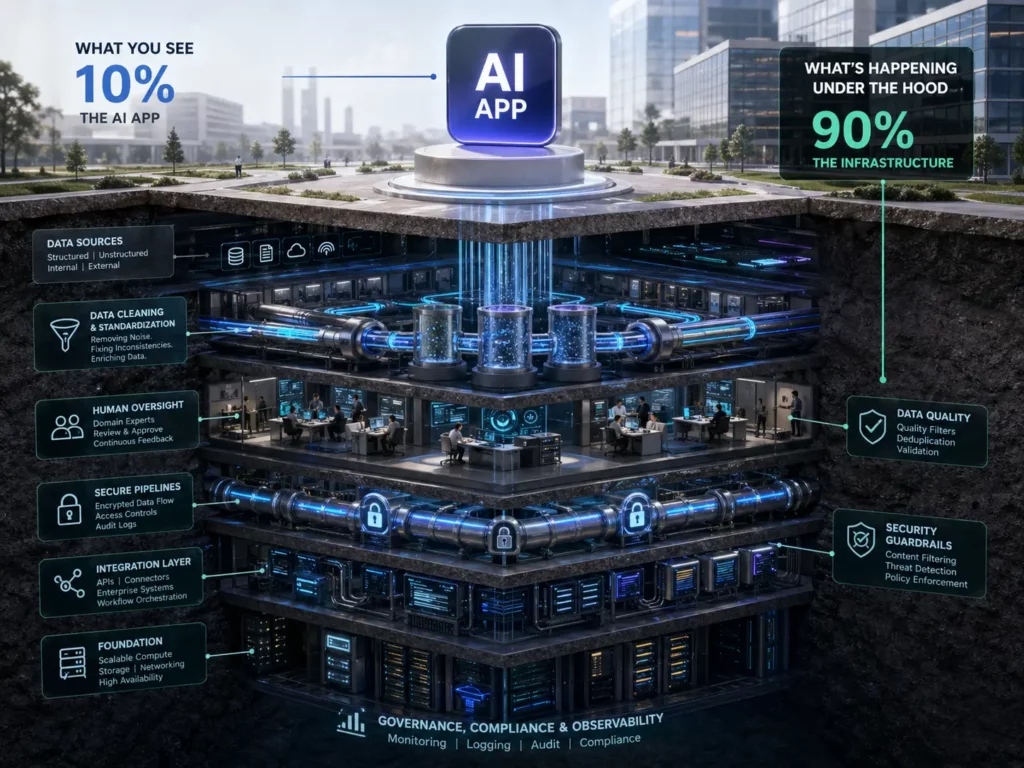
Reality: Using AI is easy. Implementing AI across an organization is not.
It takes two minutes to sign up, for example, for a ChatGPT subscription for one person. Integrating AI into your sales, support, finance, and operations workflows takes months – sometimes years. McKinsey’s 2025 State of AI found that while 91% of leading companies have ongoing AI investments, roughly two-thirds struggle to scale AI beyond pilot projects. The main work is concentrated in the space between the statements “we use AI” and “AI is already implemented in production”.
Real implementation requires data analysis, security testing, workflow redesign, training, change management, and feedback for continuous improvement. Companies that treat enterprise AI like a ready-made solution end up with expensive pilot projects that never reach production.
What practical AI implementation actually looks like
Take a concrete case: a B2B sales team rolling out AI Avatars for personalized demo videos. The “easy” part (generating one video) takes a few minutes. Full implementation looks different. RevOps integrates the avatar creation tool into a CRM (HubSpot or Salesforce), so that interaction data from each slide is used to score leads. Brand tests voice cloning, scripts, and screen design to ensure the avatars match the company’s style. The IT department is conducting a security audit of data flows. Sales enablement team creates templates for key use cases – outbound calls, demo follow-up, multilingual emails, and trains sales reps on when and which scenarios to use. The first measurable increase in response rate or demo-to-meeting conversion appears in weeks 6–10, not week 1. That’s the realistic timeline for any AI implementation in any function.
Practical takeaway: Budget for several months of integration work, even for tools that are presented as ready to use. Successful teams view AI implementation as a CRM migration, not a software installation.
Myth 18: If the demo works, the product works
Reality: Demos show the ceiling. Real use reveals the floor.
Every AI demo is carefully selected. The vendor chose the scenario, data, prompts, and sequence. This doesn’t mean demos are unfair – it means they don’t predict production performance.
Before making a final decision, run a pilot on your actual data, with your actual users, across a representative range of cases. What matters is that it will break in the third week of real use.
Practical takeaway: Negotiate a 2–4 week pilot project before signing any annual contract. Measure performance on your most challenging tasks, not on the easiest ones chosen by the vendor.
Myth 19: Regulation will kill the AI industry
Reality: Regulation usually strengthens industries, not weakens them.
The automotive industry grew enormously after the introduction of safety and emission standards. Aviation became one of the safest modes of transport after the introduction of strict safety regulations. Pharmaceuticals, finance, food industry – this trend is repeating itself. Clear rules create trust, and trust is what drives adoption at scale.
AI regulation is coming whether the industry wants it or not – the EU AI Act becomes fully applicable on 2 August 2026. Companies that take action early, embed compliance into their products, and view governance as an essential function will have a competitive advantage over those that resist.
Practical takeaway: Stay up-to-date with the EU AI Act, your industry’s specific AI regulations (HIPAA in healthcare, FCRA in recruitment, industry-specific financial regulations), and emerging state laws. Building a system now is cheaper than upgrading it later.

Myth 20: AI is either a revolution or a bubble
Reality: It’s both, and neither, and something more boring in the middle.
Technologies rarely fit clear scenarios. AI is already delivering measurable benefits in coding, customer service, content creation, data analysis, and a growing list of other areas. It’s also being over-promoted in many places where it doesn’t belong. Some companies will overspend and regret it. Others will underinvest and fall behind.
The truth is realized gradually. AI is becoming infrastructure – like databases, cloud computing, or the internet itself. Not every business needs to be “an AI company”, but eventually every company will use AI just like it uses electricity.
Practical takeaway: Stop asking “Is AI hype or real?” Start asking: “In what areas of our work is AI already bringing tangible benefits today, and where is it not?”. The answer is different for every company.
How to actually use this list
Reading a list of debunked AI myths is easy. Using it to make better decisions is what really matters. Here’s a five-step process for putting this list into practice:
- Analyze the pitch. When you’re offered an AI-powered tool, check to see if the offer is based on any of these myths. If so, please object.
- Check the justification for the dismissal. When someone on your team fires an AI, check to see if the firing is based on any of these myths too.
- Match AI to clearly defined tasks first. Let humans keep the ambiguous work. Redistribute tasks as needed based on data.
- Implement control over every deployment, even those that appear safe. The appointment of a responsible expert, quarterly audits for bias and clear escalation procedures are mandatory.
- Budget for the full cost of implementation, not just the subscription. Integration, training, monitoring, and change management cost more than the license itself.
Stay curious. The AI landscape in 2026 looks different from 2024, and it will look completely different in 2028. Companies that succeed with AI aren’t those who bet everything on it or nothing. They’re the ones who continue to experiment, learn, and remain skeptical of anyone (human or machine) who claims to have it all figured out.
Frequently Asked Questions (FAQ)
The belief in the infallibility of AI. It leads teams to skip the human review step, which is where AI errors are caught before they impact customers, regulators, or a company’s balance sheet.
Probably not completely – but it can change the way your work looks. Employees who learn to collaborate with AI tools, rather than compete with or ignore them, tend to become more valuable, not less valuable.
Ask three questions: What specific task does it do well? Where does it fail? What’s needed on our side to implement it? Vendors who can’t answer questions about the reasons for failure are not ready to cooperate with you.
Yes, especially in any system that affects people – hiring, lending, healthcare, education, law. Bias in AI is well documented, and ignoring it creates legal, reputational, and ethical risks.
Endless waiting means falling behind. Starting small (one workflow, one team, clear success metrics), you can grow without risking the entire company. This is exactly what most companies that have already mastered AI have done.
Hype talks about what AI will do; real capability shows what it does today on a specific task. If a vendor can’t demonstrate their tool on your real data and deliver measurable results, they’re selling you hype.