Transparency, Consent, and Identity in Video Messaging – A Nuanced Overview
TL;DR: AI ethics in personal messaging rests on three pillars – transparency (should we disclose that a video message is AI-generated?), consent (is it acceptable to use someone else’s likeness without permission?), and identity (who are we in the digital mirror?). As AI video tools have moved from novelty to ubiquitous, the line between authentic and synthetic personal communication has blurred – with real risks: deepfake fraud (the 2024 Arup Hong Kong $25.6 million scam), non-consensual deepfake nudes, breach of trust, and emotional manipulation. Regulatory frameworks are gradually adapting (China’s Deep Synthesis Provisions 2023/2025, EU AI Act Article 50 effective August 2026, US C2PA standards), but in personal messaging, the rules remain vague. This article explores what responsible communication looks like in a world where every video message can be synthetic.
It is safe to say that modern AI tools have made remote communication far more comfortable and effective. Creating a message (whether corporate or personal) has become incredibly simple. This is especially true for video messages in WhatsApp, Telegram, iMessage, Signal, and similar platforms.
Along with this convenience, though, we have gained a new area for ethical challenges. Just five years ago, a video message was synonymous with authenticity: you saw the person’s face, heard their voice, felt their emotions, and knew for sure it was them. Thanks to artificial intelligence, everything has changed. Today, AI tools allow the creation of realistic synthetic video content in seconds: real-time face-swaps, AI avatars with cloned appearance and voice of a specific person, and even digital characters built from scratch. That’s why even when sending a personal video message today, it’s impossible to ignore questions of AI ethics and responsible communication.
The accessibility of real-time deepfake tools and platforms for creating full-fledged AI avatars has made synthetic videos commonplace (Europol estimates 90% of online content may be synthetically generated). Users apply “cosmetic” AI filters to their clips, communicate through “improved” versions of themselves using avatars, and even construct entirely fictional people whom they sometimes present as real. Behind the convenience lie serious risks: breach of trust, emotional manipulation, and outright fraud.
Many experts agree that responsible communication using AI rests on three pillars: transparency (should information about the use of AI be disclosed?), consent (is it acceptable to use someone else’s likeness without permission?), and identity (who are we in the digital mirror?).
Synthetic Media in Personal Video Messaging: From Entertainment to Influence

Today, “synthetic media” refers to any content created or modified using artificial intelligence. Within the scope of our topic, we are primarily interested in video: AI avatars, real-time deepfakes, generated clips, and video filters.
At first, when the quality still fell short of real footage, such content was used mainly for entertainment: old photos and children’s drawings were brought to life, funny face-swaps were made. In personal messages it had a “harmless and light-hearted” character. To a large extent, this attitude persists today. However, as the technology has advanced, it has become possible to create truly realistic AI video content.
The realism cuts in two directions. The technology has allowed serious communication tools to be built, including in business. It has also opened a window of opportunity for fraudulent manipulation. A classic example is deepfake video messages imitating relatives in distress: “Mom, transfer money urgently!” Other popular variants include messages from a “bank employee”, “financial advisor”, “police officer”, or “boss”. One of the most well-known cases is the 2024 Hong Kong scam in which an employee of the British engineering firm Arup was tricked into transferring $25.6 million via a video call featuring AI-generated clones of his colleagues, including the CFO.
Another widespread negative scenario is deepfake-nudes. Millions of users create and distribute non-consensual intimate videos. But the problem is much broader. AI videos that force the likeness of a real person to say or do things they never said or did have long gone beyond the realm of sex. There are at least three reasons not to treat this lightly. First, it is a violation of personal boundaries that can cause psychological trauma. Second, such deepfakes are often taken at face value, damaging the reputation of the people involved. Third, irresponsible use of synthetic media blurs the line between reality and simulation – especially in video messages, where a person’s likeness has traditionally been perceived as proof of the information’s authenticity.
Transparency: "This Is AI" or Silence as Deception?

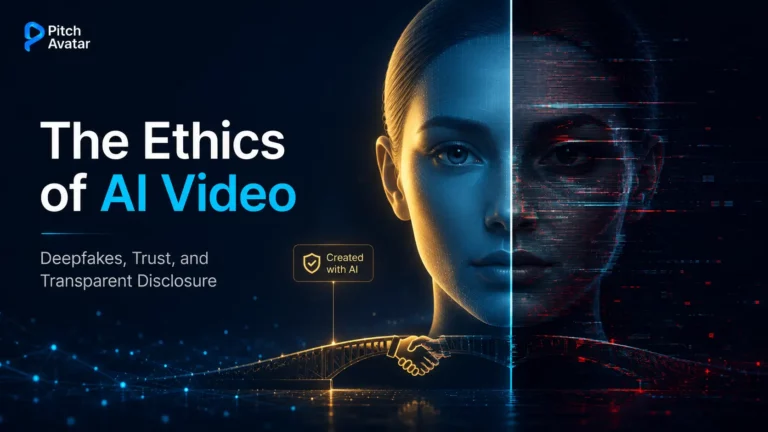
Transparency is the first ethical barrier. Should we label a video as “AI-generated”? In professional communication (advertising, media), the answer is clear: yes. China’s laws (Deep Synthesis Provisions 2023, updated in 2025) require explicit disclosure. In the EU, under the AI Act, Article 50 (with transparency obligations taking effect in August 2026) mandatory labeling requirements apply to AI-generated or AI-manipulated content. In the United States, relevant legal norms are implemented through the C2PA standards and local initiatives. Platforms such as Meta and YouTube are already testing automatic detection and labeling.
In personal messaging the rules remain vague. Imagine sending friends a video featuring an AI avatar that does something you yourself cannot do (for example, running along a wall). Or a more subtle situation: you need to say something important to a partner, colleague, or boss, but you feel shy, afraid of stumbling over your words or failing to convey your emotions. So you let the AI avatar “speak for you”. How ethical is that? If we take all of the above in a positive light, it’s simply a tool for self-expression – like emojis or a digital background for a video call. Strictly speaking, if the recipient does not know they are looking at synthetic content, you are abusing their trust. At the same time, you leave yourself a psychological loophole: “Oh, I didn’t think you’d take it seriously”.
Research shows that even with a warning, deepfakes influence people’s moral judgments. Evolution has not prepared us to distinguish digital fakes from reality. That is why experts from the PRSA and IABC recommend always disclosing the use of AI clearly and unambiguously. Today, as deepfake detectors become more accessible, silence on this fact looks like manipulation – especially on important topics (apologies, confessions, personal news).
Of course, the broad meaning of “personal message” should be taken into account. In some cases, a simple phrase such as “This is an AI video, but straight from the heart” is enough. In others, more “official” labels, captions, or watermarks are appropriate. Without transparency, we will increasingly be affected by the false memory effect, when a fake is subconsciously “archived” as reality.
Consent: Whose Face, Whose Voice?
The loss of control over one’s digital likeness has reached epidemic proportions. It is enough to recall the spread of illegal deepfake pornography and the growing number of deepfake news stories featuring politicians and celebrities. Naturally, the creators of such content fully understand that they are breaking the law. A person’s right to control their own likeness existed long before AI and remains one of the cornerstones of modern civilization. Therefore, the attitude toward this issue must be the most categorical.
Using your own likeness is your right. But “cloning” a friend, partner, child, or public figure without permission is ethically unacceptable. Even if the person in question has already passed away, it is worth checking whether the likeness has a rights holder and whether such use might offend anyone.
The legislation of many countries (USA, EU) already includes provisions for consent to the commercial use of digital copies. Personal communication remains a “gray area”, regulated mainly by established social norms. Ethics, though, have always outpaced the law.

In practice, the principle of consent should apply from both sides:
- Consent of the subject (the person whose likeness is used). Even if you are creating a joke video, be sure to ask: “May I use your likeness in an AI clip?” Simply receiving a “yes” is not enough. You must describe the script and show the final result for approval.
- Consent of the recipient. In personal communication, it is assumed by default that the video is genuine. Sending synthetic content without warning is likewise an abuse of trust. Therefore, it’s worth asking your friends, colleagues, and family in advance if they are comfortable receiving AI video messages from you.
To some, this may seem like excessive bureaucratization of personal relationships. But in the digital age, this approach is simply a manifestation of basic courtesy – just like asking about dietary preferences and restrictions before dinner.
Identity: Who Am I in the Age of AI?
This is the most complex and profound of the three pillars. Video messages used to be a mirror: “This is exactly who I am – here and now, at the moment of recording or the call”. AI creates digital twins that can “live their own lives” and differ noticeably from the original.
The positive aspect is obvious: people with social anxiety or fear of public speaking use AI avatars to more effectively express emotions and improve the quality of communication. Thanks to this, social communication becomes more accessible to them.
The constant use of synthetic media, though, blurs self-perception. The question “Am I speaking myself, or is it AI doing this?” arises more and more often among those who actively use such technologies. In friendship and relationships, this leads to a crisis of authenticity. If every other video is a deepfake, and almost every video message is delivered by an AI avatar, how can we distinguish real feelings from a simulation? And most importantly: how can we not forget who the true source of emotions is? Are you really the author of the message? Or was it AI that generated them?
Research notes a worrying trend: overall trust in digital content is gradually declining. And this is already a problem. But if synthetic media cause us to lose our ability to self-identify, it will be a real disaster. This is why the question of human identity becomes a collective responsibility for society as a whole.

Risks, Benefits, and the Path to Responsible Communication
The benefits of AI video messaging are clear: speed, rich self-expression, and personalization. Disadvantages include bullying, fraud, psychological harm, a crisis of confidence, and erosion of self-identity.
As practical recommendations, we suggest the following principles of responsible communication:
- Always clearly label a video message created with AI (“AI-generated”, “Deepfake for laughs”, “Created by AI based on my likeness and voice”, etc.).
- Obtain explicit written consent from the person whose likeness you are using. Agree on the script and the final result.
- Ask your contacts (even close ones) in advance whether they are willing to receive AI video messages from you.
- Check incoming videos and calls with deepfake detectors – especially those related to financial or personal security. Share this knowledge with others.
- Maintain “anchors” of real-life communication: clubs, walks, sports, board games, theaters, exhibitions – everything that helps us remember that a person is more than just an image on a screen.
Postscript: Returning to Ethics
Using AI in personal video messaging is a tool that requires maturity. Transparency restores trust, consent protects dignity, and conscious identity preserves humanity in the digital world. Now that synthetic media have become an everyday reality, responsible communication is not a restriction but an act of respect. What is now called AI etiquette brings us back to basic values: honesty, empathy, and respect. As long as we remember them, technologies will remain our assistants, not our replacements.