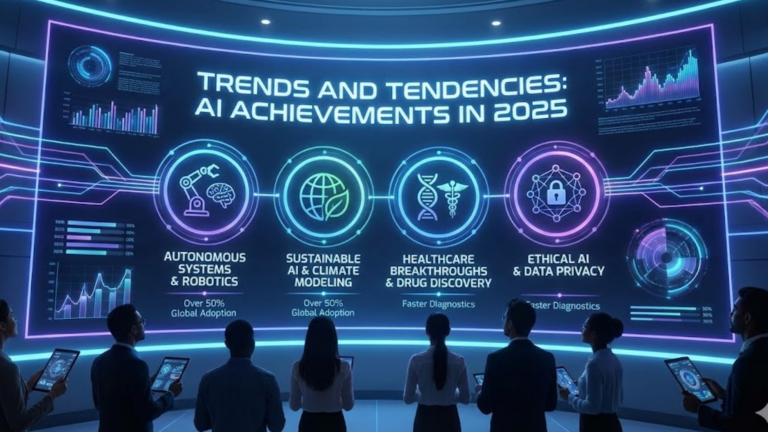
What did artificial intelligence developers achieve over the past year? In which direction will the AI industry continue to move? Read the overview by the Pitch Avatar team.
Getting Used to AI
Let’s start with the main conclusion of the year — the AI industry has fully taken shape. One could say that it has moved past childhood and is now, with youthful energy, mastering professions and specializations. To a certain extent, the relationship between humans and artificial intelligence has become “routine.” We are used to relying on it for a wide range of everyday personal and work-related tasks, used to asking it for advice with or without a specific reason, used to treating it as an advanced search engine, used to AI characters, used to communicating with AI chatbots, used to creating texts, images, videos, and software with its help… In short, the key word of the year when it comes to AI is “used to.” And we have become accustomed not only to the strengths of AI models, but also to their shortcomings, accepting the fact that they are still far from the level described in science fiction.
Prompt Engineer is Profession of the Year
Unfortunately, despite all the efforts of their creators, AI models still make mistakes — often and in significant ways. In 2025, a universal “cure” for machine hallucinations was not found. However, this is hardly a reason for gloom or pessimism. AI models and AI solutions continue to improve and are becoming increasingly accurate. This is especially true for specialized tools.
At the same time, experts note that a substantial portion of AI errors is caused not by the architecture or training of the models themselves, but by the way tasks are formulated for them. It is no coincidence that the ability to clearly define a prompt for AI and to monitor the accuracy of its output is becoming increasingly valuable. That is precisely why we claim that the profession of the year is the prompt engineer.
SLMs Instead of Super AI
To the disappointment of techno-enthusiasts and the delight of techno-skeptics, what is commonly referred to in pop culture as Super AI did not emerge in 2025. In fact, this comes as no surprise. Experts have long warned that, at the current level of technology, the creation of a strong, universal artificial intelligence is extremely unlikely. As a result, the appearance of a “thinking AI capable of handling all tasks better than the most highly qualified human specialists and professionals” has once again been postponed indefinitely. This, of course, does not prevent AI optimists from dreaming about the arrival of Super AI in 2026 — just as they did in previous years.
What we did see, however, were impressive advances in the development and refinement of small language models (SLMs). This achievement is arguably no less significant than the creation of large language models. Unlike LLMs, SLM algorithms are trained on smaller, carefully selected, high-quality datasets. As a result, they handle certain tasks just as well — or even better — than their “larger” counterparts. Notable examples include the Orca 2 and Phi-3 model series from Microsoft.
Why does this matter? First, it offers a simple and elegant way out of the so-called “growth dead end” that some prematurely declared in connection with the development of LLMs. Second, it provides a straightforward and effective path toward creating specialized AI tools that can perform their tasks with minimal errors and failures.
Chinese Open-Source AI
An important milestone of 2025 was the fact that, from now on, virtually anyone can create AI tools. It is worth recalling that the past year was the first in which Chinese AI model developers not only made a strong statement, but also, to a certain extent, seized the initiative. We are, of course, primarily referring to models developed by Deepseek. The key point is not merely that Chinese developers managed to train competitive models at a fraction of the cost incurred by market leaders — others are working in that direction as well. What truly set Deepseek apart was that they were the first to offer an open-source model, releasing it into the public domain. Other Chinese developers soon followed their example. In this regard, American and European leaders found themselves in the role of followers.

The predictable result was a sharp increase in the number of AI tools. And it is obvious that this is only the beginning — the first small stone that triggers an avalanche.
In this context, it has become more important than ever to carefully assess the reliability of AI solution providers and the quality of their products. This is especially true when it comes to data protection and secure interaction with databases and other software.
AI Transportation and AI Medicine
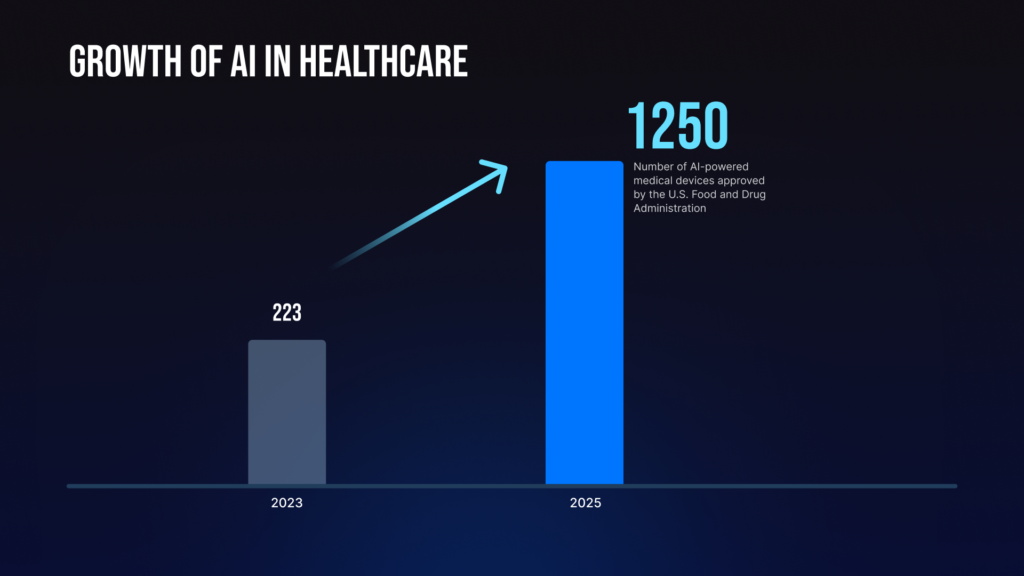
Since we are already discussing safety, this is a good moment to note that AI has reached a level of maturity that allows for its large-scale and safe use in medicine and passenger transportation. For example, in 2025, the number of AI-powered medical devices approved by the U.S. Food and Drug Administration reached 1,250 (compared to just 223 in 2023).
The effectiveness of AI in areas such as medical diagnostics is vividly demonstrated by the Xp-Bodypart-Checker and CXp-Proction-Rotation-Checker models developed by the Research Group of the Graduate School of Medicine at Osaka Metropolitan University. Designed to analyze X-ray images, these models demonstrate accuracy rates ranging from 98.5% to 99.3%.
As for transportation, last year both the U.S.-based robotaxi operator Waymo and their Chinese counterparts from Apollo Go announced that they had reached the milestone of a quarter of a million rides per week. Meanwhile, at the very beginning of 2026, NVIDIA announced the open Alpamayo model suite designed for developing AI-powered autonomous vehicles that simulate human-like reasoning.
Of course, it is far too early to say that AI doctors and AI drivers will soon replace the majority of their biological counterparts. However, the growing influence of artificial intelligence in medicine and logistics is clearly evident. Most importantly, the accelerating pace of AI adoption in areas that require particularly strict oversight serves as a strong indicator of progress in AI-driven automation.
The Ability to Think Is More Important Than Knowledge
The most significant achievement of 2025 — and the one that will define the direction of the AI industry in the near future — lies in the serious progress made toward creating “reasoning” AI. To begin with, there was a sharp increase in scores on the MMMU, GPQA, and SWE-bench benchmarks — by 18.8, 48.9, and 67.3 percentage points respectively. It is worth recalling that these benchmarks were originally designed primarily to demonstrate the limitations of cutting-edge AI systems. After their release, it was widely believed that improvements on these tests would be very slow — just a few points per year — and would quickly hit a technological ceiling that current systems could not overcome. In this sense, AI models delivered a genuine surprise to the creators of these benchmarks.
An even greater surprise was the emergence of models that do not simply search for answers and compile data in response to a prompt, but instead generate hidden “chains of thought” — consisting of hundreds of words and concepts — that remain invisible to the user. The concepts behind such systems were introduced back in 2024. In 2025, both Google DeepMind and OpenAI showcased their capabilities in spectacular fashion, for example by winning gold at the International Mathematical Olympiad. Based on last year’s achievements, it is fair to say that the idea that “training AI to build long chains of reasoning is more important than training it on massive datasets” has received strong confirmation. This does not mean, of course, that large datasets will be removed from AI training entirely. However, in light of these new results, training approaches will be revised and adjusted in favor of building systems capable of genuine reasoning.
The progress is evident and gives hope that, in the foreseeable future, it will lead to the creation of nearly “error-free” AI models, free from machine hallucinations.
Most importantly, in our view, this approach will dramatically enhance the capabilities and performance of autonomous AI agents. Reasoning digital virtual robots are becoming the mainstream of AI technology — a trend that will continue the AI revolution both in video production and in the development of artificial assistants and employees.
Good luck to everyone, and successful work with artificial intelligence in the 2026! Including, of course, AI solutions from our Pitch Avatar team.