For many executives, managers, and support leads, the term “chatbot” still conjures up images of long and pointless conversations with a “dumb” program that understands only a few keywords. And indeed, the old bots, which operated on simple scripts with a limited “decision-tree” of just a few branches, often created more problems than they solved. However, with the development of artificial intelligence, this technology has undergone fundamental changes and, one might say, has been reborn. Modern AI assistants relate to old bots much like a smartphone relates to a rotary phone.
In this article, we will move beyond the outdated concept of simple chatbots and show how modern virtual assistants powered by generative AI can handle complex queries, integrate with backend systems, and autonomously resolve customer issues, transforming customer service operations.
Not Your Average Bot: The Difference Between a Chatbot and an AI Assistant
The most important distinction that every support or operations leader should understand is that not all automated communication tools are the same. The failures of the past were mainly associated with the limited capabilities of primitive chatbots that operated on rigid, predefined scripts. Modern platforms have evolved into something fundamentally different: AI assistants capable of adapting to changing circumstances.
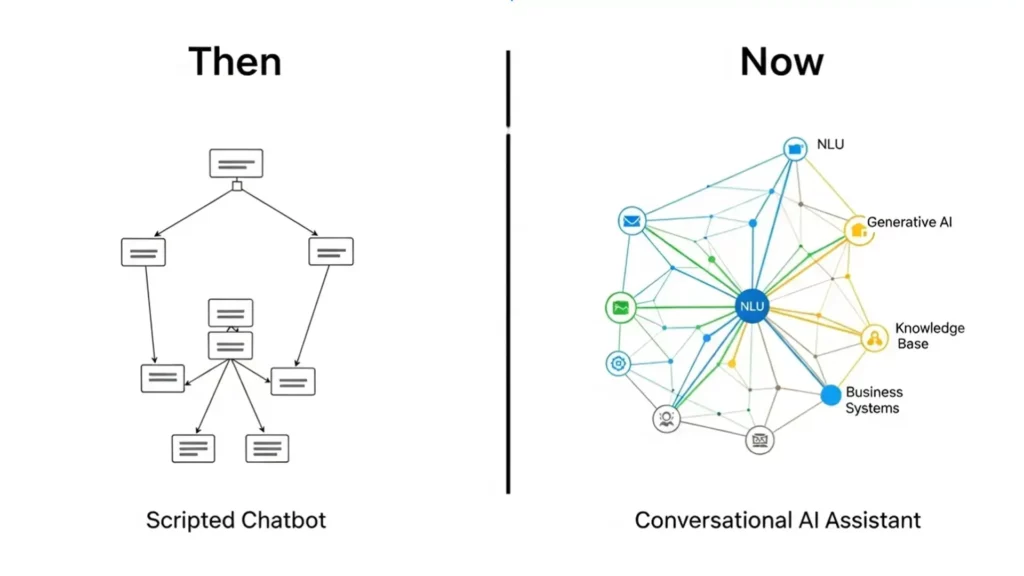
- Simple Chatbots in the Past: These bots follow a rigid decision-tree model. They operate according to preprogrammed scripts manually created by developers. For example: IF a customer types “password”, THEN the bot replies with a link to the password reset page. They can only handle a very limited set of basic frequently asked questions with few phrasing variations. But once a customer asks a question in an unusual way or raises a slightly more complex issue, these bots quickly become ineffective.
- AI Agents / Virtual Assistants In The Present & Future: A modern AI assistant is not scripted – it is trained on large volumes of data and diverse real-world examples. It uses a powerful combination of Natural Language Understanding (NLU) and Generative AI to understand the context and intent behind the customer’s words. Instead of simply matching keywords, it can analyze the problem. Such a system can connect to knowledge sources (help centers, documentation) and even business systems (CRM, order management) to retrieve and apply relevant information when responding. This enables AI assistants to manage complex multi-step conversations and independently resolve unique issues that arise in real interactions with customers.
Organizations have moved away from rigid, brittle models that require constant manual coding toward flexible, intelligent systems based on learning and access to knowledge. This evolution is the key to achieving true automation and efficiency in customer support.
What Can a Modern AI Assistant Actually Do?
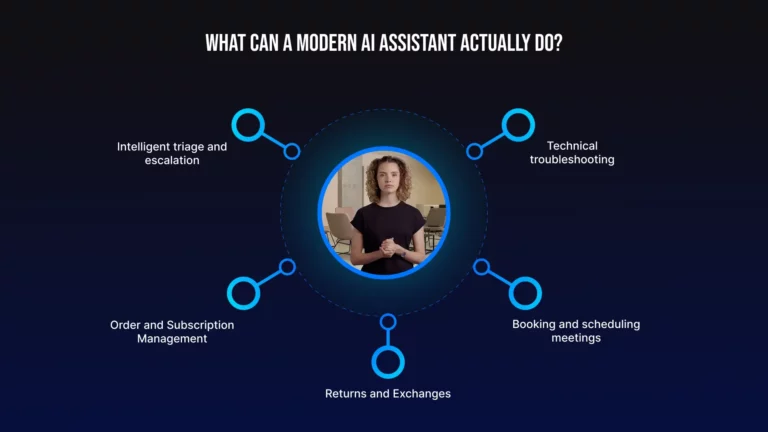
The key advantage of an AI assistant lies not only in its ability to answer questions but also in its capacity to solve customer problems by handling tasks of varying complexity. This ability to take action is what separates it from a simple FAQ Bot and delivers real value to both the customer and the business. Below are concrete examples of what a modern AI assistant can do:
- Order and Subscription Management: An AI assistant can integrate with your e-commerce or billing platform to handle a wide range of transactional queries.
- “Where is my order?” – The assistant can check the real-time shipping status and provide a tracking link.
- “I need to change my shipping address.” – The assistant can authenticate the user and update the address in your backend system before the order is shipped.
- “I want to cancel my subscription.” – The assistant can process the cancellation request directly in the chat.
- Returns and Exchanges: Instead of sending a customer to a complicated returns page, the AI assistant can initiate the entire process conversationally, asking for the reason for the return and even generating a return shipping label.
- Booking and scheduling meetings. By integrating with calendar systems, an AI assistant can schedule product demos for sales teams or book service calls with technical support, finding a convenient time for both sides without lengthy email conversations.
- Technical troubleshooting: For common product issues, the AI assistant can guide the customer through a step-by-step diagnostic and troubleshooting steps. It can access technical documentation to provide accurate, reliable instructions and resolve the problem without the need for a human technician.
- Intelligent triage and escalation. If the AI assistant encounters an issue that is too complex, it performs intelligent triage: collecting all the necessary information from the customer (name, account details, the nature of the problem, and the steps already taken). It then analyses the data and seamlessly hands off the conversation to the most appropriate human specialist, who can pick up exactly where the assistant left off, without asking the customer to repeat information.
How AI Assistants Increase Business Value
For customer service and operations leaders, implementing an AI assistant delivers three key business benefits that address the main challenges of cost, efficiency, and customer satisfaction.
- 24/7 availability and instant problem resolution. Customer needs are not limited to business hours from 9 to 5. AI assistants provide fast, high-quality support 24/7/365. This eliminates wait times caused by closing hours, weekends, or holidays. They ensure that customers receive help exactly when they need it. By autonomously handling routine inquiries, AI assistants significantly reduce the workload on human agents, leading to significant cost savings.
- Improved Operational Efficiency: By automating high-volume, low-complexity tasks, AI assistants create a significant “operational leverage” for employees. A well-trained and properly deployed AI assistant enhances human agent productivity, allowing your team to handle a growing volume of customer inquiries without a proportional increase in headcount. This allows your support function to scale effectively in line with the rest of the business.
- More Effective Human Agents: AI assistants act as a force multiplier for your team. Freed from the repetitive strain of answering the same questions over and over, your skilled agents can dedicate their time and expertise to the most complex, sensitive, or high-value customer issues. This not only improves performance in these critical cases but also increases employee satisfaction by reducing burnout. AI handles transactional tasks, while humans focus on relationship-oriented ones.
What to Look for in an Enterprise-Grade AI Assistant Platform
When choosing a platform for building and deploying AI-powered assistants, support and operations leaders should evaluate not only the stated features but also the actual performance. It is important to understand how well the platform meets enterprise-level requirements. Below are the main evaluation criteria:
- NLU Accuracy and Reasoning Quality: How well does the AI understand user intent, even when the request contains complex phrasing, slang, typos, or mistakes? Ask the vendor or software provider for performance metrics and test the AI’s ability to reason through multi-step problems, not just answer single questions. A powerful NLU is the foundation of an effective AI assistant.
- Deep Integration Capabilities: The assistant’s value directly depends on its ability to connect to business systems and take action within them. Can it integrate with your specific CRM, order management system, and other backend platforms via APIs? Without deep integration, the assistant remains just an information source rather than a problem-solving tool.
- Enterprise-Grade Security & Compliance: Protecting customer data must always be a top priority. The platform should use robust security protocols and hold certifications such as SOC 2 and GDPR compliance. Ensure the vendor has clear policies on data privacy, encryption, and access controls to minimize risk.
- Ease of Training and Customization: A modern AI assistant shouldn’t require a team of developers to maintain it. Look for a platform with a low-code or no-code interface that allows your support managers to “train” the system. This includes easily feeding it new knowledge from documents, providing feedback on its conversations, and refining its behavior without writing a single line of code.
Conclusion
The era of tedious chatbots programmed to follow predefined scripts strictly is over. Modern AI virtual assistants represent an entirely new class of technology – intelligent, efficient, and designed to analyze and solve problems. For most operations managers and сustomer service leaders, they are no longer a novelty but a strategic tool for boosting efficiency, controlling costs, and ensuring high-quality service. By adopting this technology, you can transform your support function from a cost center into a system that drives customer satisfaction and business growth.
Frequently Asked Questions (FAQ)
You can train an AI assistant by connecting it to your existing knowledge sources. Platforms can automatically ingest and learn from your help center articles, product documentation, and even the history of past support tickets. You are essentially providing the AI with the same materials a new human agent would use to learn.
A well-designed system includes a seamless and intelligent handoff process. The AI assistant is trained to recognize the limits of its knowledge. When it encounters an issue it cannot resolve, it will collect all the necessary information from the customer and then intelligently route the entire conversation, with full context, to the appropriate human agent for resolution.
Yes, AI platforms are designed for global support. They use advanced translation models to converse fluently in multiple languages, allowing you to provide high-quality service to your customers across different regions without needing to hire native speakers for every language.
While the AI learns automatically from its interactions, there is an ongoing optimization process. Your team will want to periodically review conversations to identify areas where the AI’s responses can be improved and regularly update its knowledge base with new product information or policy changes. This “training” process is far less intensive than the constant manual scripting required by older chatbots.
Yes. With Natural Language Processing (NLP) and Natural Language Understanding (NLU) models, AI assistants are highly effective at understanding the user’s intended meaning, even when the query contains typos, grammatical errors, or informal slang.
An AI assistant is interactive and diagnostic. Instead of forcing a customer to read through a long page to find an answer, the assistant engages them in a conversation. It asks clarifying questions to diagnose their specific problem and then provides a direct answer or solution, leading to a much faster resolution and a better customer experience.
important metrics include: Containment Rate (the percentage of queries fully resolved by the AI without human help), Customer Satisfaction (CSAT) scores from bot conversations, and the Reduction in Average Handle Time (AHT) for human agents, who are now receiving better-qualified escalations.