
Working on online presentations is a creative process. Ideally, each of them should be unique and inimitable, a perfect reflection of a unique idea delivered to a specific audience. However, in their pursuit of perfection, many presenters fall into a common trap: they take specific recommendations too literally and turn them into absolutes. They cling to rigid formulas, restricting their creative initiative and often acting to the detriment of the tasks at hand. This approach results in thousands of identical presentations, as if they came off the assembly line.
The truth is that it’s rare that any particular presentation format is ideal for every situation. True creative freedom and impact come from a deep understanding of structure, not from ignoring it. The most iconic and effective presentations are not created in a vacuum – they are the result of a presenter who understands the “canon” of presentation theory so deeply that they can wield it with purpose, precision, and creativity.
This guide aims to provide that fundamental understanding. We will analyze well-known recommendations, not to reject them, but to reveal the strategic thinking underlying them. The goal is to help you move from being a rule-follower to a strategic decision-maker, one who can select, adapt, and even break the rules to create a truly memorable presentation.
The Universal Principles of Presentation Architecture
Before exploring specific formats, let’s understand the fundamental principles that underlie any successful presentation. These principles are the basis of any effective communication. They’ll answer the “why” first, then the “how”, giving you a foundation for strategic thinking that goes beyond any single format or style.
Defining Your Audience, Purpose, and Message
The first step to any effective presentation is clarifying your goals, your audience, and your key message. These three elements form an interconnected system: changing one of them requires a re-evaluation of the others.
- Audience Analysis: First, you must know your audience. Who will be in attendance? What is their prior knowledge of your topic? What are their interests, motivations, and potential pain points? Are they senior executives who need a high-level summary or newcomers who require more context? Understanding your audience will determine the depth of detail, the tone of your language, and the overall approach you take.
- Purpose Identification: With your audience in mind, define a clear, audience-centric goal. Vague objectives like “to update my team” aren’t enough. A powerful purpose is specific and actionable, such as “to persuade the board to approve the Q3 marketing budget by demonstrating a clear return on investment”. This purpose becomes the guiding star for every content decision you make.
- Crafting a Key Message: Finally, boil your entire presentation into a single, memorable takeaway sentence. This is the key idea you want your audience to remember long after you have finished speaking. If the listener could only remember one thing from your speech, what would it be? This key message is the heart of your presentation and shapes the story you will tell.
Structuring Your Presentation as a Story
While data and facts are important, audiences typically struggle to remember them. People are much better at understanding and retaining stories than isolated pieces of information. Storytelling is the most crucial factor in making a presentation memorable, even more so than statistics and visuals.
By framing your presentation as a story with a clear beginning, middle, and end, you create an engaging journey for your audience. One of the most effective and widely used storytelling frameworks is the Problem/Solution/Benefit structure.
Problem: Start by explaining the problem and why it exists. This creates tension and establishes relevance for your audience.
Solution: Transition to what can be done about the problem. This is where you introduce your idea, product, or proposal.
Benefit: Conclude by detailing how your solution uniquely resolves the problem and the advantages it offers. This provides a satisfying resolution and a clear call to action.
This storytelling method quickly establishes and resolves conflict, making it easier for audiences to engage with and understand your message. For more technical presentations, an “hourglass” structure can be highly effective: begin broadly with a concept that resonates with the audience, narrow down to the specifics of your work, and then broaden again to explain the impact and link back to the bigger picture.
Basic Outline: How to Master the Introduction, Body, and Conclusion
Just like any well-written document, a presentation requires a clear beginning, middle, and end. Mastering this fundamental structure ensures that your message is delivered with clarity and logic.
- Introduction (The Hook): A strong introduction is crucial for capturing attention. It should clearly state your purpose, briefly outline the structure of your speech (often referred to as “signposting”), and, if necessary, limit the scope of your topic. You might start with a compelling story or a surprising fact to immediately engage your audience.
- Body (The Evidence): This section is where you provide support for your central message. Discuss each of your main points in a logical order, using clear transitions to guide your audience (e.g., “Turning to the next point…” or “Another important consideration is…”). Use examples, data, and evidence to illustrate your points and build a convincing argument.
- Conclusion (The Takeaway): A powerful conclusion leaves a lasting impression. Clearly conclude your presentation by summarizing the main points and reminding the audience of the importance of your message. This is your final opportunity to reinforce your central idea and, if appropriate, use a clear call to action. In conclusion, thank the audience and invite them to ask any questions.
Deconstructing the "Canon": Common Presentation Formats
With a clear understanding of the underlying principles, we can now analyze the well-known “rules” and “formats” that dominate presentational discourse. These are not arbitrary restrictions but strategic tools, each designed to solve a specific communication problem. Understanding their fundamental purpose helps you choose the appropriate structure for a particular task. Selecting a format is a strategic decision about the relationship you want to build between you as a presenter, your slides, and your audience.
Investor’s Pitch: Guy Kawasaki’s 10/20/30 Rule
The 10/20/30 rule, popularized by venture capitalist Guy Kawasaki, is a well-known presentation formula designed to prevent “death by PowerPoint”. Its purpose is to encourage entrepreneurs to distill their ideas to their core, avoiding overly long, overloaded pitches.
- The Rule: A presentation should consist of 10 slides, last no longer than 20 minutes, and use a font size of at least 30 points.
- The Breakdown: The ten slides should address the fundamental questions that any investor would have:
- Title: Include your company name, your name and title, and your contact information.
- Problem/Opportunity: Describe the pain point you are addressing.
- Value Proposition: Explain the value and uniqueness of your solution.
- Underlying Magic: Detail the technology, special features, or a demo of your product.
- Business Model: Explain who your customers are and how your business generates revenue.
- Go-to-Market Plan: Outline your strategy for reaching customers.
- Competitive Analysis: Provide an overview of the competitive landscape.
- Management Team: Highlight the key members of your team and their expertise.
- Financial Projections & Key Metrics: Present your financial forecast for the next three to five years along with key assumptions.
- Current Status, Accomplishments, and Timeline: Summarize your current status, what you have achieved, and what you are requesting.
Strategic Application: This format is optimized for busy decision-makers (like VSs) who often have limited attention spans. The 20-minute limit allows for ample time (approximately 40 minutes in a typical hour-long meeting) for discussion, which usually leads to significant progress. This structure is ideal for important presentations where clarity, brevity and engagement are crucial.
Creative’s Sprint: PechaKucha Presentation (20×20)
PechaKucha, which means “chit-chat” in Japanese, was created by presenters who wanted to “talk less, show more”. It is a direct response to text-heavy, monotonous presentations, forcing a focus on fast-paced, visual storytelling.
- The Rule: A PechaKucha presentation consists of 20 slides, each displayed for exactly 20 seconds. The slides advance automatically, bringing the total presentation time to 6 minutes 40 seconds.
- Structure: This format is characterized by a clear tempo and visual accompaniment. Each slide typically contains one striking image, and the presenter should briefly comment on it before the next slide appears. The focus is on conveying a story through images, with the narration acting as a supportive soundtrack.
Strategic Application: In PechaKucha, slides take precedence, dictating the pace of the speaker’s presentation. This makes the format ideal for creative showcases, personal storytelling, introducing new concepts in an engaging way, or for educational purposes to enhance student engagement and critical thinking. However, it is less suitable for complex, data-heavy presentations that require detailed explanations or audience interaction.
Paced Narrative: The Rapid-Fire Lessig Method
The Lessig Method, named after Stanford University law professor Lawrence Lessig, was developed to transform dense and complex academic arguments into dynamic and engaging presentations. This approach shifts the focus from the slides back to the speaker.
- The Rule: The Lessig Method involves using a large number of simple, minimalist slides – often containing just a single word, short phrase, or image. These slides change quickly in perfect synchronization with the speaker’s speech.
- The Breakdown: Slides serve as visual punctuation for the presentation. The fast, rhythmic tempo creates a captivating rhythm that holds the audience’s attention and emphasizes key points. Slides are often meaningless on their own; their power comes from their synchronization with the spoken word.
Strategic Application: This method gives the speaker complete control over the presentation. It is particularly effective for charismatic presenters delivering well-rehearsed speeches on complex topics. It creates momentum and ensures the audience is focused on the speaker rather than reading ahead on the slides. However, it requires a lot of practice and is not well-suited for interactive or improvisational settings.
“Idea Worth Spreading”: The Anatomy of a TED Talk
The TED Talk format has become the gold standard for thought leadership. Its structure is designed to make powerful ideas accessible, engaging, and memorable for a broad audience.
- The Rule: A presentation focused on a single, powerful idea, delivered in 18 minutes or less. This time limit was strategically chosen to allow enough time to explore a topic in depth while remaining short enough to hold the audience’s attention.
- The Breakdown: A successful TED Talk is a carefully crafted narrative journey.
- Introduction: It begins with a hook (personal story, surprising statement, or relatable experience) to create an emotional connection with the audience.
- Body: The talk then develops its central idea, using a mix of evidence, data, and storytelling to make the argument compelling and understandable.
- Conclusion: It concludes with a powerful and inspiring summary that highlights the significance of the idea, often including a call to action to leave the audience with a new perspective.
Strategic Application: The TED format strives for a perfect balance between speaker, slides, and audience. It’s an ideal structure for keynote speeches, conference presentations, and any situation where the goal is to inspire, educate, and share a transformative idea.
How to Adapt to the Modern Audience
Understanding classic formats is essential, but they need to be adapted to today’s realities. The modern audience faces distractions, has a shorter attention span, and expects a more immersive experience. Recent data clearly illustrate the challenges and opportunities that presenters will face. The evolution of presentation methods is a direct response to the market’s main competitor for audience attention: the smartphone in the pocket.
Attention: Audience Engagement Data
The competition for attention has never been more intense. Research indicates that the average attention span for any single point on a screen is now just 47 seconds. Additionally, one in three audience members admits to multitasking during presentations, often checking emails or browsing social media while the speaker is talking.
This reality highlights the importance of concise presentations. Ideal presentation length is around 20 minutes – long enough to convey meaningful information but short enough to maintain focus. Furthermore, visuals are now essential. Since 90% of information transmitted to the brain is visual, presenters must utilize high-quality images, charts, and minimal text to communicate effectively. Audiences overwhelmingly prefer slides that contain less than 25% text, viewing them as visual aids rather than documents to be read.25
The Critical Role of Interactivity and Personalization
To effectively combat distractions, presenters need to transition from a monologue to a dialogue format. Data reveals a significant trend toward active participation: 70% of presenters now include interactive elements such as live polls, quizzes, and Q&A sessions in their presentations. These techniques help re-engage the audience, transforming them from passive listeners into active participants.
Additionally, a generic, universal format is no longer effective. The vast majority (80%) of audiences prefer personalized presentations that address their specific needs and interests. This underscores the importance of audience analysis as a foundational principle. By personalizing your content, you demonstrate an understanding of your audience’s problems and a willingness to offer relevant, valuable solutions.
AI Frontier: Expanding Your Presentation Strategy
The latest development in presentation strategy involves the use of Artificial Intelligence. AI is not intended to replace human creativity but to serve as a powerful co-pilot. It automates routine tasks, provides deep analytics, and enables delivery on an unprecedented scale. This technology fundamentally separates the “presentation” as a piece of content from the “presenter” as a live human. As a result, it creates an entirely new category of communication: the scalable, interactive, on-demand presentation asset.
How AI is Changing Presentation Creation, Analysis, and Delivery
AI tools have quickly become essential for modern presenters. Over 72% of presenters now utilize AI for content generation and slide design, which saves significant time and enhances the overall quality of their work. AI can serve as a tireless assistant in several key areas:
- Text and Idea Generation: Conversational AIs can assist in drafting scripts, brainstorming ideas, and structuring initial outlines.
- Visual Content Creation: AI tools can generate custom images, slide designs, and even video clips based on simple text prompts.
- Data Collection and Analysis: AI can help presenters gather up-to-date information about their audience, competitors, and market trends.
- Optimization: AI-powered tools can analyze your presentation for clarity, grammar, and overall effectiveness, providing recommendations for improvement.
Using AI Presenters for Unmatched Consistency, Scale, and Engagement
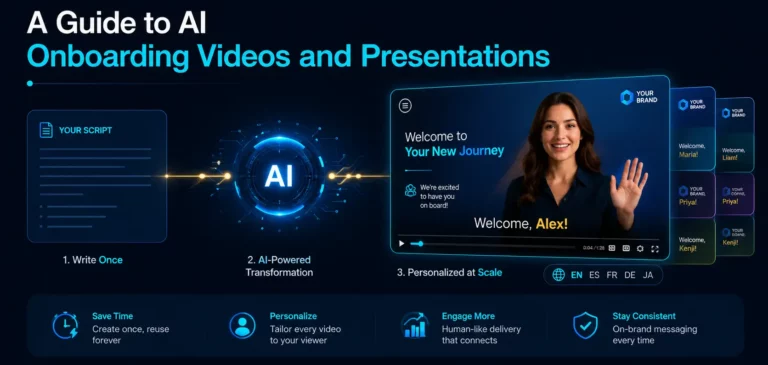
Beyond creation tools, the next frontier is the AI-powered virtual presenter. This technology transforms a static slide deck into a dynamic, interactive, and endlessly scalable communication asset. Pitch Avatar allows you to deploy presentations that were previously impossible:
- Perfect Consistency: An AI presenter can deliver your message flawlessly every time, ensuring brand consistency and accuracy across all communications.
- Global Scale: With the ability to voice content perfectly in any language, you can localize and deliver training, sales pitches, or corporate content to a global audience instantly.
- 24/7 Availability: AI presenters work 24/7 without fatigue. This allows you to deploy sales demos, HR onboarding modules, or customer support guides on demand, precisely when your audience needs them.
- Interactive Engagement: AI presenters can engage in conversations with the audience, answering questions based on a pre-loaded knowledge base and even notifying a human sales or support representative when a live discussion is necessary.
This shift from “giving a presentation” to “deploying a communication asset” enables businesses to scale their best pitches and training modules infinitely, delivering personalized, interactive experiences at the right moment.
Conclusion: Creating Your Own Unique Presentation Style
We have moved from exploring universal principles of structure to strategically deconstructing familiar formats, all while considering the realities of the modern audience and the potential of AI presenters. It has become clear that formulas, standards, advice, and solutions serve merely as guidelines and starting points. They are intended to assist the presenters rather than limit them.
If, during the creative process, a presenter realizes that a different format is needed, they will likely choose a new format that better suits their piece instead of compromising their masterpiece. The objective, however, is not to imitate figures like Guy Kawasaki or TED speakers. Instead, the goal is to synthesize lessons from various sources (such as Kawasaki’s brevity, PechaKucha’s visual appeal, Lessig’s rhythmic style, and TED’s narrative depth) into a unique, authentic, and compelling presentation style that resonates with you, your message, and your audience.
By mastering the foundational elements, you obtain the freedom to transcend them. You can make informed, strategic choices, blending different elements to create something new and powerfully unique.
Good luck to everyone, successful presentations, and high income!