The Pitch Avatar team has compiled several quotes from the renowned psychiatrist who was among the first to deeply explore the problem of creating and developing “intelligent machines.”
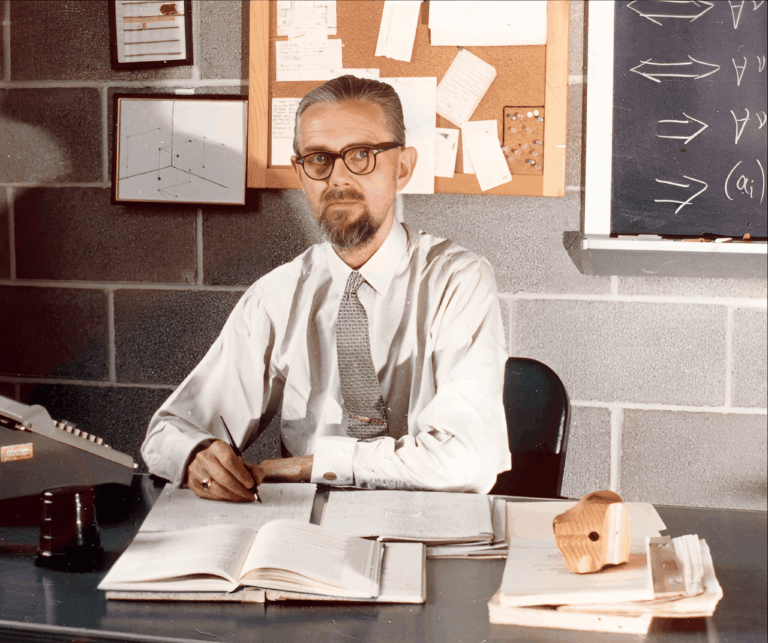
William Ross Ashby (1912–1954), a British psychiatrist and graduate of the University of Cambridge. Practicing psychiatrist and researcher since 1930. Head of Research at Barnwood House Hospital from 1947 to 1959. Director of Burden Neurological Institute from 1959 to 1960. From 1960 — Professor of Cybernetics and Psychiatry, Department of Electrical Engineering, University of Illinois. Formulated the law of requisite variety. Introduced the concept of “Self-organization.” Invented the homeostat. Author of major works that played a significant role in the development of cybernetics, including Design for a Brain, An Introduction to Cybernetics, and Mechanisms of Intelligence. The quotes are taken from these and other books and articles by Ross Ashby.
Cybernetics treats not things but ways of behaving.
One of the most important principles for understanding the term “artificial intelligence.” Among other things, it points out that what matters is not whether a brain is natural or artificial, but the processes taking place within it.
The invasion of psychology by cybernetics is making us realize that the ordinary concepts of psychology must be reformulated in the language of physics if a physical explanation of the ordinary psychological phenomena is to become possible. Some psychological concepts can be re-formulated more or less easily, but others are much more difficult, and the investigator must have a deep insight if the physical reality behind the psychological phenomena is to be perceived.
Ross Ashby was one of the first to clearly define cross-disciplinary research at the intersection of psychiatry, biology, physics, chemistry, mathematics, and other sciences and disciplines as the main direction for the development of cybernetics. Today, the situation remains unchanged.
During the last few years it has become apparent that the concept of “machine” must be very greatly extended if it is to include the most modern developments. Especially is this true if we are studying the brain and attempting to identify the type of mechanism that is responsible for the brain’s outstanding powers of thought and action. It has become apparent that when we used to doubt whether the brain could be a machine, our doubts were due chiefly to the fact that by ‘‘machine’’ we understood some mechanism of very simple type. Familiar with the bicycle and the typewriter, we were in great danger of taking them as the type of all machines. The last decade, however, has corrected this error. It has taught us how restricted our outlook used to be; for it developed mechanisms that far transcended the utmost that had been thought possible, and taught us that ‘‘mechanism’’ was still far from exhausted in its possibilities. Today we know only that the possibilities extend beyond our farthest vision.
These words, written by Ross Ashby in 1951, remain relevant today. Every time someone begins to argue that humanity has approached the limits of machine and software development, a breakthrough inevitably occurs, opening new horizons. Naturally, this also applies to the development of “artificial intelligence.” It can be said that Ross Ashby was one of those who believed and encouraged others to believe in the boundless potential of technological progress.
If intellectual power is to be developed, we must somehow construct amplifiers for intelligence — devices that, supplied with a little intelligence, will emit a lot.
In his 1956 article “Design for an intelligence amplifier,” Ross Ashby very precisely formulated the main task of the overwhelming majority of artificial intelligence developers. AI model creators primarily strive not to build independently thinking devices, but human assistants. Modern AI tools require an intellectual prompt from people in order to begin acting, “amplifying” it into a result that satisfies human needs. It is logical to assume that this principle will remain relevant even in the creation of strong AI, which will likely seek its “source of inspiration” in collaboration with humans. In our view, this is a strong argument against AI alarmists.
Cybernetics is likely to reveal a great number of interesting and suggestive parallelisms between machine and brain and society. And it can provide the common language by which discoveries in one branch can readily be made use of in the others… [There are] two peculiar scientific virtues of cybernetics that are worth explicit mention. One is that it offers a single vocabulary and a single set of concepts suitable for representing the most diverse types of system… The second peculiar virtue of cybernetics is that it offers a method for the scientific treatment of the system in which complexity is outstanding and too important to be ignored. Such systems are, as we well know, only too common in the biological world!
You have to admit, this quote from An Introduction to Cybernetics (1956) proved to be prophetic. It could hardly have been more accurate.
There comes a stage, however, as the system becomes larger and larger, when the reception of all the information is impossible by reason of its sheer bulk. Either the recording channels cannot carry all the information, or the observer, presented with it all, is overwhelmed. When this occurs, what is he to do? The answer is clear: he must give up any ambition to know the whole system. His aim must be to achieve a partial knowledge that, though partial over the whole, is none the less complete within itself, and is sufficient for his ultimate practical purpose.)
Applied to the topic of artificial intelligence, this serves as an excellent argument for setting aside debates about the “intelligence of machines.” What is the point of arguing about how exactly artificial intelligence completed a task? By performing intelligent actions, or… through the imitation of intelligent activity? Does it have any practical significance? Of course, there will always be those eager to debate whether AI possesses “real” intelligence or even a soul. However, from the standpoint of developing and using artificial intelligence, this is a waste of time.
With this quote, we will allow ourselves to place not a period, but an ellipsis in our exploration of the views and opinions of key figures in the history of cybernetics and “intelligent machines”…