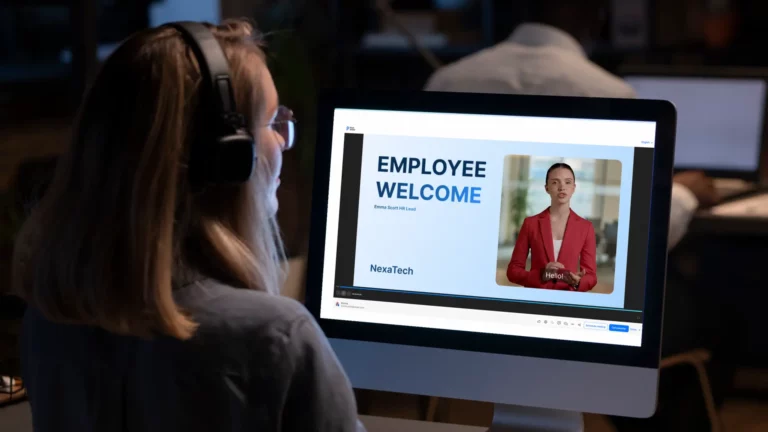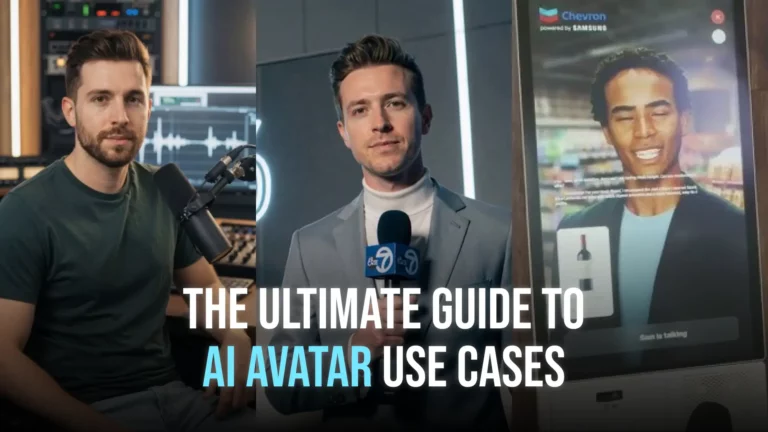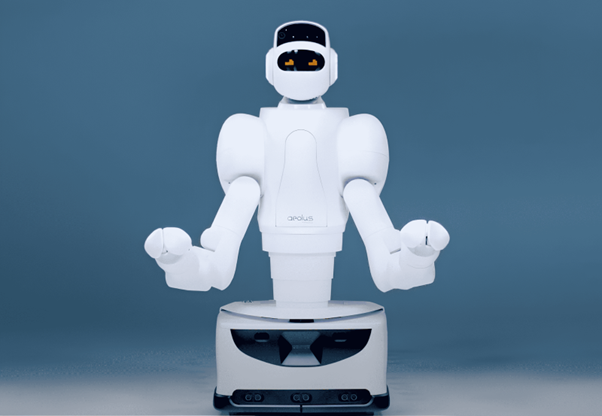
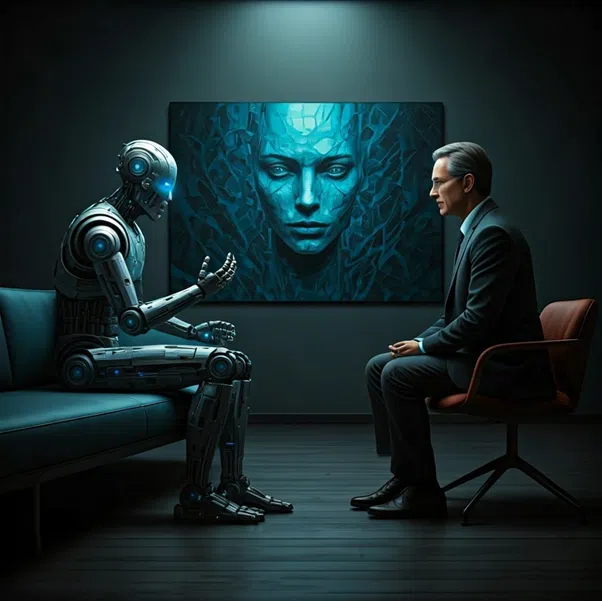
After writing the headline, I caught myself realizing that I was adding a clarification – not just “employees,” but “human employees.” What once seemed like science fiction has become reality. For example, our team is working on a product that can already replace a human today in the role of a host, speaker, product consultant, HR specialist conducting initial interviews, onboarding guide, online salesperson, video translator, audiobook narrator, and more.
But – and this is very important to understand – not in all situations. Although, of course, we are actively working to expand the capabilities of our AI solutions.
At the same time, we clearly understand that completely replacing humans in many fields of activity is most likely impossible. Frankly speaking, we are not even trying to achieve that. Our task is more modest: to free people from routine work. I dare say that most specialists in the field of AI development and AI tools see their core mission in the same way.
Let people focus on creativity and the development of new ideas, and let routine be left to robots – that is our motto.
But even this approach comes with challenges. The fact is, we humans are remarkably universal. That is our strength. One could say that we are the most universal species on the planet. After all, we live and work on all continents, in all climate zones and even beyond the planet, on orbital stations. The history of evolution clearly shows that the more specialized a species is, the higher the risk of extinction. If the specific food source it specializes in disappears – that’s it, see you in a paleontology museum.
However, high universality equals relative weakness in each individual ability. We see worse than eagles and hear worse than cats, run worse than horses and swim worse than dolphins, and when it comes to smell, any dog will easily outperform us. Not to mention how many creatures on the planet are stronger, more dangerous, and better equipped with teeth and claws. What saves us is our brain, which allows us to create specialized tools that amplify our abilities. Attach a stone tooth to a long stick, what will you say to that, saber-toothed tiger? Binoculars to see better, cars to “run” faster, and so on.
Smart machines (or, more precisely, smart software) are, in this sense, the heirs of the very first tools. Their strength and weakness lie in specialization – just as a human’s strength and weakness lie in universality. Take, for example, a chess program that plays at the grandmaster level. What happens if you offer it a game of Go? For it to play, specialists would need to do serious work. A human, on the other hand, only needs the rules explained. Yes, of course, a beginner will play worse than a specialized program. But they will play. And starting their first game will take minutes, not many hours of programmers’ work.

Quickly switching a robot trained to perform one task to another is far more difficult than switching a human.
Even when it comes to simple, routine actions such as conveyor belt manipulations. For now, we are still far from machines that can be assigned tasks as quickly and easily as humans. Users of modern conversational AI know well that even the most advanced versions make mistakes no less frequently than people do. Human intervention is required to review, edit, adjust, and correct AI outputs.
Of course, if you train and configure an AI-based chatbot specialist by filling its knowledge base with the necessary information, it will work no worse and on average, better than a human. But only within the limits of its competence. For example, if you use Pitch Avatar to create an online consultant that explains a specific product, it will have several advantages over a human. But if you need a speaker for a children’s presentation, you will have to train and configure a different AI agent.
A human, however, can almost instantly “switch” between different tasks. Yes, with varying degrees of success. But theoretically, like Sherlock Holmes, one person can simultaneously be a detective, a boxer, and a fairly decent improvisational violinist.
Moreover, AI systems are still completely lacking original creative thinking. They already know how to compile based on known examples just as well and faster than humans. But coming up with something fundamentally new, original, and unconventional is still not their domain.
That is why I would not advise executives of enterprises, companies, and organizations to go too far with automation plans. Human universality, flexibility, and creative thinking have no real replacement yet.
I dare to assume that even when we build a universal SuperAI, its universality compared to humans will be rather conditional. SuperAI will always lack spontaneity, randomness, and unpredictability generated by the influence of emotions, instincts, and natural drives on the mind. In addition, it will most likely be not very effective at what is called “understanding humans.” Simply put, SuperAI will lack humanity.
Unless, in the future, we manage to combine the capabilities of humans and SuperAI in a single being (or machine?). But even if that happens, it will be very, very far in the future and frankly, I do not see this direction as particularly promising.
Most likely, a kind of balance will emerge in the foreseeable future. AI machines will take on all the heavy, dangerous, routine, rough, and compositional work. Humans, in turn, will focus on creativity, task formulation, and reviewing the work done by AI machines. And, of course, they will continue inventing new machines. One would like to believe that along this path we will be able to create an artificial intelligence that gains self-awareness, original creative thinking, and becomes an equal partner.