

The practical implementation of artificial intelligence within a specific department or area of work may seem like a challenging task. Project managers, CTOs, and operations leaders responsible for AI integration in their areas of responsibility often fear difficulties related to data migration, employee adaptation, organizational changes, and, of course, costs.
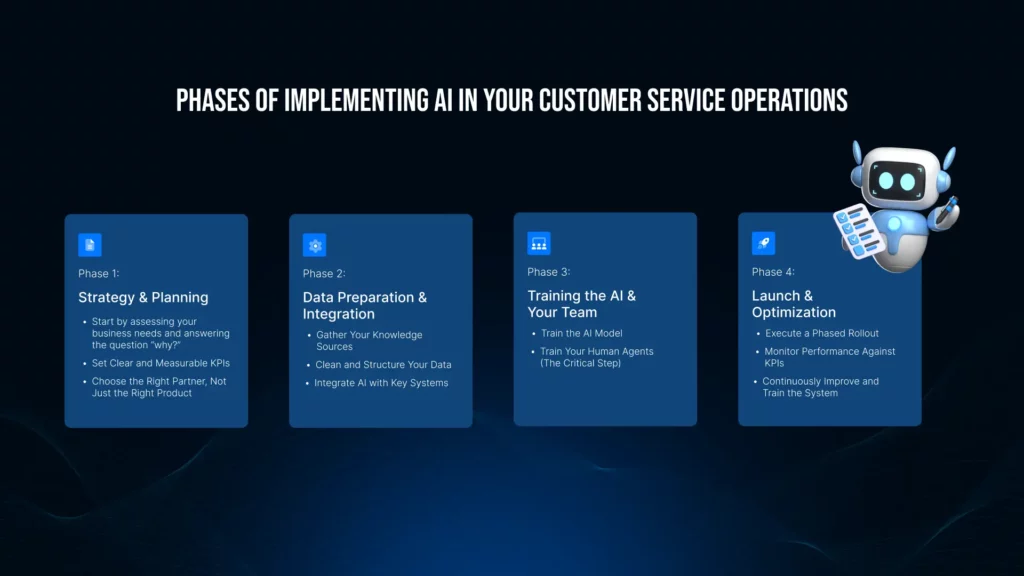
To ensure successful AI implementation, it is advisable to follow a step-by-step integration strategy rather than attempting to accomplish everything in one “giant leap.” Such a structured, phased approach reduces risks and allows for faster, tangible results.
Below, we describe a clear and practical guide that breaks down the AI integration process into manageable steps. It will help you ensure a smooth implementation of AI-based solutions, driving positive transformations in your customer service operations.
Phase 1: Strategy & Planning
To achieve sustainable long-term success, this stage is the most important. Unfortunately, many organizations jump straight to evaluating various AI solutions without first defining their strategic goals or developing an action plan. This is a common mistake. Before selecting specific tools, the team must establish a solid strategic foundation for all subsequent steps related to AI adoption.
- Start by assessing your business needs and answering the question “why?”. The first step is not to ask “What can AI do?” but rather “What are our biggest business problems that AI could solve?”. Conduct a thorough analysis of your customer service operations to identify major pain points. Do your customers face long wait times for responses? Is your team overwhelmed with a high volume of repetitive questions? Is the information customers receive always accurate and satisfactory? Are your customer support costs rising – and how fast? Answering these questions will give you a clear understanding of the key problems you want to solve, which, in turn, will provide your AI implementation project a clear direction and purpose.
- Set Clear and Measurable KPIs: Once you have defined your “why,” you must also determine what success looks like in specific, measurable terms. KPIs will serve as your guiding star throughout the AI implementation process. Moreover, they are critical for demonstrating return on investment to leadership. Vague goals such as “improving efficiency” are not enough. Instead, set concrete goals, for example:
- Reduce First Response Time (FRT) from 2 hours to under 5 minutes.
- Increase the 24/7 customer issue resolution rate (containment rate) to 40%.
- Decrease the cost per ticket resolution by 30%.
- Improve Customer Satisfaction (CSAT) scores by 10 points.
- Choose the Right Partner, Not Just the Right Product: Once your goals and KPIs are defined, you can begin the vendor selection process. Look for a vendor whose platform and expertise align with your specific needs. If your goal is to support complex B2B enterprise clients, a vendor specializing in simple B2C e-commerce chatbots will not be a good fit, regardless of its features. Use your KPIs as a checklist when evaluating potential vendors.
Phase 2: Data Preparation & Integration
At the next stage, after developing the strategy and selecting a partner, the focus should shift to preparing the technical foundation. The capabilities of AI – and, figuratively speaking, the level of its “intelligence” – directly depend on the quality and volume of the data it is trained on, as well as on the systems it can connect to.
- Gather Your Knowledge Sources: To turn artificial intelligence into a “specialist” in your business, you need to provide it with the relevant data for study and analysis. Consolidate all relevant knowledge sources in one place. Typically, these include: articles from your public help center, internal knowledge base documents for employees, saved macro responses, and product documentation. However, the most important source is the history of past customer service interactions and conversations between clients and support agents. These data are the fuel that powers the AI engine.
- Clean and Structure Your Data: This step should never be overlooked. The principle of “garbage in, garbage out” applies to AI training without exception. If your knowledge base is full of outdated materials and your customer communication history contains errors, AI performance will decrease significantly. Before using data for training, review and structure it to ensure accuracy, relevance, and consistency. Modern AI platforms can assist in this process by identifying gaps and inconsistencies in your data.
- Integrate AI with Key Systems: For maximum efficiency, the AI platform should interact with other critical business systems, usually through APIs (Application Programming Interfaces). The most important integrations are with your CRM system (such as Salesforce or HubSpot) and your existing customer service platform. This enables AI to access customer context (e.g., purchase history or subscription level) and ensures a seamless workflow, where tickets can be transferred between AI and human agents without losing information. Before going live, it is recommended to conduct pilot testing of these integrations to ensure their reliability.
Phase 3: Training the AI & Your Team
At this stage, special attention should be paid to working with employees. Implementing AI in customer support is not purely a technical project. To a large extent, success depends on how effectively the necessary changes are introduced into your team’s work.
Neglecting the human factor is a sure path to failure.
- Train the AI model. It is time to provide the AI system with all the data prepared during Phase 2. Machine learning algorithms will analyze the information to study the specifics of your company’s language, products, and business issues. The platform will form an initial understanding of how to respond to questions and what patterns lead to successful resolutions. Modern low-code platforms make this process highly automated, but they still require active participation from support agents to review and refine the AI’s knowledge and skills.
- Train Your Human Agents (The Critical Step): From the very beginning of AI implementation, it is critical to address employee concerns. Maintain maximum transparency by clearly explaining the purpose and meaning of each step. Consistently and in simple terms, show your team that AI is a tool designed to complement their work, not replace them. Emphasize that its implementation is not linked to layoffs or salary cuts. Present artificial intelligence as a “co-pilot” that takes on tedious, repetitive, routine tasks, freeing people for more interesting, creative, and valuable work.
Actively involve agents in the implementation process. Train them in the new workflow: effectively taking over a dialogue handed off by AI and collaborating with it to resolve customer issues more quickly and efficiently. During training, demonstrate exactly how AI functionality will make their jobs easier. Once agents see AI as a tool that helps them succeed, they will become its strongest advocates.
Phase 4: Launch & Optimization
The initial launch is not the end of the project – it’s the beginning of a continuous improvement journey. The key to success is a measured, data-driven approach to implementation.
- Execute a Phased Rollout: Do not attempt a “big bang” launch by enabling AI for all customers and all channels at once – this is far too risky. Instead, deploy the system gradually, in small and controlled steps. For example:
- Start with just one channel, like email, before enabling web chat.
- Automate only the top 5-10 most common and simple requests first.
- Launch the AI to only a small percentage of your customer base.
This step-by-step approach allows you to test, learn, and refine the system with minimal risk, gradually scaling it across the entire organization.
- Monitor Performance Against KPIs: Once live, your primary focus should be on tracking the KPIs defined back in Phase 1. By how much has the average first response time decreased? To what extent has the 24-hour resolution rate improved? Are CSAT scores increasing? Has the volume of repetitive requests facing your team declined? Has the overall workload on employees been reduced? These metrics provide an objective assessment of project success and highlight areas requiring attention.
- Continuously Improve and Train the System: Use the platform’s analytics to identify where AI is performing well and where it is struggling. Review conversations where the system failed or had to escalate to a human agent. Based on these insights, “train” the AI further: update the knowledge base, refine response formulations, and add new automation rules. A successful AI implementation is a dynamic process of continuous learning and optimization, not a one-time setup.
Conclusion
Successful AI implementation is a long road, not a final destination. It requires a well-thought-out strategy, high-quality data, and attention to both the technological and human aspects of the process. AI integration demands careful planning and precise execution, which can be achieved more easily by breaking the project down into the four stages described above. By doing so (and by choosing a vendor ready to become a true partner to your business), you can reduce risks and ensure that your investment in AI for customer service operations delivers fast, measurable, and transformative results.
Frequently Asked Questions (FAQ)
The biggest and most common mistake is poor planning. Companies that jump straight into technology without clearly defining their goals, pain points, and KPIs from the very start often struggle to measure success, demonstrate ROI, and gain organizational buy-in. A clear and well-defined strategy is the most important first step.
The key is transparent communication and focusing on expansion. From the outset, position AI as a tool to assist employees, not as a replacement. Emphasize that it will handle the repetitive, routine tasks, allowing them to focus on more interesting, complex, and high-value work. Involve your agents in the training process and let them see firsthand how agent-assist tools will make their jobs easier and more effective.
This is a very common challenge and should be expected. Any good implementation plan must include a data cleaning phase. The process of preparing for an AI implementation is often a valuable opportunity to audit and improve your existing knowledge assets. Modern AI platforms can also help by automatically identifying duplicates or inconsistencies in your knowledge base, making the cleanup process more efficient.
You should assign a dedicated project manager to lead the effort. During the initial strategy, preparation, and training phases (typically the first 6-8 weeks), this manager, along with key stakeholders from your support and IT teams, will be actively involved. After the launch, the time commitment becomes less intensive, shifting to a more periodic focus on monitoring performance and ongoing optimization.