TL;DR: Customer reviews in sales presentations build credibility, neutralize objections, and shorten B2B sales cycles. 95% of customers read online reviews before making a purchase decision, and products with 5+ reviews convert 270% better than products without reviews. The best results come from mixing review formats (text quotes for instant social proof, star ratings for credibility, video testimonials for emotional impact, case studies for B2B depth), placing reviews at objection points in the presentation (pricing, implementation, competitor comparison), and automating collection through CRM workflows so the review pipeline is continuous. This guide covers what reviews work where, how to collect and select the right ones, how to integrate them into your deck without overloading the audience, and how to scale the process – based on 2025–2026 B2B sales enablement practice.
Sales presentations are a cornerstone of sales processes, and harnessing the power of customer reviews can take them to the next level. This underrated strategy can add credibility to your claims, inspire trust, and demonstrate the real impact of your products or services. Below, we offer practical tips for effectively using customer testimonials in your sales presentations.
Why Do Customer Reviews Matter in Sales?
Before getting into how to use customer reviews, let’s first understand why they are so important in sales presentations.
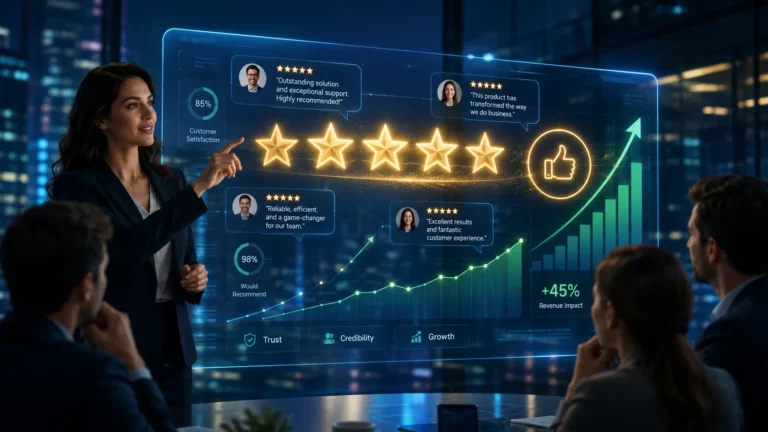
Customer reviews are firsthand accounts from buyers who have used your product or service – shared as text, video, star ratings, or detailed testimonials. They provide real proof that your product or service delivers what it promises. They serve as social proof, a powerful psychological phenomenon where people conform to the actions of others, assuming it’s the correct behavior. The data backs this up: 95% of customers read online reviews before making a purchase decision, and 88% of B2B buyers trust online reviews as much as personal recommendations.
In a sales presentation, these testimonials help overcome skepticism by showcasing the experiences of satisfied customers. Moreover, reviews humanize your presentation. Rather than relying purely on facts and figures, you’re offering a more relatable, emotional perspective. The goal isn’t just telling your potential customers what you can do for them – it’s about showing them how you’ve already benefited others. A one-star increase in rating can lead to a 5–9% boost in sales according to Harvard Business School research – that’s the kind of measurable lift that justifies considering feedback integration as a real discipline that helps improve sales efficiency.
Lastly, customer reviews offer a chance to demonstrate how you handle feedback. By including not just positive, but also neutral or negative reviews followed by how you addressed the issues, you demonstrate transparency and commitment to customer satisfaction. 72% of B2B buyers say negative reviews give depth and insight into a product – illogical but well-documented.
Understanding these strengths of customer reviews helps to realize their role in sales presentations. Now, let’s explore how you can effectively use them to your advantage.
Types of customer reviews: text, video, ratings, and testimonials

Not every customer review carries the same weight in a sales presentation. Understanding the different formats helps you choose the right evidence for the right moment:
| Review type | Format and effort | Best use case | B2B applicability |
|---|---|---|---|
| Text reviews | Most common format - found on G2, Capterra, Trustpilot, and Google. Easy to screenshot and embed into slides. | Quick social proof anywhere in the deck. | High - B2B buyers actively check G2 and Capterra during research. |
| Star ratings and scores | Aggregate metrics (e.g., "4.8/5 on G2"). | Headlines or explanatory blocks are designed to establish credibility at the beginning of a presentation. | High - single-glance credibility for opening slides. |
| Video testimonials | The highest-impact format. Seeing a real customer speak about their experience builds trust far faster than text alone. Takes more effort to produce. | Emotional impact, mid-deck or pre-close. Particularly effective in B2B sales cycles where buying committees need to feel confident. | Very high - converts significantly better than text alone. |
| Detailed case studies | The B2B equivalent of a five-star review. Combines narrative, data, and outcomes into a structured proof point. | Pre-close validation, RFP packets, and proposal documents. | Highest - documented results carry more weight than anonymous star ratings. |
For example, see how Fiona’s AI Chat-Avatar achieved a 40% conversion rate through interactive customer engagement – that’s a documented customer success story you can reference in any presentation.
The best sales presentations use a mix: a headline rating for instant credibility, one or two short text quotes woven into your narrative, and a video testimonial for emotional impact. If you’re in B2B, prioritize reviews from platforms your buyers actually check – documented results like “75% faster onboarding” and “25% faster deal closures” carry more weight than anonymous star ratings.
Selecting the right customer reviews
Not all customer reviews are equally valuable. The selection process is critical to ensuring that the feedback you provide is relevant to your goals. Here are a few tips:
- Look for reviews that support your selling points. If you’re promoting a product’s durability, for instance, look for testimonials that highlight this feature.
- Give preference to a variety of reviews. Different customers appreciate different aspects of your product. Showcasing a variety of experiences will help you connect with a wider audience.
- Prioritize recent reviews. They carry more weight as they reflect the current state of your product or service.
- Match the reviewer with the buyer persona. A VP of Sales who can show measurable results across the sales funnel will impress a sales manager far more than a general positive comment. If you sell to multiple segments, create testimonial sets for each segment.
Strategically integrating reviews into your presentation
Strategically integrating customer reviews into your presentation can make them more impactful. Simply reading a list of testimonials can become monotonous; instead, weave them into your content to maintain audience interest. The average B2B buyer consults 11+ pieces of content before making a purchase decision – your presentation needs to do real work, not just stack testimonials.
- Use reviews to support your claims. If you’re promoting a product feature, back up your claim with a customer review.
- Create a story. People connect better with stories than with statistics. Use reviews to tell a success story about your product or service.
- Avoid overloading your audience. Too many reviews can be confusing. Formulate it briefly and convincingly.
- Place reviews at objection points. Anticipate where skepticism rises in your pitch (pricing slides, feature comparisons, implementation timelines) and include a relevant customer review right there. A review that directly answers “we were worried about installation time, but it took less than a week” neutralizes the objection before it becomes a barrier.
Presenting reviews visually
Presenting your customer reviews in a visually engaging way can make a significant difference. Instead of just reading them aloud, add visual aids to highlight key points and make your presentation more dynamic. G2 reviewers spend more time on G2 listings that include video reviews – the visual format helps keep people’s attention longer.
- Use eye-catching graphics or short videos. These can be particularly effective if the customer has provided a video review.
- Incorporate reviews into infographics showing your product’s features or successes.
- Experiment with different formats. Remember, the goal is to keep your audience interested and engaged.
- Embed interactive content. Instead of a static quote on a slide, consider using a conversational AI assistant to dynamically present customer success stories during a live or asynchronous presentation. This will turn your passive testimonial into an interactive piece of evidence that your audience can engage with.
Authenticity and verification
Transparency and authenticity are keys to building trust. When sharing customer reviews, it’s crucial to be able to verify their authenticity.
- Ask for permission from the customer to use their review. This builds credibility and avoids potential legal issues.
- Where possible, provide verifiable information such as the reviewer’s full name, their location, or their profession.
- Always maintain an ethical approach. Never create or manipulate customer reviews to suit your sales pitch.
- Use third-party platforms as verification. Linking to or screenshotting reviews from independent platforms like G2, Capterra, or Trustpilot gives your claims more weight than self-hosted testimonials alone. Buyers know those reviews go through independent verification processes.
Where to collect customer reviews: platforms by business type
To get started, you’ll need to find the right reviews to use in your presentation. This process looks different for each business, depending on how strong your online reputation is and who your buyers are.
B2B: G2, Capterra, LinkedIn
If you sell to other businesses, focus your review collection efforts where B2B buyers actually research solutions. G2 and Capterra are the two most checked platforms for software purchasing decisions. LinkedIn recommendations are of great importance for services and consulting. Your sales team should be directing happy customers to these platforms specifically – a review on G2 is worth more to your pipeline than five reviews on a consumer platform.
B2C: Google, Yelp, Trustpilot
For consumer-facing businesses, Google Business reviews directly impact local and map visibility. Trustpilot and Yelp serve as independent platforms for verifying information that buyers check before making a purchase. Prioritize the platform where your customers already search for businesses like yours.
On-site: Website testimonials
Start by examining the reviews your business already has. These can be on your website, social media pages, or other third-party review platforms. Review them and select those that highlight the benefits of your product or service and align with the key points you want to highlight in your sales presentation.
How to get more customer reviews
Existing reviews are a great resource, but actively seeking out new reviews will help keep your presentation fresh and relevant. Here’s an example of a strategy that is scalable:
When to ask (timing)
The best time to request a review is immediately after a measurable win – a successful onboarding, a key milestone achieved, or a support ticket resolved well. Don’t wait for quarterly check-ins. The closer the ask is to the positive experience, the higher the response rate.
How to ask (scripts and video requests)
You can use existing feedback, collect new ones, use prompts, and integrate this process into your feedback collection system. Implement a feedback system to collect fresh customer reviews. Once customers have used your product or service for a long time and have evaluated it, contact them and invite them to share their experience.
The most effective review requests are personalized and specific. Instead of a generic “please leave us a review”, be specific about what the client achieved: “You mentioned that your team cut onboarding time in half. Would you mind sharing that on G2?”. This specificity makes it easier to respond to a request and allows you to receive a higher-quality review.
For B2B teams looking to scale personalized requests without manual effort, Pitch Avatar lets you send personalized video messages that feel human – delivered at the right moment in the customer lifecycle, directly through Gmail, Outlook, or LinkedIn.
Automating requests with CRM
Implementing this feedback collection strategy can ensure a constant flow of customer feedback for your presentations, keeping your content dynamic and up-to-date. This will add extra authenticity to your presentation, helping you establish a genuine connection with potential customers.
You might be wondering: “Who has the time and energy to do all this?” The good news is that you don’t have to spend time and effort on this. You can outsource and automate the collection process using the right tool.
The most scalable approach is CRM-triggered automation. Set up workflows in HubSpot, Salesforce, or your CRM of choice to trigger review requests after key milestones – deal closed, onboarding complete, first value delivered. Pitch Avatar integrates with HubSpot and Salesforce to automate personalized outreach, so your team can generate fresh customer reviews without additional manual work.

Turning reviews into marketing assets (video testimonials and case studies)
A great customer review doesn’t have to be posted on just one platform. Turn your best reviews into reusable marketing assets that work across your entire funnel:
- Video testimonials: Ask your happiest reviewers if they’d record a short video. Even a 60-second clip of a customer describing their results outperforms any written testimonial. If scheduling customer video sessions is a challenge, consider using AI-powered tools to create professional video content from written testimonials – AI avatars can help you turn client testimonials into engaging videos without requiring the client to be on camera.
- Case studies: Take detailed reviews with measurable outcomes and expand them into structured case studies with context, challenge, solution, and results.
- Sales deck quotes: Extract the most compelling phrases from reviews and incorporate them directly into your sales enablement materials.
- Social proof snippets: Use review excerpts in email signatures, landing pages, sales pitches, and follow-up sequences.
Common mistakes to avoid
Even the best intentions in a peer review strategy can backfire. Here are the most common mistakes we see:
- Asking too early: Asking for feedback before the customer has experienced real benefit seems premature and often results in generic, unhelpful feedback.
- Ignoring negative reviews: Unanswered negative reviews signal to prospects that you don’t care about customer experience. Always respond.
- Falsification or unfair incentive: Fake reviews destroy trust instantly. Many platforms have detection systems, and the reputational risk far outweighs any short-term benefit.
- Overloading presentations: Too many reviews can be confusing. Three to five well-chosen, well-placed are more effective than a page of twenty.
- Using only text: In a world of video and interactive content, relying solely on text quotes misses an opportunity to build an emotional connection with your audience.
- Not updating: Stale reviews from two years ago raise questions about whether your product has changed. Keep your review arsenal updated.
How to use this guide
Reading about customer reviews in sales presentations is the easy part. Turning this practice into a result that helps build a sales funnel requires three specific steps:
- Audit your current presentations. Find 3 places where you make claims that are not supported by customer reviews. Replace these slides with feedback-based versions. Slides covering pricing, implementation, and competitive comparisons are the most effective to start with – these are where buyers’ skepticism peaks.
- Select relevant platforms. Decide where your team will refer satisfied customers – G2 and Capterra for B2B SaaS, Trustpilot for B2C, Google Business for local customers. Don’t spread review requests across 6 platforms if 2 account for 80% of the buyer’s weight.
- Set up the trigger. Automate the review request from your CRM. Whatever tool you use, the trigger should be tied to specific stages (post-onboarding, post-contract renewal, post-deal closing), not calendar-based.
Conclusion
Incorporating customer reviews into your sales presentations can provide a compelling argument for your products or services, building trust with your audience. With the right selection, integration, presentation, and verification, these testimonials become powerful tools that strengthen your sales pitch and bridge the gap between your brand and its potential customers.
Just remember to always prioritize authenticity and respect for your customer’s experiences. With the right tool, implementing your review strategy becomes easy.
The most effective strategy connects the entire customer journey: from the first interactive product experience that builds buyer confidence, through responsive AI-powered customer support that resolves issues fast, to automated, personalized outreach that captures feedback at the moment of highest satisfaction. When every customer interaction produces results, positive reviews become a natural byproduct – not something you have to chase.