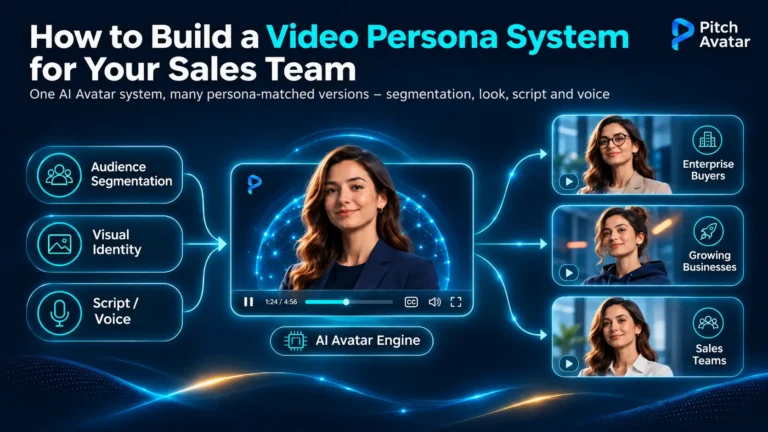
Build ready-to-use scripts and voice profiles for AI avatars, each one matched to a buyer persona.
TL;DR: A video persona system is a matrix of three things working together: audience segmentation, an avatar’s visual look, and a script and voice profile matched to each persona. It exists because generic video has stopped working – 91% of businesses now use video, but the number of marketers who report a good ROI dropped from 93% to 82% in a year, largely due to widespread adoption, which has led to a greater amount of average video content. The solution is audience segmentation instead of increasing video production volume. One critical caveat most guides miss: Gartner found that content customized to individual relevance has a 59% negative effect on buying-group consensus, while group-level relevance improves it by 20%. So vary the content per persona, but keep the shared business case consistent across all of them. Below, we cover how to segment, how to define tone for each persona, how to build interaction scripts, and how to measure which variant actually performs best.
Imagine an experienced car salesperson showing the same sporty crossover to two customers at once: a dad of three and a 22-year-old tech founder. Clearly, he won’t pitch them in the same way. With the dad he’s the calm, patient expert, pointing out how easy it is to get in and out, the trunk’s capacity, the safety ratings, the automatic emergency braking. With the founder, he becomes one of the group, focusing on 0-60 times, matrix LED headlights, and the newest driver assistance systems. No one finds this surprising; it is exactly what people expect, whether the product is shoes, property, books, or washing machines.
So why do so many sales videos in B2B and B2C still sound like they were made by someone who couldn’t care less who’s watching, or who they are, or what they actually need? The opposite extreme, a presenter with the permanent infomercial smile, isn’t any better: it’s exactly the same indifference, just poorly hidden.
The problem is that traditional video lacks flexibility. One polished video takes weeks and a real budget. Ten versions for ten customer types is impossible even for large companies. So most teams settle for the lowest common denominator: a slick, safe, and uninspired video that aims to speak to everyone but connects with absolutely no one.
The good news is that AI makes this compromise unnecessary.
Why Personalized Video Is Now Essential

If you send the same generic sales video to a sawmill, a satellite manufacturer, an ice cream factory, and a game studio, and you’ll likely lose all four within seconds. They can tell it wasn’t made for them.
Video is now a central business communication channel:
- 91% of businesses use video for marketing, matching an all-time high.
- 96% of consumers have watched a video to learn about a product or service.
- 85% say a video has persuaded them to make a purchase.
- 82% of marketers say video gives them a good ROI.
That last figure deserves a closer look, as it represents an 11 points drop from 93% the previous year. The most probable explanation is not that video stopped working. Instead, with 91% of businesses creating videos, much of that content is only average, which pulls down the overall return as more participants enter the market.
Two caveats on these figures, because they are often cited without these details. The study group was small, involving 266 marketers and consumers surveyed in late 2025. And the ROI number indicates confidence rather than actual returns: 67% of those marketers measure ROI by video views, only 32% by direct sales, and 17% do not track their video spending at all.
At the same time, the report shows that 84% of consumers want more video content from brands, and 89% say that video quality directly affects how much they trust a brand. On one hand, reported ROI is dropping; on the other, demand for more and better video is rising. Both trends suggest the same thing: the problem is not the video format itself, but its lack of diversity (We cover the full dataset in our roundup of video content statistics).
People now ignore generic sales pitches, so the quickest solution is to segment videos to specific buyer personas. While the evidence for personalized marketing is encouraging, it is thinner than marketers often suggest. The most frequently cited statistic comes from Terminus, an ABM company. Terminus added personalized video into its outbound campaigns and recorded a 40% higher open rate, a 37% higher click rate, and a 216% higher response rate – more than three times their usual reply rate.
The difficulty is in production. Creating dozens of customized videos for each segment manually is an arduous task, requiring many voice actors and a substantial budget. Wyzowl’s data confirms this: among marketers who do not use video, 24% say it takes too much time, another 24% say it costs too much, and 10% don’t know where to start.
The practical answer arrived only recently: a structured video persona system built on AI avatars.
What is a Video Persona System?
First, what it isn’t: a library of good-looking AI avatars. A video persona system is a structure built on three parts working together:
- Audience segmentation
- The avatar’s visual identity
- The script and voice profile of the persona built on that avatar
Instead of sending a prospect a static slide deck or a demo recorded three years ago, you can send an interactive AI avatar. It doesn’t just read a script. It speaks to one specific person in their own language, with the right pace, energy, and arguments.

Step 1. Segment Your Audience Into Key Personas

Don’t try to cover twenty different buyer types right away. You’ll drown in detail. Start with the three or four sales personas your team meets most frequently.
Say you sell complex cloud software to businesses. Your typical decision-makers might include these profiles:
- The Tech Lead (CTO, IT Director). This person focuses on architecture, security, SLAs, and easy integration. They are naturally skeptical and have no time for marketing jargon.
- The Numbers Person (CFO, Commercial Director). This individual prioritizes ROI, total cost of ownership, time to value, and risk. Pragmatic. Thinks in terms of spreadsheets.
- The Operator (small business CEO, department head). This person needs a simple interface that a beginner can use and quick results. They rely on intuition and value ease of use and their own time.
Each of these segments receives its own persona profile.
Step 2. Define Tone of Voice and Delivery for Each Persona
One of the most common mistakes is giving every avatar the same message and only changing the face. Each persona needs its own delivery style, pace, and emotional tone.

| Persona | Look | Tone | Sample line |
|---|---|---|---|
| The Tech Lead | Understated, polished "engineer" look | Calm, confident, measured. No fake excitement, no exaggerations | "Let's skip the intro and go straight to the architecture and encryption." |
| The Numbers Person | Sharp business clothes | Clear, focused, professional. Steady pace, deliberate pauses on key figures | "Let's discuss the finances: here's how the system reduces operating costs in the first quarter." |
| The Operator | Friendly, energetic, expressive | Optimistic, warm, conversational, with a smile in the voice | "Imagine your team getting back three hours daily that they now spend on manual data entry." |
Pitch Avatar gives you precise control over these details. You’re not just picking a voice: you can set its emotional tone to fit the moment. This means you can make it sound more persuasive, gentler, more understanding, or purely professional. You can also clone a real rep’s voice so the familiar delivery style carries over when an avatar delivers a video.
Most Important Caveat: Customize the Presentation, Not the Facts
This key discovery should shape all the points mentioned above, yet it is rarely discussed in guides on this topic.

- Adjust the presentation. This includes the entry point, focus, examples, wording, sequence in which you address concerns, and delivery’s tone and speed.
- Keep the key information consistent. The business case, financial figures, product claims, pricing structure, and proof points should remain identical in all versions.
A CFO and a CTO should agree on your company’s value proposition, even if they reach that understanding through different paths. If they leave with different ideas about your value, your persona system will create the very internal conflict that stops deals. Design your approach so that different entry points lead to the same conclusion.
Step 3. Build Interaction Scripts

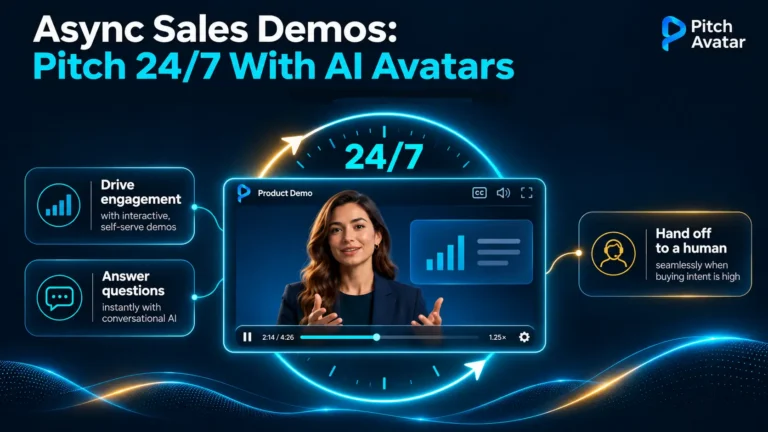
A typical video is like a train on a fixed route: viewers either watch it all or stop early. An interactive avatar changes this into an experience where you choose your own journey.
- Greet and qualify. The avatar says hello and asks a qualifying question on screen: “What is more important to your company right now: reducing infrastructure costs or helping your team work faster?”.
- Switch the script. Based on the click, the system switches the script, adjusts its delivery, and jumps to the relevant part of the presentation based on the viewer’s selection.
- Answer questions on the spot. If a viewer has a question, they don’t get sent to a generic contact form. Right in the player, a chat avatar can answer, or a live sales rep can join the discussion.
Personalization goes beyond just merging a first name. It becomes a genuine two-way interaction.
Step 4. Add It to Your Sales Funnel
A good video persona system fits the sales stack you already have:
- Inbound leads. When someone fills out a form, instead of a generic thank-you page, they see a brief avatar video customized for their industry. This video lets them choose a topic for a quick demo.
- Outbound sequences. Sales representatives can send personalized links to interactive pitches through cold emails or LinkedIn messages.
- Sales proposals. Instead of a 20-page PDF that no one reads, clients receive an interactive presentation with an avatar guiding them through the content.
Each part of the process needs a clear next step. Our guide on high-converting video calls to action explains how to write and place them.
Step 5. Measure Which Personas Actually Work

Most teams build a persona system and then never find out which versions actually deliver results. Include measurement from the start, because you can test different persona variations in a way that was never possible with a single, generic video.
Here are some metrics to measure for each persona:
| Metric | What it tells you |
|---|---|
| Completion rate by persona | Shows if the tone and length fit that audience |
| Branch selection split | Whether your segmentation matches reality, or whether everyone chooses the same branch |
| Drop-off point by variant | Identifies which argument causes a specific persona to disengage. |
| CTA click rate by persona | Whether the suggested next step you offered fits their current stage |
| Reply or booking rate | The only number that definitively proves success |
Run two diagnostic checks early on. If one content gets almost all the clicks, your personas are not real segments – they are essentially one segment with minor differences, and you should combine them. Also, if a persona’s completion rate is high but their CTA rate is low, the content resonates, but the call to action isn’t right for that buyer. This is a much simpler problem to fix than rewriting the entire script.
Start with three personas. After one quarter, keep the two that perform best, and use those learnings to develop the next one. A persona system that goes unmeasured just multiplies the effort for content creation without improving results.
Three Mistakes that Can Sink the Whole Thing

Making the avatar seem human. Don’t present an AI avatar as if it were a real staff member. For example, avoid saying, “Here’s our sales manager, live from the office!” People will recognize it is not real, and it costs you trust. It is more straightforward and works better to introduce the persona as an AI assistant designed to save the potential customer time and answer their questions instantly.
Using corporate jargon. If your script begins with phrases like, “In the current competitive market, our advanced product…”, no avatar can save it. Write as a bright, personable individual with a sense of humor would speak. This is especially true for drafts generated by AI: they should be carefully edited.
Forgetting the call to action. Each interaction should end with a clear next step: book a demo, get a quote, download a case study, or buy now. A video persona without a CTA is just an expensive screensaver.
Summary
The first thing salespeople worry about when AI avatars come up is simple: “Will these replace us?”.
In reality, the opposite is true. A video persona system handles the most exhausting, repetitive part of the job: delivering the same intro pitch for the hundredth time, answering the same common questions, and performing initial lead qualification.
With AI personas managing the front line, your team receives leads that are already filtered and interested instead of cold prospects. This frees up reps to focus on what humans do best: building relationships, negotiating complex deals, and closing big deals.
You can set up such a system with the right tools in just a few days. The real change lies in perspective: stop seeing video as a static showcase for your product. Instead, use it as an adaptable, scalable part of your sales operation.
Want to create one? Book a demo to see how the persona matrix works with your own content.
Frequently Asked Questions
A video persona system combines three elements: audience segmentation, an avatar’s visual identity, and creating a script and voice profile matched to each persona. Instead of making one generic video for everyone, you create different versions that speak to each buyer group’s unique language, tone, and main concerns. Using AI avatars means that producing each additional version takes only minutes instead of another full video shoot.
Begin with three or four personas, focusing on the decision-makers your team most frequently interacts with. Creating twenty personas is more of a planning exercise than a practical system. Run with three personas for a quarter, track their performance, keep the successful ones, and then introduce the next persona based on what you learned.
It can, if you customize the wrong aspects. Individual-level relevance decreases group consensus by 59%, while relevance at the group level increases it by 20%. Adjust the framing, emphasis, examples, and tone for each persona, but keep the business case, numbers, and proof points remain identical across all versions. Think of it as providing different entry points to the same discussion.
To determine which persona performs best, compare the completion rate, how interactions are chosen, where users stop engaging, the click-through rate for calls to action, and replies or bookings rate across different versions. Two quick checks: if one interaction gets almost all the clicks, your personas are not real segments. If completion rate is high but CTA click-through rate is low, it means your content is effective but your CTA is poorly designed.
Yes, you should. If you try to present an avatar as a real employee, you risk losing trust once people realize it’s not real – and they certainly will. Instead, introducing it as an AI assistant that provides instant answers and helps avoid endless negotiations is more truthful and effective.