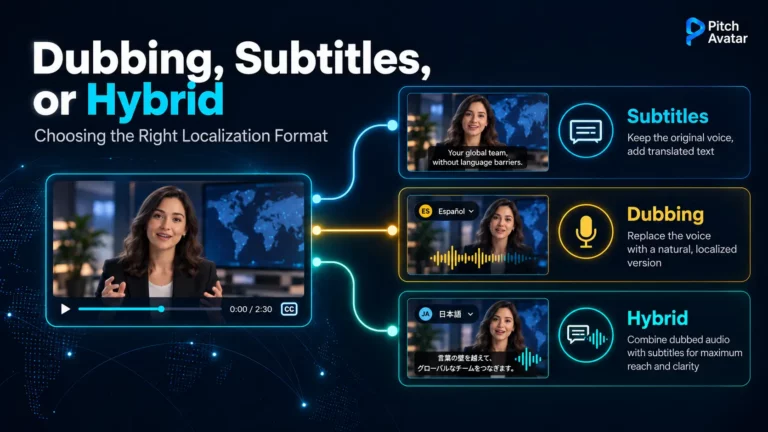
A decision matrix for choosing the right format based on channel, audience, and budget.
TL;DR: There is no single best localization format – there is a right one for each job. Subtitles are fast, cheap, and indexable, but they tax attention: viewers cannot read text and absorb complex visuals at once. Dubbing removes that load and builds the strongest connection, at the highest cost. Hybrid (AI voiceover plus synced subtitles) is the practical default for scalable B2B. Choose using three factors: the distribution channel, how your audience actually watches, and the economics of the project. The matrix below maps those to a format. And before you ship anything, remember that in regulated markets captions are a legal requirement, not a stylistic choice.
Video is winning the global content game on sheer volume, and losing itself, over and over, in the labyrinth of language and culture. Any company selling internationally knows that creating a good video is at best half the job. Considerable effort must be put into ensuring that a video effectively conveys its message in the viewer’s native language. Skip that part and they’ll close the tab in seconds.
For years, choosing between subtitles and dubbing meant a hard trade-off: budget limits on one side, frustrated viewers on the other. Subtitles kept production cheap but cost you audience engagement. Dubbing provided a superior viewer experience but was expensive due to the costs of voice actors and studio rentals.
AI tools are now part of everyday workflows, you’d think the problem was solved. In most projects, you no longer need manual subtitle synchronization or professional dubbing studios. But the confusion hasn’t gone away. When are good subtitles enough, and when do you need dubbing? When is a hybrid worth the effort, and when will one format do? When is a single voice fine, and when do you need multiple voices with voice cloning? You need to determine where you can save money during the localization process, and where such savings could lead to the loss of a major client. I will describe these options.

Why Language Still Matters and Why Text Is Necessary
Three Options: Pros, Cons and Hidden Traps

Before examining the matrix, here is a realistic, non-marketing assessment of each format.
1. Subtitles: fast and cheap, with a cognitive tax
Subtitles are every budget-conscious manager’s favorite. They’re easy to generate, synchronize, and edit, and search engines index them well. For a long time, their big advantage was preserving the speaker’s original voice, with all its charisma and natural delivery. That was important for personal and expert branding. But now AI tools can clone a speaker’s voice and produce full AI dubs, that advantage carries much less weight.
The main downside: split attention. We cannot read text while processing detailed visuals at the same time. This is not just intuition – a mixed-methods eye-tracking study showed that viewers who watch subtitled video with the sound off experience measurably higher cognitive load along with reduced comprehension, immersion, and enjoyment. Participants described the silent versions as “soulless” and “bland.” If your video has complex graphics, software screens, slides, or small details, viewers have to choose between the text at the bottom and the picture above it. Something is being missed, and it may be the very point you wanted to make.
2. Full dubbing: the premium experience
Dubbing removes cognitive load. Viewers watch and listen as if the video were made in their native language. It creates the strongest emotional connection and builds trust, especially in conservative industries or markets where high product quality is expected. And with AI, you can now get high-quality dubbing that clones the original speakers’ voices, generated at the same time as the translation.
The main downside: even though technology has made dubbing faster, simpler, and cheaper, it’s still the slowest and most expensive option. It’s nothing like the days of booking studios and hiring production crews. But businesses now need a much higher volume of video content than in the past.
3. Hybrid: the tech-powered middle ground
A hybrid combines an audio track, usually a synthetic or cloned AI voice, together with subtitles. More advanced versions add interactive elements too. Viewers can watch videos without sound in public or turn on the sound in private places.
The main downside: hybrid versions are usually generated automatically, so they often contain mistakes in both the text and the audio. Voiceovers often have issues with intonation and word stress. Correcting these errors manually is a slow process, which makes the quality assurance checklist provided below necessary.
One Voice, Many Voices Or a Cloned Voice?

The format question has a second half that often gets skipped: whose voice should be heard?
- A single synthetic voice is suitable for internal training, knowledge bases, product tours, and anything where the content matters more than the presenter. It’s the cheapest option, and no one expects a strong personality.
- Multiple distinct voices are used for videos that have more than one speaker, such as interviews, panel discussions, or role‐play scenarios. Using one voice for several speakers confuses viewers quickly.
- A cloned voice is suitable when the speaker delivers the main value. This covers sales videos from a founder, expert explanations, personal‐brand content, and executive communications. If a prospect has met your CEO or heard them on a podcast, hearing a stranger’s voice in the localized version will be distracting.
The practical rule: clone the voice when the person is part of the message, and use a stock voice when they are not. And get documented consent before cloning anyone’s voice – this is required for ethical reasons and is becoming a legal requirement.
Captions Are Sometimes Not Optional
Before considering the matrix, you need to handle a constraint that overrides preferences. In some markets, captions are a legal requirement rather than an optional format.
- The European Accessibility Act has been in force since June 2025. This legislation imposes accessibility obligations on a wide range of digital products and services sold within the EU.
- In the United States, ADA Title II designates WCAG 2.1 Level AA as the standard for state and local government web and mobile content. Compliance deadlines for these regulations have been extended until 2027 and 2028.
- WCAG serves as the standard that most of these laws reference. It mandates the presence of captions for prerecorded audio content.
If your video is intended for audiences in regulated markets or the public sector, the decision is not “subtitles or dubbing”, but “dubbing plus subtitles” as subtitles are mandatory regardless of the audio version you provide.
The Decision Matrix

Choosing a localization format shouldn’t be based on the preferences of your executives, marketers, or art director. It should be determined by three factors: the distribution channel, how your audience consumes content, and the project’s economics.
| Factor | Scenario | Best format | Why |
|---|---|---|---|
| Channel | Social and short-form (TikTok, Reels, Shorts, LinkedIn feed) | Subtitles with bold, dynamic text, or hybrid | Viewers scroll while traveling, on public transport, or during meetings. You have ~1.5 seconds to hook them with text. Full dubbing is usually unnecessary here because most users keep the sound muted. |
| Channel | B2B presentations, pitches, cold outreach, landing pages | Dubbing or hybrid | A prospect who opens a video proposal is ready to pay attention. Subtitles make decision-makers read small text instead of absorbing your value. Providing dubbing in their native language can significantly increase conversion. |
| Channel | Training, webinars, knowledge bases, product tours | Hybrid: dubbing plus subtitles for key terms | Effective learning depends on correct terminology. Voice-overs in the native language convey the overall logic, while subtitles help viewers remember technical terms, function names, or code. |
| Content | Visually dense video (software demos, technical drawings, charts) | Dubbing or voiceover only | Asking viewers to follow a cursor across a chart while reading subtitles is a sure way to frustrate them and lose them. |
| Content | Interviews, talking heads, expert monologues, video podcasts | Subtitles | The visual remains static and the focus is on the speaker. Bottom?placed text does not conflict with the visuals, and the speaker retains voice and charisma. |
| Budget | Focused entry into a high-value Tier-1 market | Full, polished localized dubbing | The size of the deal justifies the cost. Mistakes or sloppy subtitles can damage your product's reputation among premium buyers. |
| Budget | Testing 10+ new markets at once | AI dubbing with auto-generated subtitles (hybrid) | Using studio dubbing to test a hypothesis is financially self?defeating, and subtitles alone receive a weak response in B2B. With AI platforms, you can release presentations in ten languages ??in just a few hours and identify where the real demand is. |
Before You Send: a QA checklist for AI Localization

AI localization is fast, which makes it tempting to publish content without checking. The errors it produces are usually minor and specific, and a quick check will catch most of them.
- Names and brands. Synthetic voices frequently mispronounce product names, company names, and people’s names. You should listen to each one.
- Numbers, units, currency, and dates. Entries like “$1,000” and “1.000 $” can have different meanings in different markets, and date formats may be reversed in different regions.
- Technical terminology. Create a glossary before beginning the translation. Using three different variations of the same term in one video reduces the content’s effectiveness.
- Intonation and stress. Listen to the full audio once. Applying incorrect stress to a key word is the most frequent indicator of an unreviewed AI dub.
- Subtitle timing and line length. Make sure the text matches the speech and subtitles don’t cover on-screen graphics or existing labels.
- Cultural fit. Idioms, humor, sports metaphors, and local references are frequently distorted during translation. Localization demands an understanding of context and language.
- Native speaker review for critical content. When targeting a primary market or a specific client, be sure to involve a native speaker in proofreading the text. This is an affordable way to avoid a negative first impression.
Localization Economics Have Changed
Previously, you needed to decide between costly studio dubbing for high quality and cheaper subtitles for average results. AI tools created for this purpose have altered those options.
Take a typical B2B marketing task. You need to send a personalized video presentation to partners in Japan, Germany, and Brazil. Until recently, this meant finding three voice actors and editing three versions, or sending a video in English and hoping clients spoke it well enough or that subtitles would help.
Pitch Avatar removes those delays. You can translate and generate accurate AI voiceover in 70+ languages, while preserving a human connection via a digital avatar or an adapted presenter. Pitch Avatar also automatically generates synchronized subtitles, giving you a ready-made hybrid format.
There’s one more difference from a standard video file. A video made or dubbed in Pitch Avatar becomes an interactive tool. Viewers can switch language tracks, ask questions to a Chat-Avatar inside the player, click built-in CTAs, and even bring a live sales rep into the conversation.
Summary
Modern video localization strategy does not demand selecting a single format. You should apply the specific tool needed for each task:
- Subtitles still rule social media, short promos, and expert videos where the original speaker’s voice matters.
- Full dubbing is the norm for complex presentations, long product demos, and high-value deals at the closing stage.
- Hybrid is the default for scalable B2B marketing, training, and international sales.
AI platforms like Pitch Avatar turn localization from a headache into a simple, repeatable workflow. Today, even a small business can communicate with customers in their own languages without large budgets or complex production processes, and localize video as fast as the market moves.
Frequently Asked Questions
Neither is better in general – the choice depends on the channel and the content. Subtitles are appropriate for social feeds, talking-head videos, and any material where the speaker’s voice adds value. Dubbing works well for visually intensive content (software demos and charts), for long-form presentations, and for important deals, as it eliminates the need to read text while viewing. For most scalable B2B projects, the practical default option is a hybrid that combines AI voiceover with synchronized captions.
When the visual is simple and the voice is important. Interviews, expert monologues, podcasts, and short social clips all perform well with subtitles only, because visuals don’t compete for attention, and viewers scrolling with the sound off need the text anyway. Don’t use subtitles only for software demos or any content with dense on-screen detail.
It consists of a localized audio track (typically a cloned or synthetic AI voice) paired with synced subtitles in the same language. This supports both viewing modes: muted scrolling on a phone and full attention at a desktop. More advanced versions add interactive features like clickable CTAs or language switching inside the player.
Clone the voice when the person is part of the message: founder-led sales videos, expert explainers, executive communications. Use a stock synthetic voice when the content outweighs the messenger, for example in internal training, product tours, and knowledge bases. Always obtain documented consent before cloning anyone’s voice.
The European Accessibility Act has been in effect since June 2025, and in the US, ADA Title II mandates WCAG 2.1 Level AA for state and local government digital content, with compliance deadlines extending through 2027 and 2028. WCAG requires captions for pre-recorded audio. If you sell to regulated markets or the public sector, consider captions mandatory rather than optional.
Brief QA check: verify names and brands, numbers, currency and date formats, and technical terminology against a glossary; listen once for incorrect intonation or stress; check subtitle timing and ensure the text does not overlap on-screen graphics; and also analyze cultural references that may be untranslatable. For Tier-1 markets or key clients, additionally involve a native speaker for verification.