TL;DR: The future of video dubbing is multilingual by default, AI-driven, and rapidly moving toward real-time production. AI dubbing is already reducing localization costs by approximately 70–90% and shortening the process from weeks to days, with the technology advancing in five areas: visual (lip-sync) dubbing, real-time dubbing for live content, hyper-personalized dynamic audio, emotion and prosody preservation, and ethical frameworks for voice cloning. Market size estimates vary widely depending on how the segment is defined, but every research firm predicts strong double-digit growth or growth of more than 40%+ annual growth through the early 2030s. For businesses, the practical question is no longer whether to adopt AI dubbing, but how to quickly scale it – the tools (visual dubbing, voice cloning, real-time translation) already exist today, not as future capabilities.
Understanding the Current State of AI Video Dubbing
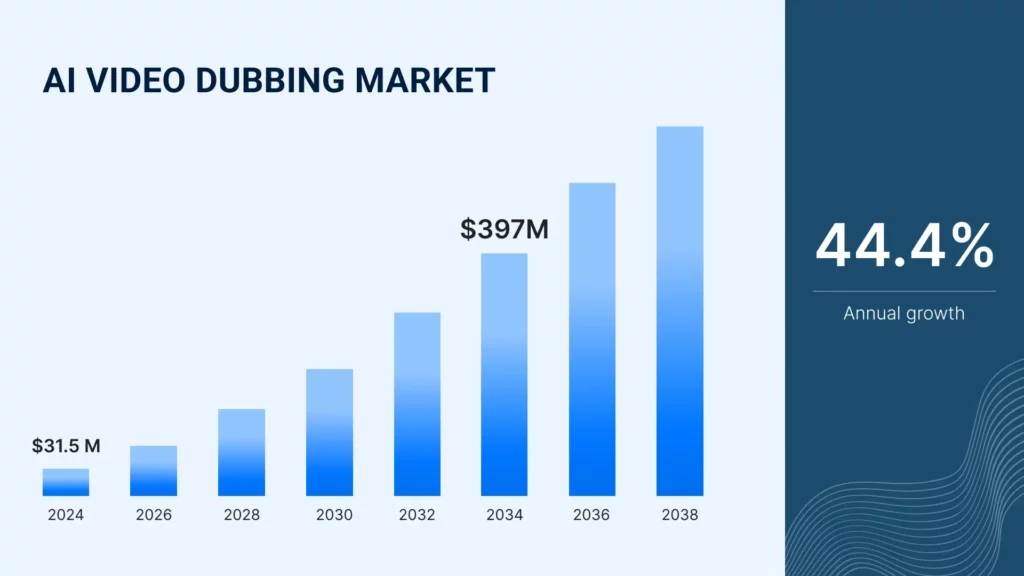
The AI video dubbing market reached $31.5 million in 2024 and is projected to reach $397 million by 2032 (IntelMarketResearch), with an average annual growth rate of 44.4%. This expansion indicates how organizations worldwide are adopting AI dubbing to meet global content demands. The technology combines speech recognition, neural translation, and voice synthesis to create localized audio tracks that maintain the original speaker’s tone and rhythm across multiple languages.
AI dubbing can reduce production costs by up to 90% and cut production times from months to days, removing one of the biggest barriers to global communication. What once required weeks of studio work with voice actors can now be completed in hours, making international content distribution accessible for organizations of all sizes.
Breaking Down Language Barriers: The Democratization of Content
The trajectory of the video industry suggests that language barriers as an obstacle to content consumption will virtually disappear in the near future. The concept of “Foreign Language Film” may become obsolete. Content will simply become “Content“, accessible to anyone, anywhere, in their native language.
This shift expands the opportunities for so-called “Global Content Creators” – an individual in Omaha can now build a fanbase in Osaka without the million-dollar localization costs that once served as barriers to entry. Generative AI has removed these financial barriers, allowing content creators and companies to reach international audiences without traditional budget constraints.
Of course, the revolution in artificial intelligence has democratized more than just entertainment content creation. Thanks to it, even organizations with the most modest budgets now have the opportunity to deliver marketing, educational, corporate, and other materials to a global audience. First of all, we are talking about the most popular video format today. Previously, such opportunities for business expansion were only available to large companies that could afford to allocate significant funds for content localization.
Key AI Dubbing Trends Shaping 2026
Trend 1: Visual Dubbing: Matching Lips to Audio
Visual dubbing, sometimes called “vubbing”, represents a significant advancement in video localization technology. Unlike traditional dubbing, which adjusts the audio to match the existing video, visual dubbing modifies the video to match the audio track.
The Technology: Using Neural Radiance Fields (NeRFs) and Generative Adversarial Networks (GANs), AI systems can reconstruct the lower part of an actor’s face. When dubbed audio requires an ‘O’ mouth shape, the AI reconstructs the lips to form an ‘O’, integrating it with the rest of the face in a way that appears natural to viewers.
The Impact: This technology addresses the disconnect viewers experience with traditional dubbing, where mouth movements don’t match spoken words. By synchronizing visual lip movements with audio, viewers subconsciously perceive the speaker as a native speaker, which research suggests increases viewer trust and engagement.
Current Limitations: While the technology shows promise, it still faces challenges in processing complex facial angles and maintaining consistency over long video sequences. These technical barriers are expected to decrease in 2026 as computing power increases and algorithms improve.

Trend 2: Real-Time Dubbing for Live Content
The industry is shifting from post-production dubbing to live streaming capabilities, where translation and speech synthesis are performed simultaneously with content creation.
Live Translation: Processing latency is approaching near-zero levels. Platforms like Twitch, YouTube Live, and Zoom are developing native language selection features that allow viewers to choose their preferred language, with the speaker’s voice translated and synthesized in real-time as they speak.
Technical Requirements: This capability requires substantial computational power to process translation, voice synthesis, and audio synchronization within milliseconds. Edge AI computing (where processing occurs on local devices instead of remote servers) is becoming sophisticated enough to handle these demands. However, maintaining quality while achieving real-time processing remains a technical challenge that developers continue to resolve.
Applications: Real-time dubbing opens new possibilities for international conferences, live educational streams, and global business presentations, eliminating the need for separate language-specific sessions or delays for translation.
Trend 3: Hyper-Personalization and Dynamic Audio
Marketing strategies are evolving from broad broadcast to targeted, niche broadcasting with AI dubbing, enabling unprecedented levels of personalization.
Dynamic Audio Insertion: AI systems can insert variable data into video audio tracks automatically. A single sales video template can be customized so that AI seamlessly inserts the prospect’s name (“Hi Sarah…”) and company details (“…I see Tesla is growing…”) into the audio, matching the original voice characteristics perfectly.
The Business Case: This programmatic approach to dubbing can increase conversion rates in B2B outreach. Instead of creating hundreds of individual videos, companies can generate personalized versions based on one main video. Integration via API platforms makes this approach scalable for sales teams managing large lead databases.
Implementation Considerations: Success requires clean data management and thoughtful scripting to ensure personalized elements integrate naturally into the broader message. Organizations must also consider privacy implications when using customer data for personalization.

Trend 4: Emotion and Prosody Preservation
The most advanced AI dubbing systems will focus on emotional authenticity. Early AI dubbing tools translated words accurately, but they lost the speaker’s emotional tone – the sarcasm, excitement, or hesitation that conveys meaning beyond a literal translation.
Advanced Prosody Modeling: New systems analyze pitch variation, speech rhythm, and emotional tone in the source audio, and then reproduce these patterns in the target language. This means that a joke delivered ironically in English retains that rhythm and tone when dubbed into Japanese or Spanish. The AI doesn’t just translate words – it translates intent.
Accent and Dialect Handling: AI dubbing systems will offer detailed dialect selection. Instead of the standard “Spanish” option, users will be able to choose between Castilian, Mexican, Colombian, or Argentine variants, each featuring authentic regional pronunciations and colloquial expressions.
Trend 5: Voice Cloning Ethics and Industry Standards
The ability to accurately clone voices opens up both new opportunities and creates additional responsibilities. The potential for abuse in fraud and deepfakes has prompted the industry to develop ethical standards.
The Ethical Standards: The industry is converging around principles of “Consent & Compensation” as core requirements for voice cloning technology.
Voice Banking: Actors and speakers can “bank” their AI voice representations and receive royalties when their voice clone is used in productions. This model protects voice talent while enabling efficient content production at scale.
Watermarking and Authentication: Audio files increasingly contain digital watermarks that verify their origin. The Coalition for Content Provenance and Authenticity (C2PA) provides an open technical standard for publishers, creators and consumers to establish the origin and edits of digital content (C2PA). These standards allow us to verify that audio was generated using legitimate tools and not the result of unauthorized deepfake operations.
Regulatory Landscape: Regulations are developing to require disclosure when content is AI generated. Organizations should expect transparency requirements regarding AI-generated audio content, particularly in the European Union (where the AI Act’s Article 50 takes full effect August 2026) and the United States, where copyright laws are adapting to the challenges of AI-generated media content (IntelMarketResearch).
Industry Applications and Use Cases
E-Learning and Education
Educational institutions and corporate training departments benefit significantly from AI dubbing. Training modules can be localized into multiple languages simultaneously, ensuring consistent information for all employees worldwide. Global companies report performance improvements when they deliver training in multiple languages simultaneously, as faster localization creates more cohesive and productive teams.

Entertainment and Media
Streaming platforms are actively testing AI dubbing. Amazon’s Prime Video launched an AI-aided dubbing pilot in March 2025, initially covering 12 licensed movies and series in English and Latin American Spanish, using a hybrid model in which AI handles the initial work and localization professionals review for quality. Netflix and other platforms have publicly discussed using AI within their localization processes. The general trend is for AI dubbing to be implemented cautiously, for licensed or catalogued content, while maintaining human quality control and cultural accuracy.
Corporate Communications
Global organizations use AI dubbing for CEO messages, company announcements, and internal communications. A single executive recording can be distributed to international offices in local languages while maintaining the executive’s recognizable voice characteristics, which helps strengthen organizational cohesion.
Marketing and Sales
Marketing teams use AI dubbing for campaign localization and personalized outreach. Early adopters have documented measurable improvements, with reports of 22% higher click-through rates on advertisements localized with AI-dubbed language tracks.
Content Creators and Influencers
YouTube creators, online educators, and social media influencers use AI dubbing to expand their audience reach without learning new languages, and many report meaningful subscriber growth after localizing their content archives into additional languages
Implementation Considerations for Businesses
Cost Analysis
Traditional dubbing involves several levels of costs: voice-over artists’ fees, studio rental, directing, editing, and project management. Each additional language multiplies these expenses. AI solutions reduce costs by 70-90% compared to traditional dubbing methods, making localization cost-effective for content that previously could not justify the expense.
Organizations should still consider the full cost picture: AI dubbing platforms typically charge based on usage volume, require technical integration, and may require quality assurance processes. The ROI becomes clear when comparing the cost of covering ten markets using AI with the cost of traditional dubbing, even for two languages.
Technical Requirements and Implementation
Large-scale implementation of AI dubbing requires specialized infrastructure:
Computational Resources: Cloud-based processing handles most needs, but organizations producing high volumes of content benefit from dedicated GPU instances. A typical 10-minute video requires 15-30 minutes of processing time on standard infrastructure.
Audio Quality Standards: Source audio should be recorded at a minimum of 48kHz/24-bit with isolated voice tracks. Background music and sound effects should be on separate tracks when possible, as this allows the AI to replace dialogue without affecting other audio elements.
Integration Points: Enterprise implementations typically integrate via API with existing video management systems, learning management platforms, or content delivery networks.
Quality Metrics and Benchmarks
Organizations should measure AI dubbing performance across several parameters, using standard evaluation metrics used in this field:
Translation accuracy: Professional human review of content samples is the standard verification. AI translation quality is high for the main language pairs (English, Spanish, French, German, Japanese, Chinese) and lowest for idioms, regional dialects, and specialized terminology – this is where human verification is concentrated.
Voice naturalness: Measuring using Mean Opinion Score (MOS) testing, where listeners rate a voice quality on a 1–5 scale (the ITU-T P.800 standard). Modern AI dubbing demonstrates good naturalness, but is generally still inferior to human dubbing and original recordings – the gap is narrowing but remains realistic, so emotionally charged content still benefits from human dubbing.
Lip-sync accuracy: For vubbing applications, more accurate synchronization of audio and video is perceived better by viewers; small synchronization errors become noticeable to viewers, so long sequences and complex facial angles remain the most problematic cases for modern systems.
Preparing Your Organization for AI Dubbing
For businesses, a “wait and see” approach risks falling behind competitors who are already building global reach through AI localization. Tools for content globalization (visual dubbing, voice cloning, real-time translation) are already in use today and are not future features.
Organizations can prepare by:
- Start with Archive Content: Test AI dubbing on existing video libraries. This presents minimal risk while building internal expertise and work processes.
- Set Quality Standards: Determine which content types require human review, which can be fully automated, and how to handle brand-critical messaging.
- Train Content Creators: Teams should understand how to produce “dubbing-friendly” content – clear speech, minimal overlapping dialogue, proper audio separation.
- Build Infrastructure: Integrate AI dubbing into your production processes now, not as an afterthought. By implementing these workflows today, organizations can create the infrastructure for a cross-border brand presence, ensuring they speak everyone’s language.
By developing these capabilities now, organizations can compete effectively in an increasingly global digital marketplace where languages are no longer a barrier to audience reach.
Conclusion: The Polyglot Future of Video
The future of video will be multilingual by default. Today, viewers expect all brands and companies to communicate with them in their native language. Organizations that are unable to localize their content effectively will face artificial limitations on their reach. Technologies that enable brands to meet audience expectations (AI dubbing, visual synchronization, voice cloning) already exist and are rapidly evolving.
Organizations that implement AI dubbing into their processes are creating the infrastructure for unlimited brand presence. Very soon, they will be speaking all languages, while their competitors will struggle to catch up. The question is not whether to implement AI dubbing, but how quickly to scale it to the level of a strategic advantage.
Frequently Asked Questions
Visual dubbing (or “vubbing”) is AI technology that modifies lip movements in video to match the dubbed audio track, creating natural synchronization between what viewers see and hear.
Real-time dubbing is in advanced development for live streaming platforms and video conferencing. Limited implementations exist today, with broader mainstream availability expected as latency and quality challenges are resolved.
AI voice clones are legal when you own the voice rights or have explicit permission from the voice owner. Non-consensual voice cloning faces legal restrictions in many jurisdictions, with regulations continuing to develop.
AI is expected to handle high-volume, informational content where speed and cost matter most. Human voice actors will continue to perform premium creative work where emotional nuance and artistic interpretation add significant value.
Currently, minor symmetry irregularities or the absence of natural breathing sounds may indicate the use of AI for dubbing. As the technology improves, digital detection tools and watermarking standards like C2PA will become necessary for verification.
Hyper-personalization uses AI to insert specific names, company details, or other variable data into a video’s audio track, creating customized versions for individual viewers or customers.
Enterprise-grade AI dubbing platforms implement data protection protocols and ethical cloning practices suitable for business use. Organizations should verify security certifications and data handling policies before implementation.
Large Language Models (LLMs) are responsible for translation and natural language processing, while Generative Adversarial Networks (GANs) and Neural Radiance Fields (NeRFs) provide speech synthesis and visual modifications. These technologies work together to create comprehensive dubbing solutions.