TL;DR: Agentic AI is artificial intelligence that autonomously pursues a goal by breaking it into steps, planning actions, using external tools, and adapting as it goes – with minimal human supervision. The key difference: generative AI is reactive (it answers a prompt, then stops), while agentic AI is autonomous within a specific process (it plans and acts). This is achieved using AI agents – individual software units that perform each task.The technology is moving fast: Gartner predicts that by 2028, 33% of enterprise software applications will include agentic AI, up from less than 1% in 2024, with at least 15% of daily work decisions made autonomously. But the same data urges caution – Gartner expects more than 40% of agentic AI projects to be canceled by the end of 2027 due to cost, unclear value, and risk controls. This guide explains what agentic AI is, how it differs from generative AI and from AI agents, and where businesses actually use it.
Just as we were getting used to generative AI (which writes and edits text, creates images and videos, helps analyze data, and performs intelligent searches), a new form of artificial intelligence has emerged: agentic AI. And it is developing very quickly. Gartner predicts that by 2028, 33% of enterprise software applications will include agentic AI, up from less than 1% in 2024, with at least 15% of day-to-day work decisions made autonomously. The Pitch Avatar team has prepared this guide to explain what agent AI is, how it differs from other AI models, and how companies are actually using it, answering the most common questions on the topic.
Generative AI vs Agentic AI: What's The Difference?
Generative AI, built on large language models (LLMs), works on a simple principle: query → response. It reacts to a user’s request, then searches for information and generates content. It does not take independent action outside of a dialogue (for more information on this, see our guide on how to use generative AI).
Agentic AI is different. It is a system that can act autonomously, performing sequences of actions and reasoning in a human-like way. Usually, these are specialized tools.
Within the framework of the assigned tasks, they can:
- Identify a specific goal.
- Break it down into steps.
- Plan actions.
- Use external tools.
- Interact with humans, other systems, and other agents.
- Adjust their actions as they complete the task.
Simply put:
- Generative AI is a “passive digital consultant” or “ideas generation assistant”, waiting to be addressed.
- Agentic AI is an “active digital executor” that acts independently within a given process or task.
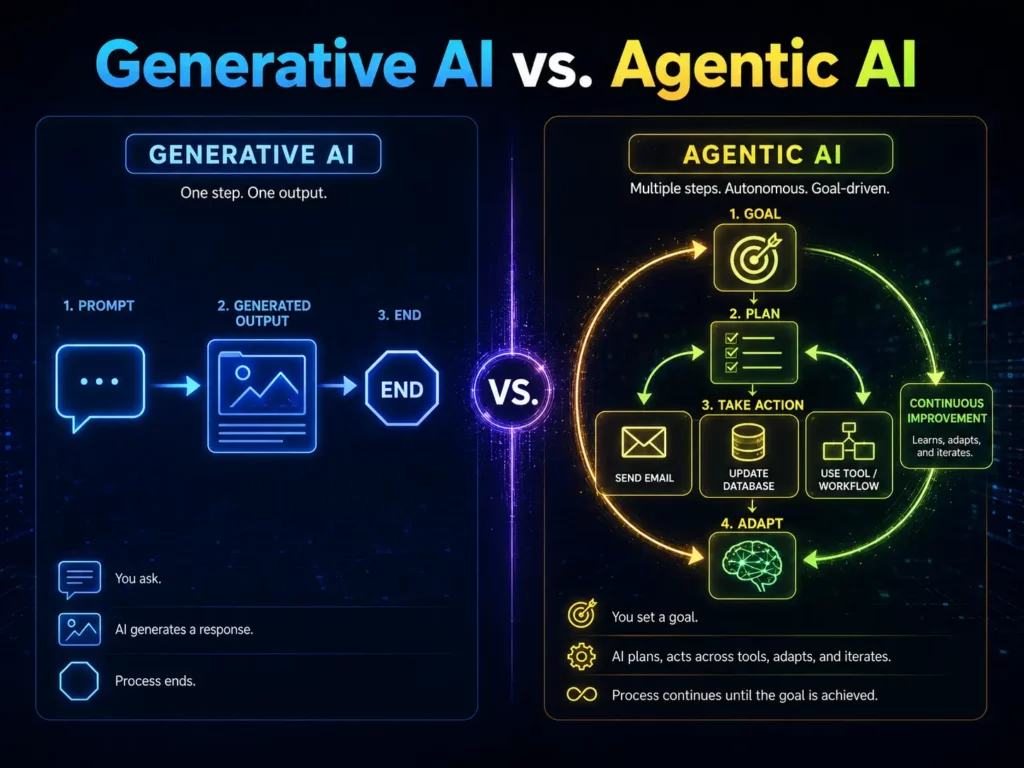
| Generative AI | Agentic AI | |
|---|---|---|
| Mode | Reacts to prompts | Acts to achieve the goal |
| Output | Content (text, images, code) | Actions (steps completed) |
| Autonomy | None outside the dialogue | Multi-step, independent |
| Analogy | Passive digital consultant | Active digital executor |
Terminology and definitions are still evolving, but almost all experts agree on one thing: the defining feature of agentic AI is a high level of autonomy and the ability to perform out multi-step processes step by step.
How Does Agentic AI Work?
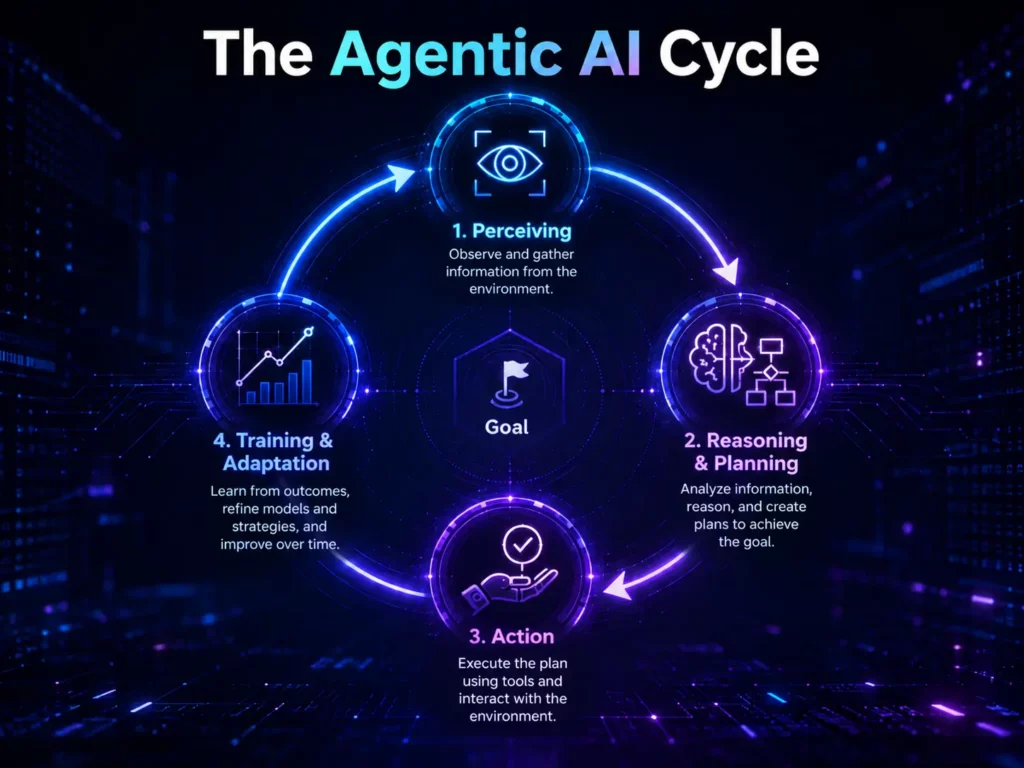
Most agentic AI systems operate in a continuous loop consisting of four steps:
- Perceiving. The system perceives information from documents, applications, APIs, databases, or sensors to understand the current situation. This is more than just reading a single request – the agent extracts the necessary context from all available systems, such as checking the CRM record, inventory database, and recent email thread, before making any decision.
- Reasoning and planning. It sets a goal (from a user instruction or a predefined task), then breaks that goal into an ordered sequence of steps. A request as simple as “follow up leads have stopped communicating this week” becomes a multi-step plan: query the CRM for inactive leads, segment them by deal stage, create a personalized message for each segment, and schedule the sending.
- Action. It performs these steps using external tools – and this is the step that sets agentic AI apart. Instead of describing what should happen, it actually sends an email, updates a record, retrieves a file, or starts a workflow on a running system. The ability to perform actions in external software, rather than just generate text about it, is a defining capability.
- Training and adaptation. It evaluates the result, takes in feedback, and adjusts its approach for the next step. If a planned step fails (an API times out or a record is missing a required field), a well-built agent doesn’t simply stop; it logs the problem and either tries an alternative route or passes the request on to a human.
To illustrate the cycle with an example: an agent tasked with processing an expense report takes the submitted receipt and the associated policy, reasons that the amount exceeds the auto-approval threshold and plans the correct processing path, acts by routing it to the correct manager with a summary, and then, based on whether that manager approved or rejected the report, refines further routing. This cycle is what separates agentic AI from a chatbot. A chatbot answers; an agent system perceives information, makes decisions, acts, and improves.
What is an AI Agent, and How Is It Different From Agentic AI?
At first, the two terms were used as synonyms. More recently, they have become different:
AI agent – a single system that works autonomously within a specific task. Examples:
- An AI agent that automatically sorts and routes incoming requests.
- An AI agent that collects data from control-system sensors and generates reports.
- An AI agent that manages ad campaigns based on how potential customers respond.
Agentic AI – the broader concept. Today it more often refers to an infrastructure that combines several AI agents interacting with each other, with humans, and with internal and external services. For example, a complete system managing automated manufacturing, logistics, electricity distribution, and other complex processes.
In simple terms:
- AI agent – “an individual digital employee”.
- Agentic AI – “a department or organization of digital employees”.
A useful way to hold the distinction: AI agent is a noun (you build agents, you deploy three of them), while agentic is a descriptor of how a system behaves (you make your software more agentic). An agent is the unit that performs work; agentic AI is the coordinated behavior of one or more agents planning and acting to achieve a goal. In practice, the line blurs (a single complex agent can be described as agentic, and most real deployments fall somewhere on a spectrum from a single scripted agent to a coordinated ecosystem), but the basic idea remains the same: agents are building blocks, and agentic AI is what you get when those blocks plan, make decisions, and act with limited control.

What Do You Need to Create an AI Agent?
Creating an AI agent means combining and configuring several components:
- AI model. Usually an LLM, responsible for understanding tasks and planning actions.
- Data. Verified information loaded in, plus access to internal databases, documents, CRM, ERP, and other systems.
- Integrations. APIs and connections to external services, so the agent can act as well as analyze – sending emails, updating records, starting processes, and responding to requests from clients, employees, or contractors.
- Rules and constraints. Clear definitions of what the agent can do, which decisions and actions require approval, and which actions are prohibited.
- Control system. Monitoring, action logging, and access and risk management.
The first three components decide what an agent can do, the last two decide what it should do. Teams that rush model creation and integration but skimp on rules and controls later find that the agent is acting beyond its intended capabilities (71% of organizations say they cannot fully trust autonomous agents for enterprise use ) – which is why constraint and control levels are as important as capability levels.
Can the Process of Building AI Agents Be Simplified?
Yes. A growing number of platforms and AI-agent builders offer:
- Ready-made solution templates.
- Pre-configured agent roles.
- Built-in integrations with popular digital services.
- Libraries of ready-made appearances and voices, so agents can take the form of “digital humans” or “digital characters”.
These tools allow you to quickly create, train, and deploy AI agents without having to develop everything from scratch – Pitch Avatar is one such option for a custom avatar and voice layer.
One caution: the market is noisy. Gartner has warned about “agent washing” – vendors rebranding ordinary chatbots, assistants, or RPA tools as “agentic”, and estimates that only around 130 of the thousands of agentic AI vendors are genuine. Choose your tools wisely and test them for real autonomy, not just marketing hype.
Should AI Agents Be Given Human Traits?
This question usually arises when the agent’s interface is a “digital human” (a virtual avatar) or a digital voice. Is it useful to give it a “personality” and “behavior”, or should it stay neutral and impassive?
Yes – in most cases, some personality helps. It makes interaction between the agent and people feel smoother and helps avoid the “uncanny valley” effect. But “humanizing” an agent is not an end in itself. It’s a way to build trust, simplify interactions, and improve team effectiveness. When the interface is a “digital human,” the avatar and voice are what users actually experience.
A typical agent is configured with:
- Communication style (formal, friendly, expert).
- Behavioral traits (cautious, proactive, analytical).
- Level of proactivity.
- Tone of interaction with users.
An agent’s “personality” is only an interface element and a scripted role – not real emotion or consciousness. Its purpose is to help solve the creator’s problems, and not to create the illusion of a conscious being. People interacting with an agent should always be made aware that they are dealing with artificial intelligence and not a human.
How Difficult Is It to Implement Agentic AI in a Company?
The difficulty usually depends on the scale of the task. Small, single-function solutions can be implemented relatively quickly. Complex agent systems require more:
- Reviewing business processes.
- Integration with multiple systems.
- Security configuration.
- Defining areas of responsibility.
- Developing KPIs and control mechanisms.
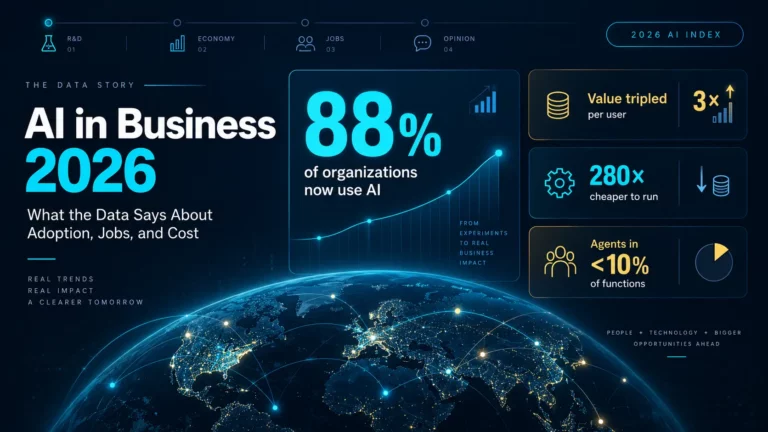
The hardest part is rarely the technology itself. Implementation problems most often arise from organizational changes rather than functionality. The data confirm this on two levels. Gartner expects more than 40% of agentic AI projects to be canceled by the end of 2027, citing escalating costs, unclear business value, and weak risk controls. And McKinsey’s State of AI 2025 finds that while 62% of organizations are at least experimenting with AI agents, only 23% are scaling them somewhere in the enterprise, and no more than 10% report scaling agents in any individual business function. The lesson is to start where the value is clear and the risks are minimized.
Are All AI Agents Equally Complex?
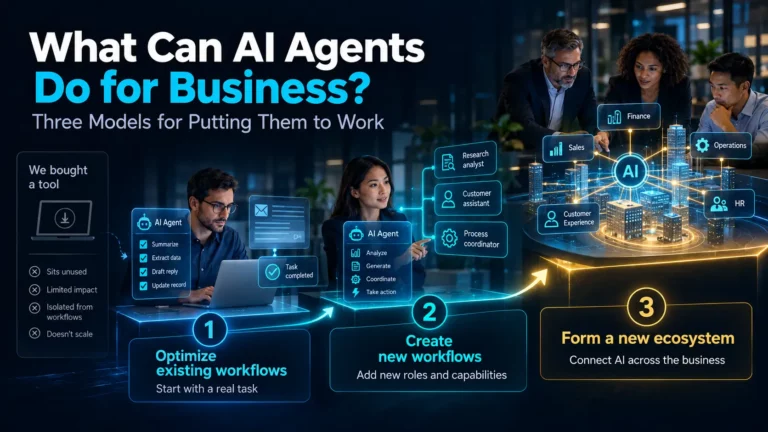
Of course not. Like most technologies, AI agents come in different levels:
- Basic agents – perform one task according to a given scenario.
- Multi-step agents – plan sequences of actions.
- Collaborative agents (multi-agent systems) – interact with each other, distribute tasks, and work with other systems and people.
- Corporate agent ecosystems – managing complex processes at the department or company-wide level.
The higher the autonomy and the broader an agent’s access to systems, the stricter the requirements for control and risk management.
Agentic AI Use Cases: Where It's Applied
One of the common misconceptions about agent AI is that its applications are limited—that agents are only good as chatbots for support or sales. In reality, the applications are much broader. A few examples:
- Business process management – document flow automation, application processing, contract approval, reporting.
- Finance and risk management – transaction analysis, anomaly detection, investment analytics preparation, budget management.
- Sales and marketing – advertising campaign management, offer personalization, customer segmentation, automatic performance analysis. Gartner expects 60% of brands will use agentic AI for personalized customer interactions by 2028, shifting marketing from channel-based campaigns toward personalized, autonomous engagement.
- HR and personnel management – resume pre-screening, training planning, employee onboarding automation, engagement analytics.
- Customer service – processing requests, automatically resolving routine issues, and redirecting complex cases to specialists.
- Logistics and manufacturing – demand forecasting, automated production management, inventory management, route optimization, equipment monitoring.
- Analytics and research – data collection and structuring, analytical reporting, market and competitor monitoring.
- Project management – planning stages, deadline control, resource allocation, risk identification.
This is far from a complete list. Agentic AI is especially effective wherever multi-step processes require analysis, decision-making, and interaction across systems.
The Main Principle: Agentic AI is a Tool for Humans
The most important principle of working with agentic AI: it should be a tool, not a replacement for people.
The model that works best looks like this:
- People create and configure the agents, defining goals and tasks.
- Agents propose plans and carry out actions.
- People monitor the process.
- People verify the results.
- Responsibility stays with people.
With this approach, control stays reliable, risks (including legal ones) are minimized, the system stays manageable, and it is clear who is responsible for decision quality.
Agentic AI can raise productivity and reduce operational load. But strategic decisions, final verification, and responsibility must stay with people.
See agentic interaction in action. Pitch Avatar turns your slides, PDFs, and videos into interactive experiences – with talking avatars and cloned voices in multiple languages, per-slide engagement analytics, and integrations with HubSpot, Salesforce, Gmail, Outlook, and PowerPoint. Start free or book a 15-minute demo.
Frequently Asked Questions (FAQ)
No. Generative AI responds to a prompt and generates content (text, images, or code), then stops. Agentic AI is goal-oriented: it plans steps, uses tools, takes actions, and adapts.
An AI agent is a single, autonomous unit designed to perform a single task. Agentic AI is the broader system – often consisting of multiple agents, coordinating their actions with each other, with humans, and with internal and external services.
Start with one clearly defined use case where the value is clear and the risks are minimized – document processing, routine customer issue resolution, or campaign performance analysis are common starting points. Define the agent’s goal, give it access to the necessary data and tools, set clear rules for what requires human approval, and implement a logging and monitoring system before expanding its scope. Technical knowledge and security expertise are essential for deploying complex multi-system solutions.
This is possible with proper controls. Risk increases with increased autonomy and access to the system, so secure deployment depends on clear rules, controls for sensitive actions, logging, and human supervision.
Not necessarily. Agent-builder platforms offer templates, pre-configured roles, and built-in integrations, so teams can assemble and deploy agents with little or no coding. Complex multi-system deployments still require technical knowledge and security expertise.
In the practical model, control remains with the human: agents propose plans and implement actions, and people set goals, control the process, and check the results.