
For decades, corporate training has been plagued by the same recurring issues: costly content production, lengthy development cycles, difficulties with localization, and chronically low employee engagement. It’s no coincidence that the phrase “death by PowerPoint” emerged – dry slides and text-heavy documents poorly capture attention and hardly help with knowledge retention.
According to the Association for Talent Development (ATD), companies are constantly searching for more effective ways to build employee skills, since traditional formats often fall short of expectations.
With 71% of L&D professionals experimenting with AI, AI Avatars are playing an increasingly important role in this process. This technology enables Learning and Development (L&D) teams to create engaging, consistent, and easily scalable video courses faster and more affordably than ever before. By transforming plain text into dynamic presentations delivered by “live” virtual speakers, AI technologies are making corporate training more flexible, accessible, and effective.
Business Case: Quantifying the Impact of AI Avatars in Training
For Learning and Development (L&D) to be seen as an integral part of business strategy, courses and programs must demonstrate a clear return on investment. With AI Avatars, the case is more than convincing: the numbers speak for themselves, showing not only cost and time savings but also significant improvements in learner engagement. In other words, exactly the metrics that matter most to executives and business owners.

Massive Cost Savings
Producing training videos the traditional way is expensive. Hiring actors, production crews, renting studios and equipment can push the cost of even a short video into the thousands of dollars. AI avatars completely eliminate these expenses.
Real-world examples are impressive:
- SmartExpert LMS saved around $70,000 by switching to AI-generated training videos.
- Teleperformance cut costs by roughly $5,000 per video, a saving that adds up quickly when building a large course library.
With savings ranging from 50–80%, L&D teams can redirect their efforts from tactical content production to higher-value tasks such as needs analysis, instructional design, and measuring business outcomes.
| Metric | Traditional 5-min Training Video | AI Avatar 5-min Training Video | Potential Savings |
|---|---|---|---|
| Cost | ~$3,000 - $5,000 | ~$30 (based on subscription) | ~99% |
| Time | ~3 Weeks | ~30 Minutes | ~99% |
Agility and Speed Instead of Weeks of Waiting
Speed is one of the defining traits of modern business. Whether it’s deploying new software, updating compliance rules, or adjusting sales strategies, employees must be trained quickly – ideally with minimal disruption to their workflow. Traditional video production, which takes days or even weeks, simply doesn’t keep pace.
AI avatars reduce production timelines to hours, sometimes minutes. This allows L&D departments to deliver new courses at the same speed as business demands. In many cases, all it takes is editing the script of an existing training video and regenerating the content. This dynamic approach ensures that the library of learning materials always remains up-to-date.
Engagement and Learning Effectiveness
The goal of training materials, programs, or courses is not just to transfer knowledge, but to ensure employees retain new information, build skills, and apply them in practice. Videos with AI Avatars that closely resemble real presenters are far more effective at capturing attention than static slides. As a result, learners absorb information more effectively, with video-based training shown to boost retention by 25–60% over traditional formats.
This effect is measurable: SmartExpert LMS not only reduced costs but also achieved a 30% increase in learner engagement after implementing AI-generated training videos.
Of course, some learners still prefer real human presenters – balancing automation and personal connection is an important consideration. But when choosing between static slide decks and dynamic videos with AI Avatars, the latter is clearly more engaging. In terms of accessibility and effectiveness, they are comparable to recordings with real presenters. Moreover, AI Avatars make it possible to standardize training content, whether it is delivered by human speakers or digital ones.
Practical Applications Across the Employee Lifecycle
AI avatars are a versatile tool that can be applied at every stage of an employee’s interaction with a company. With this technology, HR and L&D departments can deliver a higher-quality experience, ensuring every employee enjoys both a positive journey and continuous skill development.
Employee Onboarding
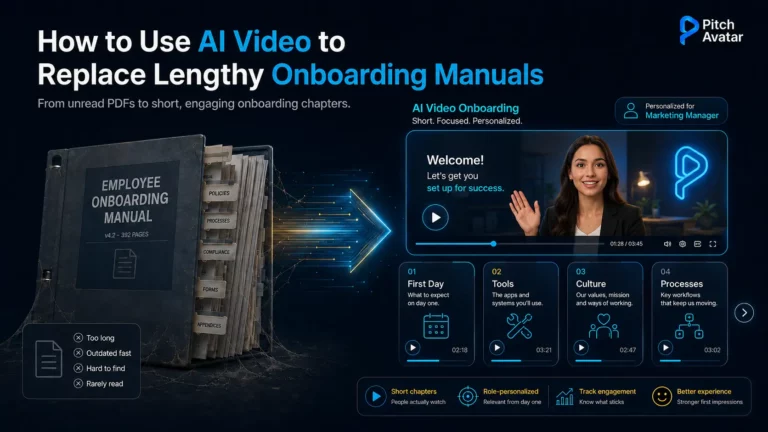
The first steps in a new workplace are often the most important. With artificial intelligence, the onboarding process can become warm and personalized for every new hire, while maintaining a consistent style regardless of location, language, or start date. AI avatars can be used to create multilingual welcome videos from the CEO, virtual company tours, content about corporate culture, step-by-step guides (for example, visual walkthroughs of initial paperwork or navigating IT systems), and other onboarding materials. This ensures that every new employee receives essential information in an engaging and accessible format, while the company creates a positive and professional first impression.

Skills and Product Training
AI avatars are ideal for building a library of short training courses and programs that support employees in their professional growth. Concise, focused videos work perfectly for software tutorials, sales training modules, and learning about new product features. Since such videos can be updated within minutes, the knowledge base remains a living resource that never becomes outdated.
Compliance and Safety Training
Mandatory training is often seen by employees as a boring formality, even as 87% of employees face compliance uncertainty. Yet, these programs typically address critical topics such as workplace safety, corporate conduct policies, information security, or HR guidelines. Delivering this content through AI avatars makes it more engaging and easier to absorb, increasing the likelihood that employees truly pay attention to what leadership intends to convey. In addition, the digital format ensures transparency: LMS platforms track training completion and generate verifiable reports on who has completed each course. This is especially important for compliance requirements and effective risk management.
The Next Frontier: Interactive Avatars for Performance Support
Training videos remain a powerful tool for knowledge delivery. However, the next step in the evolution of AI for L&D is interactive avatars that provide employees with real support exactly when they need it. These are no longer just “talking heads” – they are fully fledged virtual coaches and experts available 24/7.
For example, a new manager needs to have a difficult conversation with a team member. Instead of simply reading instructions on how to do it, they can practice with an interactive AI coach. Such an avatar, connected to the company’s HR knowledge base and trained on best practices, can play the role of the employee, listen to the manager, and immediately provide feedback on tone, phrasing, and strategy.
Another example: a sales representative preparing for an important client call. With the help of an interactive avatar, they can safely rehearse the conversation and practice handling doubts or objections. This “sandbox” environment allows employees to build confidence and refine their approach before facing the real situation.
AI avatars represent a revolutionary shift in learning: moving from a “just-in-case” model (training in advance, just in case) to a “just-in-time” performance support (mastering a skill exactly when it is needed). This format closes the gap between theoretical knowledge and real-world application, turning learning into a tool that directly drives measurable business results.
Implementation Best Practices & Avoiding the Pitfalls
AI avatars open up enormous possibilities for corporate learning. But the technology itself does not guarantee success. Everything depends on how it is used. To maximize results and avoid common pitfalls, it’s worth following a few simple rules.
Methodology First, Technology Second
It’s important to remember: AI is a production tool, not a replacement for the fundamentals of learning design. The rule here is simple: “bad script – bad outcome”. Even the most realistic avatar won’t help if it’s delivering a boring script, poorly structured information, or content with no real practical value.
The effectiveness of training videos depends on clearly defined learning objectives, logical structure, and clear, conversational language. L&D specialists must continue to build their strategies on the principles that make online employee training effective. AI avatars are simply a fast and convenient way to bring those strategies to life.
Balance Visuals and Ensure Inclusivity
Overly flashy or poorly designed visuals can actually work against learning. Too much animation or a cluttered background easily distracts from the main message. Clarity and relevance should be the guiding principles for creating training content. Every element of a video with AI Avatars must serve its main purpose. Adding things just “for fun” or “for decoration” is counterproductive.
There’s another important point – inclusivity. Avatars should be chosen to reflect the diversity of the company’s workforce and the global labor market. When employees see someone who looks like them in training materials, it fosters a sense of belonging and makes the learning experience more personal and meaningful.
Conclusion: Building a More Agile and Effective Learning Organization
Artificial intelligence technologies help L&D teams overcome their most pressing challenges. They make it possible to create more engaging and dynamic training content, deliver courses and programs faster, and do so at a significantly lower cost. In addition, AI avatars enable organizations to easily scale learning globally while maintaining a consistent process and quality standards for all employees.
By automating the time-consuming and costly aspects of video production, AI avatars free L&D professionals to focus on other important tasks, such as analyzing business needs, designing effective learning programs, and measuring the impact of training on performance.
As a result, L&D is no longer seen by top management as a mere “cost center” but instead becomes an integral part of business strategy. With AI avatars, corporate learning becomes more agile, accessible, and effective – directly contributing to overall company success.
Frequently Asked Questions (FAQ)
No, they augment them. AI automates the time-consuming production aspect of video creation. This frees up L&D professionals to focus on higher-value strategic work like needs analysis, curriculum design, measuring impact, and facilitating the live, collaborative learning experiences that only humans can provide.
AI avatars excel at delivering standardized, information-based content that needs to be deployed consistently to a large audience. This includes compliance training, software tutorials, product updates, and company policy explainers. They are ideal for content that is subject to frequent updates, as changes can be made quickly by editing the script.
Engagement comes from strong instructional design, not just the technology. To create effective videos, keep them short and focused (2-5 minutes is ideal), cover only one learning objective per video, use high-quality supporting visuals (like screen recordings or graphics), and write scripts in a clear, conversational tone. The avatar is the delivery mechanism; the quality of the content is what drives engagement.
- Yes. Most leading platforms offer a “custom avatar” or “digital twin” feature. This allows you to create a digital replica of a real person by uploading a short video of them. This is highly effective for leadership communications or when a specific subject matter expert needs to present the material, as it adds a powerful layer of authenticity and credibility to the content.