Apparently, the new IT mainstream in the coming years (possibly extending into decades) will be the development of “small” artificial intelligence models. Events of the past year and ongoing research support this view. Now is the perfect time to think about what these changes mean for business.
TL;DR: Small language models (SLMs) are trained on specific data rather than on large collections of web text. This allows them to be affordable for continuous operation, quick enough for instant use, and capable of running on your own computer. In budgeting terms, the main shift is that expenses move from per-token charges to the cost of GPU hardware. This is advantageous when usage remains consistently high, but it is less beneficial with low or unpredictable usage. There is no single threshold at which an SLM becomes more cost-effective, and different analyses produce widely varying results, by a factor of over a thousand, because the optimal choice depends on alternative API costs and how consistently your hardware is used. A practical strategy for many businesses is to use an SLM for routine tasks and forward challenging cases to a larger model. One example processed 75% of customer support requests in this manner, achieving roughly 90% lower costs. The next sections describe how SLMs work, which models matter, their limitations, the actual cost calculations, and how these factors affect the AI market.
A word on terminology first, because the market has been sloppy about it. The commonly used term is the Small Language Model (SLM) – the abbreviation used in both academic and industry publications. You will also see these systems described as compact, distilled, lightweight, or on-device models, and I personally prefer the label “meek” models, as they are likely to take over a significant portion of the positions currently held by the large models.
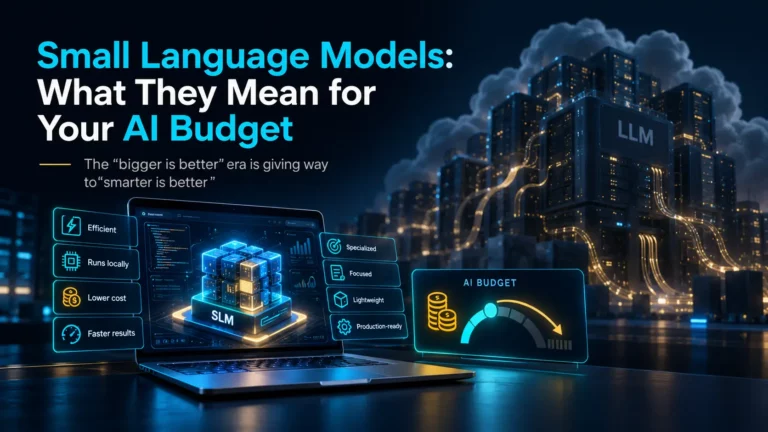
One should be wary of the popular claim that the acronym SLM actually stands for “smart language model”. It does not. The impulse behind that phrasing is understandable, and it points at something true: the industry’s guiding principle really is shifting from “bigger is better” to “smarter is better”. But that is a description of the trend, and not a definition of the acronym. Small language models are indeed compact and becoming increasingly “smart” – these are two separate facts, and conflating them only adds confusion to the understanding of both aspects.
What are Small Language Models?
A small language model is a language model built for a defined range of tasks rather than for general-purpose breadth. Where a frontier large language model may run to hundreds of billions of parameters, SLMs typically sit somewhere between a few hundred million and roughly ten billion – small enough to run on a single GPU, a laptop, or in some cases a phone.
The practical definition matters more than the parameter count, though. An SLM is a model you can afford to run continuously, host yourself, and tune to your own data. That combination is what changes the business calculus, not the size itself.
How Small Language Models Work?
This method focuses on training models with preselected, cleaned, specific information rather than the largest possible web datasets. Experts often validate this information. Expert validation does not always require specialists to sort the data manually. A large amount of high-quality, verified data is available in the public domain, and additional data can be purchased if needed. The priority lies in information quality rather than total volume.

Three techniques do most of the work:
- Curated training data. Quality outweighs volume in importance. When a model is trained on clean, relevant text it learns domain-specific patterns rather than averaging information from the whole internet.
- Distillation. A large “teacher” model passes its behavior to a smaller “student” model. Despite its reduced size, the smaller model retains a high level of capability.
- Compression and quantization. Lowering the numerical precision of a model’s weights reduces its memory requirements. This lets the model run on consumer hardware, typically with only a small loss in accuracy.
As a rule, when generating responses, such models use a more “human-like” reasoning mode – sequential, step by step. Conceptually, the development of small models is focused on controllability, accuracy, and applied efficiency. This allows better optimization for specialized tasks. It also lowers the risk of errors and hallucinations while maintaining fast performance and high quality.
For a broad audience, the effectiveness of this approach was first demonstrated by DeepSeek, which released its R1 and R1-Zero models in January 2025. Cost was the main focus. The base model, DeepSeek-V3, required roughly $5.6 million in compute to train. Other systems are reported to have cost hundreds of millions to train. (One qualification applies to this figure because it is frequently cited without context: that amount accounts only for the final training run of the base model. It does not include research and development, infrastructure, previous experiments, or staff costs. The actual total cost is higher. Even after adding those extra costs, the order of magnitude difference remained significant).
Small Models Worth Knowing
The open-model market is growing quickly, yet only a few model families dominate the professional applications space:
- Phi (Microsoft). This series showed how valuable high-quality training data can be. The Mini versions contain a few billion parameters and excel at logic and programming tasks. Their general knowledge is limited, and they are usually paired with retrieval systems in production settings.
- Llama (Meta). Small Llama models brought capable open models to ordinary consumer hardware. They are often used as base models for fine-tuning within corporate environments.
- Mistral / Ministral. These models are efficient and offer flexible licensing. They are a common choice for self-hosted business tasks demanding high processing speeds.
- Gemma (Google). These models deliver reliable general performance despite their small size. They are frequently applied in educational tools and digital assistants.
- Qwen (Alibaba). This family is recognized for its support of many languages. Some versions contain fewer than one billion parameters and are used for simple assistant tasks.
- SmolLM (Hugging Face). These were designed specifically for the smallest hardware, like mobile devices and edge computing.
Alongside these, there are also models designed for specific industries, for example BioGPT for clinical applications. These models demonstrate how focusing on one area can lead to superior results.
Benefits and Honest Limits
What SLMs do well
- Cost. The price difference is substantial. Using a tuned small model instead of a metered frontier API typically changes the unit economics of a high-volume workflow by an order of magnitude.
- Latency. A locally hosted small model usually replies within tens to low hundreds of milliseconds, as there is no network latency. Users perceive this speed in interactive applications.
- Data residency. The model operates on your own infrastructure and the data stays there. This often serves as the main requirement for regulated work in the healthcare, finance, and legal sectors.
- Accuracy. A well-tuned small model frequently outperforms a larger general model on a highly specialized task. This occurs because the small model concentrates on a specific function and doesn’t try to do everything.
- Tractable fine-tuning. Adapting a small model to your data requires a few hours and modest computing power. It doesn’t require months of work or a large server cluster.

Where they fall short
- General knowledge is limited. Small models hold less world knowledge and may give incorrect information outside their training data. In production, they are typically combined with retrieval systems so that facts come from documents instead of the model’s memory.
- Complex reasoning continues to be a strength of large models. Large systems excel at multi-step problem solving, long-context synthesis, and creative work.
- Multilingual depth differs by model and language. Performance is generally weaker than frontier models for languages beyond the major ones.
- Performance declines off-distribution. If you provide a small model with prompts that differ from its training data, the error rate will quickly increase.
The privacy caveat most guides skip
“SLMs mean privacy” is a common industry expression that doesn’t quite accurately reflect reality. A 2026 systematic review in Expert Systems explains that the privacy advantages of local SLM deployment are architectural rather than formal. Running a model on your own hardware guarantees that your data will not be shared with third parties. This is a valuable property, but it doesn’t guarantee privacy that can be formally verified and doesn’t, by itself, satisfy regulatory requirements.
The practical implication for a compliance case is that local deployment eliminates one type of risk. You still require the same controls, documentation, and assessments needed for any other system that handles sensitive data. The same review notes that smaller models memorize less of their training data – this makes them less vulnerable to extraction attacks.
What SLMs Actually Do to Your AI Budget
These models have a specific financial impact. Using precise numbers is preferable to relying on general enthusiasm.
Cost structure changes
A metered API represents a variable cost: you are charged for each token used and incur no charge when the system is idle. The total bill rises steadily according to usage. A self-hosted small model is a fixed cost: you pay for the GPU whether it is processing data or sitting idle. The cost of a single request is almost zero.
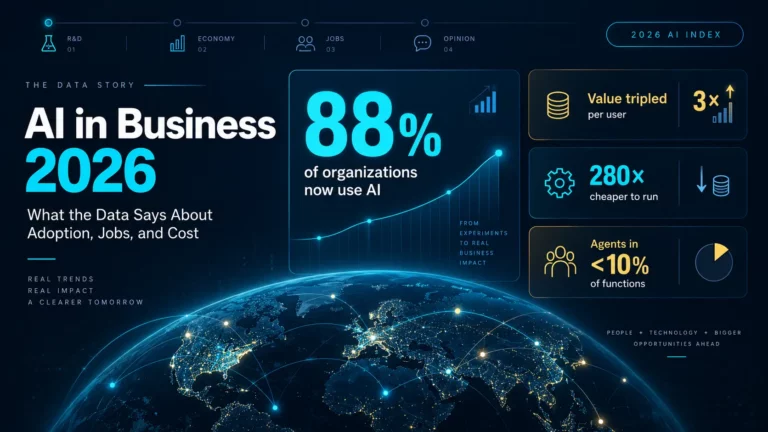
This shift is the most important factor. Fixed costs work efficiently when volume is high and consistent. They become inefficient when volume is low or unpredictable. Any claim that “SLMs are cheaper” without referring to your volume pattern is not an analysis (for the wider picture of what companies are actually adopting and spending on AI, see our breakdown of AI in business: adoption, jobs, and cost).
The figures below are estimates for 2026. Consider them as ranges rather than exact quotes since GPU rates and API prices change frequently (H100 rental contracts, for example, rose 40% in six months):
| Structure type | Metered API | Self-hosted small model |
|---|---|---|
| Pricing model | Per token used | Fixed GPU plus operations |
| Typical unit cost | Approximately $0.10 to $15 per million tokens, depending on tier | A few cents per million at high utilization |
| Hosting a small model | Not applicable | Approximately $100 to $650 a month for a 7B-class model on a single GPU, whether owned or rented |
| Upfront work | Near zero | Provisioning, serving setup, validation |
| Ops and maintenance | The provider's problem | Approximately 10 to 20 engineer-hours a month |
| Idle cost | Zero | The full monthly cost |
Cost everyone forgets
Typically, a single GPU line is modeled. This ignores the operational component, which includes monitoring, servicing stack maintenance, capacity planning, and revalidation after model updates. Industry experts estimate that this costs approximately $750 to $3,000 per month in engineer time, which for a small deployment can completely exceed the cost of the hardware.
A practical planning rule from several 2026 cost analyses is to multiply the raw GPU cost by between 1.3x and 2x to approximate the true total cost. If that adjustment eliminates your business case, the business case never existed.
There is no single break-even, and that is the most useful thing to know
Most guides quote one break-even number. Published 2026 analyses actually range from a few million tokens a month to more than ten billion – a spread of over a thousandfold. That is not disagreement about arithmetic. It reflects two variables:
Which API you would otherwise buy. Compared to the premium model, which costs between $10 and $25 per million tokens issued, self-hosting pays for itself quickly, often reaching hundreds of millions of tokens per month. Compared to a cheap hosted open-weight model (costing less than a dollar per million tokens), the break-even point could reach billions of tokens per month. So, the ROI break-even is less on the SLM itself and more on the alternative option you are considering.
How busy the hardware stays. Cost per token on self-hosted infrastructure depends on resource utilization level. Published benchmarks show swings of more than seventeenfold on identical hardware when the GPU is running near idle and under maximum load. A GPU that processes only one request at a time produces only a small fraction of the tokens it can process under a concurrent load. Many self-hosting estimates are inaccurate because the cost of the equipment is calculated based on its full capacity, while the actual utilization is only 20%.
A practical example: steady, predictable, high-volume traffic favors self-hosting; spiky or low traffic favors the API, and volume alone tells little without analyzing traffic patterns.

When a small model costs you more
Small models can be more expensive than larger ones in specific situations. This is often overlooked because current trends favor local hosting.
- Low or occasional volume is a primary factor. If you process fewer than a few million tokens per month compared to a cheap API tier, you are paying a fixed GPU cost to replace a small variable cost.
- Spiky and unpredictable traffic also increases costs. You must provide hardware for peak usage, which means you pay for idle resources during low-traffic periods.
- Rapidly changing requirements create overhead. Swapping a local model requires reprovisioning, revalidating, and redeploying. With an API, you only need to change a model string.
- Lack of personnel is another cost. If you don’t have the engineering capacity to manage the serving stack, operational tasks become a significant hidden expense.
In those cases, using an API is the most efficient choice rather than a compromise.
What to do with this
Before modeling anything, answer three questions: what is my monthly token volume, how steady is the traffic, and which API tier is the alternative? These factors determine the total cost more than the specific model choice. If volume is high and steady and the alternative is a premium-tier API, hosting a small model is usually better. If not, you should buy an API and apply engineering resources to other tasks.
Architecture Most Businesses Should Actually Build: Hybrid
Most businesses use a cascade: a small model handles the high-volume routine traffic, and anything it cannot resolve escalates to a larger model. This is the part that gets lost in the “SLM versus LLM” framing.

The economics are clear. In one deployment, an e-commerce company replaced metered frontier-API calls with a fine-tuned small model for tier-one customer support. The small model handled roughly 75% of tickets, at about 90% lower cost and three times faster, with accuracy equal to or better than the previous setup on common questions. The remaining quarter, the complex cases, still escalated to a large model. The business kept frontier capability where it was needed and stopped paying frontier prices for password resets.
Designing the handoff involves three decisions:
- Define the escalation trigger. The cleanest approach is confidence-based: when the small model’s certainty on an answer falls below a threshold, the query goes up. Intent-based routing works too – certain categories always escalate, regardless of confidence.
- Ground the small model in retrieval. Point it at your documentation rather than its own memory. This converts its biggest weakness (thin world knowledge) into a non-issue for the tasks you care about.
- Log everything that escalates. Your escalation log is a free roadmap: the patterns that recur are exactly what to fine-tune into the small model next, which steadily raises the share it can handle alone.
This is also the honest answer to “will small models replace large ones?” They will not. They will absorb the volume, and large models will keep the hard cases – which is a far better outcome for a budget than either extreme.
Which Model For Which Task
A rough decision guide for picking the right tool:
| If the task is... | And the data is... | Use |
|---|---|---|
| Narrow, repetitive, high-volume | Sensitive or regulated | A self-hosted small model, grounded in retrieval |
| Narrow, repetitive, high-volume | Not sensitive | A small model for cost and latency; a frontier API only if volume is low |
| Broad, open-ended, or novel | Either | A large model - this is what they are for |
| Mixed, with a predictable routine majority | Either | A hybrid cascade with confidence-based escalation |
| Exploratory, low volume, changing weekly | Not sensitive | A frontier API; do not build infrastructure for a moving target |
The question to ask first is not “which model is best?” but “how predictable is this task, and how much of it is there?”. Predictable and high-volume tasks are the area of application for small models. Unpredictable and irregular tasks are not worth the engineering effort.
Why the Economics Favor Smaller Models
The argument for small models is partly based on what we know about the limits of simply scaling up. The foundational work here is “Scaling Laws for Neural Language Models” (Kaplan et al., 2020), which showed that model performance improves predictably with model size, data volume, and computational resources, but according to a power law, meaning that each successive improvement in quality is disproportionately more expensive than the previous one.
It is worth noting that this picture was refined rather than settled. The later Chinchilla work (Hoffmann et al., 2022) demonstrated that the models of that era were substantially under-trained relative to their size, and that for a fixed computational budget, it is better to use a smaller model trained on more data. This finding directly confirms the thesis about the advantages of small models: the number of parameters alone never provides a complete picture.
Taken together, the research points to the same practical conclusion. As the returns from scaling large models flatten against economic and physical limits, small models (through higher-quality data, architectural optimization, and specialization) will be able to compete with large models on most measurable application metrics.
Small models should therefore be viewed not as a temporary compromise, but as a sustainable engineering strategy that complements, and in some practical scenarios surpasses, large language models. Their development reflects the AI industry’s transition from extensive scaling to rational optimization.
What This Means for Business
These developments have effects that go beyond infrastructure budgets. I have drawn a number of key conclusions about the business environment.
AI monopolies will not arise. It used to appear that only a handful of large companies would create AI models and dominate the market. This situation was frequently likened to the past of search engines, browsers, and operating systems. The presence of small models makes this scenario unlikely. If a capable model can be trained for under ten million dollars and tuned for an even lower cost, the model itself ceases to be a competitive barrier.
AI development will become accessible to mid-sized businesses and startups. Creating proprietary models will be within reach of companies capable of attracting relatively manageable investments by modern standards. They will not have to depend on technology giants or sell their companies prematurely.
AI tools will become accessible even to small businesses and independent developers. Given that many small models are distributed as open source, building AI solutions becomes a realistic prospect for companies and the proverbial garage geniuses alike.
The majority of AI solutions will be specialized. The market will be made up of applied tools that use various small models and are optimized for particular tasks instead of universal systems.
Both companies and users will train AI to meet their own needs. Custom AI solutions and AI agents will become commonplace. Organizations and individuals will customize these tools by using base platforms supplied by vendors. Competitive advantage will come from owning the specific data used for customization, rather than owning the model itself. This will lead to a more open market.
And finally, considering the constantly growing average level of programming skills and the availability of computing hardware, it can be assumed with a high degree of confidence that the AI software market will be flexible, dynamic, competitive, constantly changing, and offering new solutions every day.
Good luck to everyone and successful interaction with AI!
Frequently Asked Questions
A small language model is a language model designed for a specific set of tasks rather than broad coverage, usually containing from a few hundred million up to roughly ten billion parameters, which is small enough to run on a single GPU, a laptop, or sometimes a smartphone. In practice, definition is more important than the number of parameters: SLM is a model that you can afford to run continuously, host on your own hardware, and further train on your own data.
Neither is better in general; they are built for different purposes. Small models win in terms of cost, speed, volume of data used, and subject-specific accuracy. Large models surpass them in terms of breadth of coverage, open-ended reasoning, and handling non-standard problems. For most businesses the right answer is a hybrid model, where the small model handles routine tasks and escalates difficult cases.
Yes, that is one of the main reasons to use one. Models of this class run on a single GPU, while the smaller versions run on laptops and edge devices. This capability makes them suitable for regulated work where data may not be sent to an external API.
Within their subject area, they generally hallucinate less because they are trained on selected, specialized data instead of the open web. Outside this area, they can perform worse than larger models, consistently producing incorrect information. This is usually solved through information retrieval: anchor the model in your own documents so that facts are retrieved from your source of truth, rather than from the model’s internal memory.
It removes a category of exposure, which is valuable, but the advantage is architectural. Your data stays within your infrastructure, but this does not provide formally confirmed guarantees of confidentiality and doesn’t, in itself, satisfy the regulator’s requirements. You still need the same controls, documentation, and assessments as for any other system that handles sensitive data.
The answer depends on your task volume, its stability, and the API tier you are comparing to. Self-hosting changes a variable per-token charge into a fixed monthly cost (approximately $100 to $650 for a 7B-class model on a single GPU, plus 10 to 20 engineer-hours per month to operate it). Compared with a premium frontier API, it breaks even at relatively modest volume. Against a cheap hosted open-weight model, the break-even point can reach billions of tokens per month.
There is no universal figure, and any guide that quotes one should be treated with suspicion. The crossover depends on two variables: which API you would otherwise buy and how busy your GPU stays, and published benchmarks show cost per token can vary by more than seventeen times on identical hardware between an idle and a saturated GPU. Steady, predictable, and high-volume traffic makes self-hosting more cost-effective, while APIs are preferable for low or uneven traffic.
Consider how predictable the task is and how much of it exists. Predictable, repeatable, and large-scale work is where small models thrive, especially when the data is sensitive. For tasks that are unpredictable, open-ended, or occasional, larger models are better suited. For mixed workloads where routine tasks are predominant, a hybrid cascade is the optimal solution.