
Driving Revenue: How AI Avatars Impact Key E-commerce Metrics
The applications of AI avatars in e-commerce are not limited to a single segment of an online store. This technology is highly adaptable to the specific needs of different online retail sectors. Thanks to this flexibility, every retailer can successfully implement it in their own business context.
Fashion & Apparel: The Virtual Stylist
In the fashion industry, AI avatars can act as personal stylists. They create outfit recommendations tailored to each customer’s preferences, body type, and even specific occasions. For example, a customer might ask: “What should I wear to a summer wedding?” – and receive ready-to-go suggestions. This experience is further enhanced with AR try-ons, where customers can see how clothing looks on a digital model with their exact measurements. This approach helps bring online fashion shopping closer to the in-store experience.

Beauty & Skincare: The Personalized Consultant
For beauty and skincare brands, AI avatars can function as personalized consultants. A customer simply uploads a selfie, specifies their skin type and key concerns (dryness, acne, fine lines), and the avatar recommends a personalized skincare routine with specific products. The possibilities go even further in the world of makeup. With AI-powered virtual try-ons, customers can instantly “test” different shades of lipstick, foundation, or eyeshadow in real time, enabling them to make confident purchase decisions.

Electronics & Gadgets: The On-Demand Tech Expert
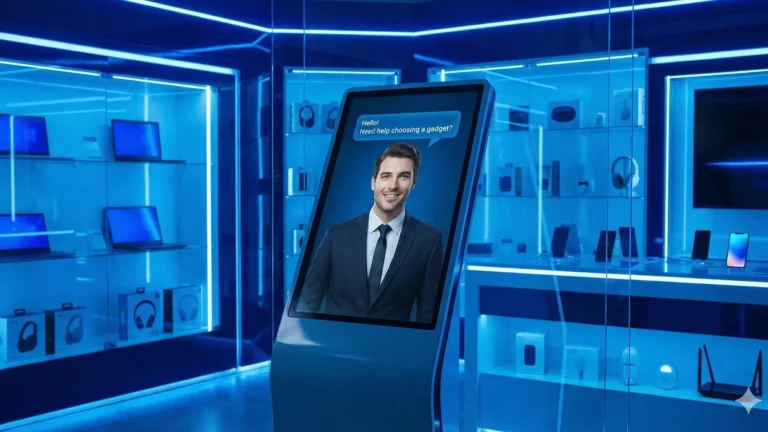
Consumer electronics space often comes with complex specifications and dozens of similar models, making it easy for shoppers to feel overwhelmed. Here, an AI avatar takes on the role of an “on-demand tech expert”. It asks clarifying questions such as: “Do you need a TV primarily for gaming or for movies?” and immediately provides a clear comparison of suitable models. Customers don’t have to dive into the technical details – the choice becomes simple and transparent.
Home & Furniture: The Interior Design Assistant
One of the biggest challenges of buying furniture online is imagining how it will look in the actual space. AI avatars, combined with AR technology, solve this problem. Using their smartphone camera, customers can “place” a 3D model of a sofa in their living room or a desk in their office. At the same time, the digital consultant can provide quick, precise answers about materials, dimensions, assembly, and delivery. Together, these features significantly reduce the risk of customers abandoning large-item purchases online.
The Authenticity Challenge: Standing Out in a Virtual Showroom

The widespread adoption of AI avatars not only opens up tremendous opportunities, but also creates a serious problem: the risk of losing brand identity. If companies rely on the same ready-made, “stock” solutions, online stores risk drowning in an “ocean of sameness”. In this scenario, no brand will stand out, interactions with virtual sellers will fail to resonate, and online shopping will become a boring, easily forgotten routine.
The solution lies in custom AI avatars designed specifically for each brand. These digital sales representatives and consultants embody a company’s signature style and values, while aligning with the expectations of its target audience. For example, a brand targeting Gen Z might opt for “bold and edgy characters”, while a luxury label could choose elegant, classic “ladies and gentlemen”.
By investing in unique digital personas, companies transform AI avatars from mere sales tools into an integral part of their brand identity. This approach builds trust, makes customer interactions more engaging and memorable, and turns the virtual salesperson into a true representative of the company.
Conclusion: The Future of Interactive E-Commerce is Here
AI Avatars have become an essential tool in the new era of online retail – “conversational commerce”, a market projected to reach $39.53 billion by 2034. In this format, shopping ceases to be a dry, mechanical process and turns into a live, personalized dialogue between the brand and the customer.
The benefits of this technology for businesses are clear and measurable: higher conversion rates, fewer abandoned carts, increased average order value, and, most importantly, a richer and more memorable customer experience.
Providing personalized 24/7 support, AI Avatars solve one of the key challenges of e-commerce. And this is not a theory or a “technology of the future” – with 39% of consumers already using AI for product discovery, it’s a practical solution available today. AI Avatars are already reshaping the standards of digital retail and setting new benchmarks for customer experience.
Frequently Asked Questions (FAQ)
When implemented well, they are very helpful. The key is to be non-intrusive. An effective AI avatar acts like a helpful store associate who is available when needed but doesn’t follow the customer around the store. They should be easy to engage with when a customer has a question and just as easy to dismiss.
- Most businesses use third-party SaaS platforms that provide the key avatar technology. These platforms often offer simple integrations or code snippets that can be easily added to major e-commerce platforms like Shopify, Magento, or WooCommerce. For more advanced features like AR-powered virtual try-ons, integration with specialized AR tools may also be required.
Costs can vary widely depending on the level of sophistication. Simple, pre-scripted video avatars can be created using affordable monthly subscription plans. More advanced, real-time conversational AI avatars that integrate directly with your product catalog and CRM represent a more significant investment and are often quoted on an enterprise basis.
- Yes, advanced conversational AI avatars can be integrated with your inventory and product information management (PIM) systems via APIs. This allows them to provide customers with real-time stock availability, accurate and up-to-date product details, and personalized recommendations based on your live product catalog.