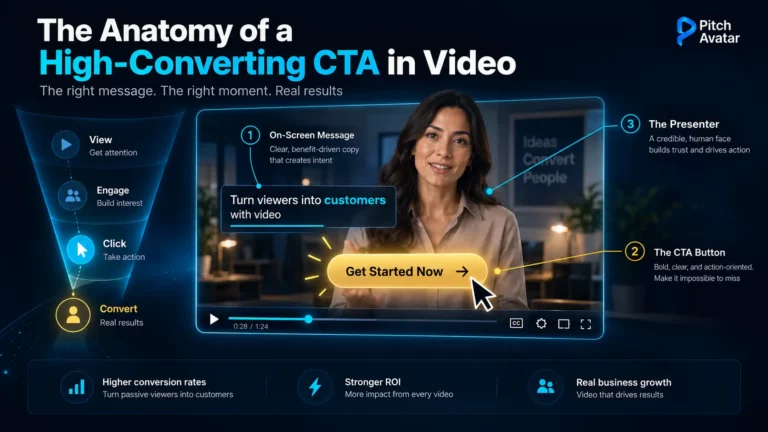
How to make your content sell, educate, and even save the world – depending on who’s watching and where.
TL;DR: A high-converting video CTA does three things: it matches the viewer’s funnel stage and persona, it requires exactly one clear action, and it articulates that action in simple language – both verbally and on-screen. A cautious viewer at the top of the sales funnel needs a gentle nudge (a free checklist); for an interested viewer at the bottom of the sales funnel needs a direct, risk-free push (a free trial, a fixed price). Give a specific reason to act right now, say it the way you would to a smart friend, and make it just one click away. And remember the honest part: AI tools deliver your CTA flawlessly to thousands of people, but if the CTA itself is weak, they’ll deliver that weakness flawlessly too.
Let’s be honest: we live in an era where artificial intelligence can generate a video in a couple of minutes that most filmmakers of the last century could only dream of. The images are clear and vibrant, the avatars speak like real people, and the emotional delivery is flawless. And yet we continue to see “production dramas”: full of inflated expectations, a marketer or PR manager uploads the video, the view count charts rise… but the conversion rate remains the same. Zero clicks, zero leads, zero subscriptions, zero downloaded presentations… or maybe not exactly zero, but far from what the creators or their clients expected.
One thing worth noting here: 83% of video marketers say video has directly increased sales, and 85% say it has helped them generate leads. So what’s going wrong for everyone else? Their viewer watches videos to the end, maybe even likes it, then closes the tab and leaves. Because at the finish line, they didn’t get a clear,timely push to action. Instead, they saw a boring slide with a website address in tiny font, or heard something vaguely bland like: “Click here, I guess”.

Marketers call this the tragedy of lost conversion. You can invest thousands of dollars in production or perfect your neural network prompts, but if your video CTA is built on a “just check a box” principle, all the magic disappears instantly.
Spending huge resources to attract a person’s attention is not enough. It is also necessary to specify precisely what action this attention should lead to. Any strong video without a clear call to action is simply forgotten.
But how do you make sure your final (or intermediate) “hook” actually grabs the viewer’s attention instead of sitting there doing nothing? Let’s break down the anatomy of the perfect video call to action.
What Makes a High-Converting Video CTA?
A high-converting video CTA matches the sales funnel stage and target audience persona, requires one clear action, and articulates that action in simple language – both verbally and on-screen. The best ones provide a compelling reason to act now (a bonus, confirmation, or free trial) and sound like a conversation with a smart friend instead of a legal disclaimer.
Context is Everything: Aligning With Funnel Stages and Personas
You can always spot an inexperienced video marketer: their favorite trick is pushing the “Buy Right Now!” button on someone, even though they only learned about the brand thirty seconds ago. It’s as ridiculous as proposing marriage on the first date.

High-converting copy always takes into account the viewer’s stage in the sales funnel and their psychological type – HubSpot’s analysis of over 330,000 CTAs found that personalized calls to action convert 202% better than generic ones. Let’s look at this chain using some real logic (and a one small table, because it’s really useful):
| Funnel stage | Viewer mindset | CTA goal | Example |
|---|---|---|---|
| Top (Awareness) | Curious but cautious | Pull them one step deeper, no money asked | "Grab the setup checklist below the video - pure information, zero fluff." |
| Middle (Consideration) | Comparing, doubting | Prove expertise, overcome objections | "Watch our case study teardown with the exact numbers on how we saved a client a million." |
| Bottom (Decision) | Warmed up, needs a safe push | Close the deal, zero ambiguity | "Submit your request today and we will fix the price to month-end. No obligations." |
Top of the funnel (awareness/introduction)
The viewer doesn’t know you yet. They came for value, entertainment, or a solution to a sudden problem. Their main feeling is caution.
- CTA goal: slightly interest a person without asking for money.
- How to talk to a Pragmatist: this type values logic and time. They want a clear bonus for clicking. “Grab the setup checklist right below the video – it’s pure information, zero fluff.”.
- How to talk to the Visionary/Emotional: they’re hooked by intrigue and scale. “In our next video, we’ll show you how this technology can transform your business in a week. Subscribe so you don’t miss the trial.”.
Middle of the funnel (consideration/evaluation)
Congratulations, the viewer realized you aren’t a scammer, and the topic has interested them. Now they’re comparing you to competitors, doubting and thinking about what to do.
- CTA goal: prove your expertise and overcome initial objections.
- How to talk to the Skeptic: they need proof. A traditional “We have the best service” will only make them smirk. What works is an offer to see for themselves: “Watch our short case study, where we show the exact numbers on how we saved a client a million. The link is on the screen.”.
- How to talk to the Innovator: let them touch the future with their own hands. “We’ve just launched the beta of our new AI tool. Follow the link, sign up, and be the first to test it while there are still open spots.”.
Bottom of the funnel (decision/action)
The viewer is already completely “warmed up”. They’re ready to take the target action, but they need one last, extremely clear and safe push.
- Universal rule: zero ambiguity. If they need to click a button, just say so: “Click the blue button below the video.”.
- And finally: give them a chance to “buy and think it over”. Or, if you prefer, “buy without paying”. For example: “Submit a request today, and we’ll lock in a price for you until the end of the month. No obligations – just book a slot for a free audit”. Or: “Sign up for a monthly subscription and get your first week absolutely free. If you don’t like it, cancel without paying a penny.”.
Templates: Ready To Use Video CTAs
Use these ideas as a basis and adapt them to your needs. They’re organized by funnel stage, matching the personas described above – just replace them with your own offers and writing style.
Top of the funnel (low commitment, value delivery):
- “Grab the one-page checklist below the video – everything I just covered, and you don’t need to write anything down.”
- “This is just the first part. Stay tuned: next time I’ll show you the full playbook.”
Middle of the funnel (prove it, remove doubt):
- “Don’t take my word for it – open the case study on screen and check the numbers yourself.”
- “Want to test before anyone else? The beta link is on the screen, and there are still a few spots left.”
- “Curious how this applies to your team? Book a 15-minute demo – the link’s right here.”
Bottom of the funnel (safe, specific push):
- “Start your free week right now – the button’s on the slide. Cancel anytime, no charge.”
- “Lock in this quarter’s price before it changes. Leave your contacts on screen, no commitment.”
- “Ready? Click the button, choose a convenient time, and I’ll take care of the rest.”
Nonprofit and Education (Sell the Results, Not the Request):
- “One coffee’s worth buys three oak saplings. Click the button and see your seedling appear on the map.”
- “Not sure it’s for you? Take a five-minute test and find out if you meet the requirements – free.”
Where and How To Place Your Video CTA
Knowing what to say is half the battle. The rest depends on where and how you say it..
Timing. You don’t have to wait for the end credits. Place a soft CTA at the beginning to reach those who don’t watch it to the end; place your main one where engagement peaks (often the middle); and save the direct call to action for the end, when the interest is highest. Align the complexity of the call to action with the specific moment in the video. The format itself helps with this: Wyzowl research showed that 71% of people consider videos between 30 seconds and two minutes to be the most effective – they’re short enough that a well-placed call to action mid-video will work while the viewer is still watching. (For a more detailed discussion of call to action timing and placement, see our guide: Crafting Effective CTAs in AI Videos.)

Make it both heard and seen. The most effective video CTAs use more than one channel at the same time:
- Verbal – the presenter or avatar says it out loud.
- On-screen text – a caption or a banner at the bottom of the frame complements what’s happening.
- Button – a clickable element viewers can interact with without leaving the video.
Say it, show it, and make it clickable – that way you’ll remove any excuses for inaction.
Where the Click Leads: Keep the Action Within the Video
Here’s the part most CTA advice misses, because most videos are hosted on platforms where the CTA inevitably leads the viewer away – to a link in the description, to a separate landing page, or to another tab. At each of these transition stages, you lose audience.
Interactive video presentations change the situation: the action can happen inside the player, while the viewer continues watching and maintains interest. With Pitch Avatar, the CTA isn’t a link to somewhere else – it’s something the viewer takes directly while watching:
- On-slide lead capture form – Users enter their information without leaving the video.
- In-content meeting scheduling – they pick a time from your calendar inside the presentation.
- “Call Presenter” live handoff – a warm viewer can connect to a real person on the spot, turning a recorded video into a live conversation at the exact moment intent peaks.
- Real-time notifications – you receive an alert the moment a potential customer opens a video or clicks a CTA button, so an agent can follow up while interest is still high.

This matters because the primary goal of a CTA is conversion, and video has been shown to encourage people to take action: Wyzowl found that 85% of people say watching a video convinced them to buy a product or service. The closer the target action is to the decision-making moment (ideally, one click away, in the same frame), the fewer users you lose due to obstacles.
Not Just for Business
It would be a massive mistake to assume that calls to action are limited to “buying and selling” or subscribing to yet another SaaS platform. The nonprofit sector needs proper CTAs no less. In practice, businesses can compensate for poor copywriting with a huge budget for targeted advertising, but charitable foundations, museums, universities, and social projects rarely have such budgets.
When you write CTAs that drive action for social or educational purposes, the rules of the game change a little. Here, we aren’t selling a product; we’re selling belonging, values, and emotions.
Charitable foundations, social, and community projects
The worn-out “Help us by donating money” is ineffective today – people have stopped responding to direct attempts to evoke pity. Instead, show the action and its measurable result.
- Bad: “Donate any amount to save forests.”
- Live CTA: “The cost of one cup of coffee is equivalent to the cost of three oak saplings that will outlive us. Click the button, select the “One Coffee for the Forest” format, and check out the interactive map to see exactly where your oak trees will grow.”
Educational institutions, courses, and lecture halls
Students and young professionals are a cynical audience, tired of academic pomposity. A call like “Enroll in our university and receive a state-recognized diploma” sounds hopelessly outdated.
- Live CTA: “You can spend four years memorizing lecture notes from ten years ago, or you can follow this link, take a five-minute test, and find out if you’re eligible for our grant to study in Virtual World Design. Take a risk – it’s free.”
Technology is Not Smarter than Humans
Since we’re talking about AI trends and automation, we can’t ignore the blind faith that technology can do everything. We created Pitch Avatar precisely so you can automate presentations, generate interactive videos, and deliver your ideas to your audience 24/7 without being there in person. And we’d love for it to sound like the ultimate solution: launch the system, and it generates leads while you sleep.
But there’s a mental trap hidden in that promise, and we prefer to speak honestly about it rather than embellish the product’s capabilities. Many people think that using an advanced tool means the tool will do everything for them. This is not true – and our tool is no exception. AI doesn’t have consciousness; it’s a powerful tool, but it’s only effective when combined with your own intelligence.
The effectiveness of even the most advanced AI platform directly depends on how you formulate, design, and place your calls to action. AI is an enhancer of your thinking, not a replacement for it. If your CTA is weak, trivial, or “wooden”, the AI will deliver that mediocrity to thousands of viewers flawlessly – without a single hitch and with a perfect smile. The result is quite predictable.
But when you research your audience, get creative, and write a call to action that reflects a real point of view, that’s when this tool really pays off: Pitch Avatar will present your idea on screen with an experienced presenter, a flawless voice, and voice-overs in 70+ languages – multiplying the effect of a good idea (instead of trying to “save” a bad one). We give you the speakers and the coverage, and you prepare the script and think through the psychology of the triggers. Conversion is achieved through a combination of these factors, not just the software itself.
Three Keys to a "Working" CTA
To prevent your text from looking like it was generated by an outdated script from the early Web 2.0 era, follow these simple rules:
- Eliminate legal jargon and corporate terminology. Phrases like “Please visit the website for informational purposes” should be removed immediately. Write as you would speak to a smart friend. Instead of “Check out our range” – “Look at the catalogue, there’s a lot of interesting stuff there”.
- One cup, one drink. Don’t ask viewers to subscribe, like, click the bell, click the link, sign up for the webinar, and tell grandma all at once – all in one video. Choose one main action for that specific video.
- A little humor helps avoid pretentiousness. If the tone becomes too serious, lighten the mood. “Click the link below. We promise not to spam you. We’re far too lazy to write to you every day”.
And don’t stop at instinct – test your ideas. Show your CTA to real friends and colleagues, and after launch, let the data decide: engagement analytics show you exactly where viewers drop off and whether your CTA moment is landing, so you can A/B test the wording and timing instead of guessing. If you wouldn’t want to click your own link, your CTA needs some work – remove what doesn’t meet expectations, or add what’s missing.
In the end, people buy from people (even if those people are represented by AI avatars). Start right now – re-read the script of your next video and ruthlessly cross out the phrase “Subscribe to our channel!”. Come up with something more interesting and exciting.
Frequently Asked Questions
Three things: it matches the viewer’s funnel stage and buyer persona, it requires exactly one clear action, and that action is presented in simple language – both verbally and shown on screen. Give a concrete reason to act now (a bonus, proof, or a free trial), nd your conversion rate will be higher than using a vague “click here”.
Don’t save it for the end. Place a subtle CTA at the beginning to reach viewers who don’t finish the video; place your main CTA where engagement peaks (often the middle), and your strongest at the end, when user intent is highest.
One primary action per video. Asking people to subscribe, like, follow a link, and sign up for a webinar at the same time distracts users and reduces conversion. One cup, one drink.
Three: verbal (presenter or avatar says it), on-screen text (a caption or button inscription), and a clickable button. The most effective CTA combines all three aspects so that the action is heard, seen, and accessible with one click.
Yes. Foundations, museums, universities, and social projects alike rely on them – they “sell” a sense of belonging, values and results instead of a product. Show the action and its measurable result (“one cup of coffee = three planted oak trees”) instead of a dry call to action, “please make a donation”.