Transform technical specifications and abstract proposals into simple, understandable stories with AI avatars.
TL;DR: Complex B2B deals rarely fail because of the product itself. They fail because nobody on the buying committee ever completely understood the offer. Gartner reports that 74% of B2B buying teams encounter unhealthy internal conflict during the decision, and 67% now favor a rep‐free buying experience, which is up from 61% a year earlier. A 45‐slide deck cannot survive that environment. A short, interactive video with an AI avatar does: it explains the offer in plain language, moves through the organization as a link, equips your internal champion with something superior to their own paraphrase, and shows you exactly who watched what. This guide addresses the champion problem, outlines what each stakeholder needs to hear, provides a five‐step production playbook, identifies where video does not belong, and explains how to measure whether any of it is working.
Do you know why B2B deals usually fall through? No, it’s not because the offering wasn’t a good fit for the prospect. In most cases, it simply stays misunderstood. Recipients get drowned in an avalanche of information and become confused by a sequence of actions too complex for an outsider to follow. As a result, nobody even gets around to analyzing pros and cons.
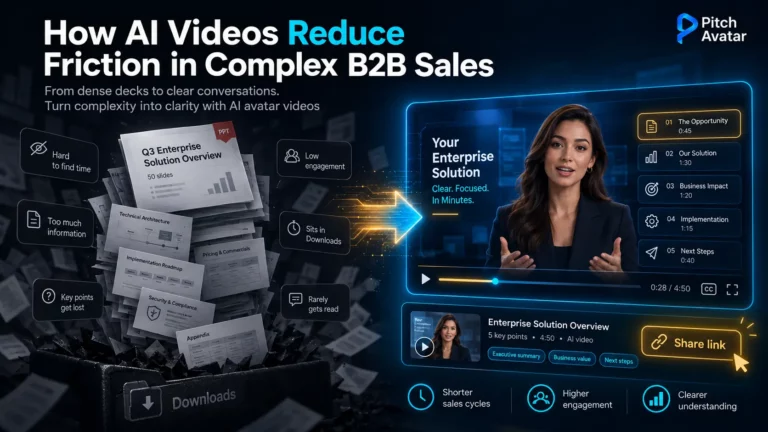
Picture a classic scene: a company might develop a truly powerful product – say, an ERP system that uses predictive AI. The sales rep might send a prospect a 45-slide presentation containing everything from microservice architecture diagrams to three-story ROI formulas. Do you know where that PDF is likely to end up? Of course you do. In the corporate black hole – the “Downloads” folder, next to the printer manual.
Why does this happen? It’s not that the product is bad; it’s that modern decision-makers are busy and do not have time to study long pitches. Add to that the friction inherent in modern enterprise sales, which has turned into an obstacle course where decisions aren’t made by a single person, but by a buying committee of several specialists. The CFO has their own concerns, the CTO has theirs, and the COO has theirs – and each of them is catastrophically short of time. Asking them to study a dense document (even if it’s just slides and not a detailed analytical report) is like assigning them complex calculus homework on the weekend.

Metaphorically speaking, every B2B proposal wilts from misunderstanding and collapses under the rubble of a “Tower of Babel” built out of complex terminology, numbers, tables, and diagrams. Deep down, it “longs” to become a simple, clear conversation between real people in plain language.
Research supports this view. Gartner survey of 632 B2B buyers showed that 74% of buying teams experience conflict during the decision process. Groups that reach a consensus are 2.5 times more likely to make a high-quality decision. A March 2026 Gartner survey found that 67% of B2B buyers prefer to buy without a sales representative, up from 61% the previous year.
These findings show buyers don’t want to read long proposals or attend many discovery calls. They make decisions in meetings where the seller isn’t present. A short video that answers questions directly is a better format. AI avatar technology can provide this. In industries selling complex products, AI avatars act as presenters who explain difficult concepts in clear terms in under three minutes.
Ally to the "Internal Champion"
B2B sales professionals rely on a particular individual known as the “internal champion”. That individual acts as your advocate inside the client’s organization, for example, an IT director or a VP of Innovation who got excited about your idea. Typically, they lack the authority to sign contracts or approve budgets on their own. They need to convince multiple specialists, department heads, and executives to “buy” your solution.

This example demonstrates how an AI avatar enhances a B2B proposal. If you provide your champion only a text document or a collection of static slides, they don’t have the tools needed to succeed. They will try to explain your solution’s architecture in their own words and will probably become confused. They will try to explain your solution’s architecture in their own words, get tangled up three minutes in, be unable to answer the CFO’s tricky questions, and ultimately return to you with a gloomy verdict: “You know, we’ve decided to push this project off until next year”.
An AI avatar video presentation changes this process. Your champion does not need to paraphrase complex ideas. Instead, they provide an interactive link to their colleagues. The digital avatar speaks directly to decision-makers on the screen, explaining the offer in plain, engaging language, highlighting main points, and answering common questions.
The human brain responds to facial expressions, vocal tones, and eye contact. When an abstract idea is presented with a face and voice, trust increases and people find it easier to absorb the information.
Instead of a “champion”, you can involve a sales representative, a marketer, or do it yourself. The basic principle of this approach stays the same.
What Each Stakeholder Actually Needs to Hear
This is where mistakes are often made when using video in sales. Teams produce one polished overview and send it to everyone, which means it is not personalized for any individual. The purchasing committee is not a single audience; it consists of four or five members with different interests, and the 74% conflict rate mentioned earlier often arises because they do not receive consistent information.

If your champion will present your case in meetings you cannot attend, give them a message version adapted for each participant in those meetings:
| Stakeholder | What they actually fear | What your video should lead with |
|---|---|---|
| CFO / finance | Spending into an unquantifiable outcome | Payback period, total cost including implementation, what the status quo already costs them |
| CTO / IT | Integration pain, security exposure, another system to maintain | Architecture in plain terms, how it fits the existing stack, security and data handling |
| COO / operations | Disruption, migration risk, team resistance | Rollout sequence, what changes for the team on day one, where the handholding comes from |
| End users / team leads | More work, a tool imposed from above | The specific daily task that gets easier, shown rather than described |
| CEO / economic buyer | Strategic relevance, opportunity cost | The one-sentence business case and the competitive consequence of doing nothing |
A practical option: develop a single core explanation and then use it to generate different introductions and conclusions for each stakeholder. Video with an avatar has a structural advantage over a recorded video with a person, as it only takes a few minutes to create and doesn’t require booking a studio again.
Step by Step: Convert Complex Offerings Into Engaging AI Demos

To turn avatar video into a reliable revenue engine instead of a simple marketing gimmick, build production and distribution as a pipeline.
Step 1: Atomize and deconstruct your source content
The most common mistake is overloading a video with your company’s entire history from day one. Take your monstrous 50-slide deck and break it into core “atoms”.
- Focus on the principle: one video, one specific problem.
- Separate a single pain point, demonstrate one precise technical fix, and highlight one primary impact metric (ROI, time savings, risk reduction).
- The optimal length for an initial B2B touchpoint is between 90 seconds and 3 minutes. If a topic requires a deeper dive, produce a series of short micro-videos instead of a single three-hour video.
Step 2: Script for the ear, not the eye
A script written for an AI avatar is fundamentally different from a trade journal article or a formal report. It should sound like natural spoken language.
- Remove jargon, convoluted clause structures, and passive voice without mercy.
- Instead of dry corporate phrasing like “Our machine learning algorithms were integrated to optimize dataset processing”, write simply: “We taught the AI to read your reports in three seconds instead of three hours.”
- Use rhetorical questions to maintain focus: “Sound familiar?”, “What does this mean for your team in practice?”, “How often do you run into this?”
Step 3: Interactive assembly and fine-tuning
At this stage, your script and visuals come together into a dynamic interactive format.
- Avatar selection and customization. Select a presenter whose look, tone, and style match your niche. For conservative fintech or legal consulting, choose an avatar in a sharp suit with a calm, measured delivery. For an IT startup or creative agency, opt for something more casual. You can even build an avatar based on one of your founders or lead subject matter experts, then fine-tune pacing, emotional resonance, and tone.
- Instant localization. If you operate globally, Pitch Avatar translates and voices your presentation into 70+ languages, preserving precise technical terminology while keeping the presenter sounding natural.
- Adding an interactive layer. The goal of modern video is to remove passive viewing. Add interactive buttons, lead‐generation forms, links to documentation, or a calendar widget for booking a call directly inside the player, so viewers can act without leaving the video. (Our guide to high‐converting video CTAs explains where to place them.)
Step 4: Contextual personalization and targeted distribution
Avoid attaching large video files to emails – enterprise spam filters will block them.
- Instead, generate a unique interactive link for the presentation.
- Use personalization features to customize the avatar’s introduction: the presenter can address the prospect by name, mention their company, and highlight the exact challenges relevant to their industry.
- Embed the link into an email, LinkedIn message, or sales proposal alongside an eye-catching preview and a clear call to action.
Step 5: Behavioral analytics and the live intercept
Standard slide decks and video links in B2B sales do not reveal what the recipient does after receiving the file.
- Deep engagement analytics. The system tracks in real time when the recipient opens the link, how long they spend on each slide, which interactive elements they click, and where they lose interest or close the tab.
- The live intercept feature contains a button inside the player. By default, it is labeled “Call Presenter”, but you can change the label to “Talk to an engineer” or “Ask a question now”. When a prospect clicks the button or types in the chat, the sales representative gets an instant alert. The representative can then join the live session right away. This lets you connect with leads while they are interested in the content.
Where Video Doesn't Belong
Avatar video is not appropriate for every situation.
- It is a poor choice for final negotiations and specific pricing discussions. Conversations about bargaining positions, concessions, or custom terms require a live person with decision‐making authority.
- Video is also unsuitable for sensitive or contested situations. Issues like escalations, missed commitments, or renewal risks require human accountability.
- Video cannot manage highly specific technical scoping. While a video can explain general architecture, it cannot conduct the discovery needed to determine if a product fits a unique environment.
- Video should not replace the professional relationship. Gartner predicts that by 2030, 75% of B2B buyers will prefer sales experiences that prioritize human interaction over AI. Use video to explain information, allowing sales reps to focus on tasks that require human interaction.
The most effective approach is to let video carry the explanation while humans handle the negotiation.

How to Measure Whether It Is Working
Vendors often promise a particular percentage of sales-cycle reduction. The honest move is to measure your own baseline, because the published figures vary widely by deal size, industry, and what you were doing before.
Track the following:
- Committee coverage: the count of distinct stakeholders in an account who opened the link. This is the number that actually indicates whether your champion is succeeding.
- Depth per stakeholder: who watched to the end, who stopped at the pricing slide, who replayed the architecture section. This informs your rep precisely what the next call should cover.
- Time to first view: how fast the link is opened after sending provides a strong early indication of real interest.
- Demo-to-meeting conversion: the proportion of sends that result in a booked call.
- Cycle length, video-touched versus not: compare deals where the committee engaged with video to those that did not. That gives you your own reduction figure, and it is the only one worth citing internally.
For context on external reports: a study of interactive demos found sales cycles shortening from 33 days to 27, and published analyses commonly report reductions ranging from 15% to 30%. Vidyard’s survey of sales professionals discovered that over a third of those using custom video said it shortened their cycle, with nearly half reporting higher close rates. Consider these values as a plausible range for comparison, not a guarantee.
Summary
Adopting AI video presentations for complex B2B sales is not merely a cosmetic facelift. It represents a sales engineering approach aimed at removing friction in the buyer‐seller dynamic. Companies that implement it effectively usually observe:
- Faster decisions. Delivering complex value propositions clearly and quickly helps buying committees decide faster, eliminating weeks of emails and follow‐up calls. Published research on video‐led and interactive selling shows cycle reductions ranging from 15% to 30%, although the exact number varies greatly with deal size and starting point.
- Empowered reps, marketers, and champions. Sales teams receive a compact, compelling asset that moves through corporate halls on its own – from manager to department head to executive board.
- Scalable expert selling. The winning pitch delivered by your top‐performing rep is captured in digital form. An AI avatar never gets tired, never misstates numbers after a long day, and presents the same demo hundreds of times without variation.
- Full pipeline transparency. Teams shift from guesswork (“did they even open our PDF?”) to decisions grounded in engagement data for each stakeholder.
- Frictionless global expansion. Instantly adapting complex technical presentations for any language market enables international growth without the need to build large local sales teams.
In an era where executive attention is the scarcest commodity in business, success goes to those who explain complex concepts simply, visually, and at the right moment, rather than to those who dump the heaviest technical document. AI avatars act as translators between dense technical detail and the only language business truly cares about: value and ROI.
Want to see how this works on your own deck? Book a demo or convert an existing presentation into an interactive video.
Frequently Asked Questions
Video explains your product before a sales call takes place. If the buying committee knows your solution beforehand, the initial conversation can concentrate on fit and terms rather than basic information. Video also lets your message reach stakeholders that your sales representative might never meet. Published studies show sales cycle reductions between 15% and 30%. You should measure your own baseline by comparing deals where the committee watched videos with deals where they did not.
Your advocate inside the prospect’s organization – the person who got excited about your solution but cannot approve it alone. They must sell the product internally to departments such as finance, IT, operations, and the executive team. Most deals rely on how well this person can present your case.
Deals often stall because committee members do not receive consistent information. Gartner research indicates that 74% of buying teams experience conflict during the decision process. Groups that reach a consensus are 2.5 times more likely to view their outcome as a high-quality decision. Because each stakeholder has different concerns, a single generic presentation often fails to convince the whole group.
A product introduction video should be between 90 seconds and three minutes long. If a subject needs more time, you should create a series of short videos on specific topics instead of one long video. Excessive length is the main reason that demo videos are not watched.
AI should not replace sales representatives. Gartner predicts that by 2030, 75% of B2B buyers will prefer sales experiences that prioritize human interaction over AI. An effective strategy uses video for repeatable explanations while representatives handle discovery, negotiation, and relationship building. This approach lets representatives focus their time on the most important deals.