TL;DR: The most common problems in dubbing videos fall into three categories: technical (lip-sync drift, audio sample-rate mismatch, floating-voice mixing), linguistic (translation and cultural-localization failures, tempo mismatches), and creative (robotic voices without prosody, speaker diarization errors, AI hallucinations). Most problems can be solved by combining traditional sound engineering methods and modern AI tools. This guide covers eleven common problems in video and audio dubbing and specific solutions for them, from time stretching and convolutional reverb to speech-to-speech voice synthesis that preserves emotional delivery.
Video dubbing has become essential for businesses expanding into global markets, content creators reaching international audiences, and educators providing accessible learning materials. However, the process of dubbing a video is fraught with numerous technical, linguistic, and creative challenges that can undermine the quality of the final product. Poor dubbing quality doesn’t just sound unprofessional – it actively reduces viewer engagement and brand credibility.
This guide examines the most common problems in dubbing videos and provides actionable solutions using both traditional techniques and modern AI-powered approaches. Whether you’re working with professional voice actors or exploring automated dubbing solutions, understanding these challenges will help you produce high-quality localized content.
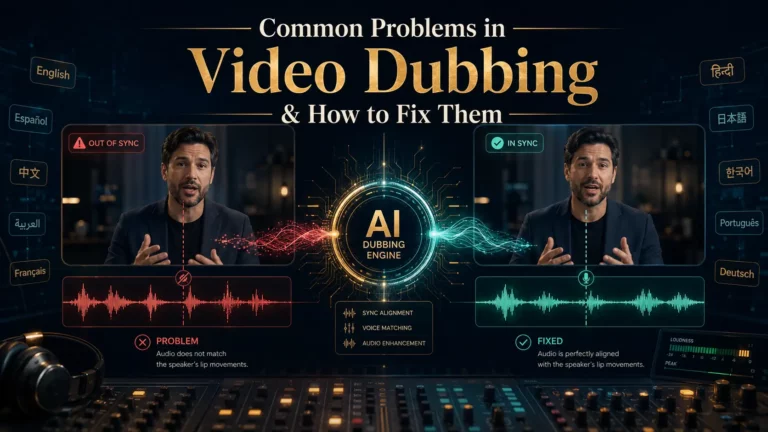
1. Lip Sync Issues: The "Bad Kung-Fu Movie" Effect
The most notorious problem in video dubbing is poor lip synching, which is often jokingly compared to poorly dubbed martial arts films from the 1970s. When audio doesn’t match visible mouth movements, it breaks the viewer’s immersion and undermines trust in the content.

This phenomenon is related to the McGurk effect, a perceptual phenomenon in which visual information received from lip movements can override or alter what our auditory system perceives. Discovered by psychologists Harry McGurk and John MacDonald in 1976, this effect demonstrates that when the lips are closed to produce a labial consonant, such as “P” or “M”, but the audio recording produces a fricative sound, such as “S”, viewers experience cognitive dissonance. Their brain detects a discrepancy, causing detachment and distrust of the content.
The technical difficulty lies in isochrony – matching the duration of speech in the target language to the original. Different languages have different rhythmic patterns and syllable densities. Spanish typically requires 20-25% more time than English to convey the same information, while Mandarin Chinese can be more compact.
Solutions for Better Synchronization
Manual Approach: Time Stretching and Script Adaptation
Professional dubbing directors use several techniques:
- Vowel extension: stretching vowel sounds to fill mouth-open moments.
- Consonant compression: shortening consonant clusters while maintaining clarity.
- Script adaptation: rewriting translations to match the number of syllables and stressed beats.
- Strategic breathing: adding natural breaths to fill pauses without appearing artificial.
AI Solutions
Modern AI dubbing technology addresses lip sync through multiple approaches:
- Visual dubbing (vubbing): a new technology, similar to deepfakes, that modifies video pixels to match new audio, adjusting lip shapes frame-by-frame.
- Smart sync algorithms: AI systems analyze mouth movement “energy” and dynamically adjust audio playback speed within an imperceptible range (typically 0.95x to 1.05x).
- Phoneme mapping: advanced systems that understand which phonemes create which mouth shapes and optimize target language text accordingly.
Some AI dubbing platforms apply automatic timing optimization algorithms that resolve isochrony problems, analyzing both source and target language to optimize timing without manual intervention.
2. Audio Drift and Synchronization Degradation
Understanding Audio Drift
Audio drift occurs when dubbed audio gradually desynchronizes from video over time, even though it was originally aligned correctly. This is typically caused by a sample rate mismatch between the audio and video files, such as mixing 44.1 kHz audio (common in music production) with 48 kHz video (standard for video production).
The problem gets worse with longer videos. A slight drift of just 0.1% results in a one-second misalignment over a 17-minute video, enough to create noticeable lip sync issues. Towards the end of the video, speakers’ mouth movements seem to either lag behind or, conversely, speed up.
Technical Solutions for Audio Drift
Sample Rate Consistency
Always match your audio sample rate to your video project settings:
- Verify source video frame rate (23.976fps, 24fps, 25fps, 29.97fps, 30fps, 60fps).
- Set audio sample rate to match video standard (48kHz for most video).
- Use professional audio editing software to convert sample rates without introducing artifacts.
- Avoid multiple conversions that compound rounding errors.
Frame-Accurate Editing
Work in video editing software that supports frame-accurate audio placement. This keeps audio alignment referenced to specific video frames rather than timecode approximations that can drift.
3. Robotic and Emotionless Voice Acting
Understanding Prosody in Dubbing
Early AI dubbing solutions failed because they lacked prosody – the rhythm, stress, intonation, and emotional nuances of natural speech. A flat, monotone robotic voice sounds like a GPS navigation system, placing the audio squarely in the “uncanny valley” where it’s almost human yet eerily artificial.
In 2025, YouTube launched auto-dubbing to 80 million creators, but viewers reacted harshly, complaining of “robotic voices” and lifeless audio that, according to one publication, resembled simultaneous translation at a UN session. Despite over 6 million daily viewers of auto-dubbed content on YouTube, the backlash made one thing clear: a robotic voice is the single fastest way to lose an audience through dubbing.
Prosody includes:
- Pitch variation: rising intonation for questions, falling for statements.
- Rhythm and tempo: natural pauses, accelerations, and fluctuations.
- Stress patterns: emphasis on important words.
- Emotional coloring: changes in the voice timbre that reflect emotions.
- Paralinguistic features: laughter, sighs, hoarse voice, aspiration.
Modern Solutions for Natural-Sounding Voices
Speech-to-Speech (STS) vs. Text-to-Speech (TTS)
Traditional text-to-speech converts written words to audio with limited emotional intelligence. Speech-to-speech technology represents a significant advance:
- Source analysis: STS models analyze the original speaker’s vocal patterns, detecting pitch curves, energy levels, and emotional markers.
- Prosody transfer: system replicates these paralinguistic features in the target language.
- Contextual emotion: if the original speaker laughs mid-sentence or adopts a sarcastic tone, the dubbed version maintains these qualities.
Advanced platforms combine voice cloning technology with style transfer so the “acting” is cloned, not just the words. This produces dubbed content where emotion and personality are conveyed across linguistic barriers – the most reliable solution for the robotic voice problem.
Human Voice Direction
Even with sophisticated AI, human oversight is still essential:
- Review automatically generated dubbing for emotional accuracy.
- Provide reference recordings demonstrating the desired emotional tone.
- Use platforms with human interaction features to clarify specific points.
- Consider hybrid workflows where AI handles large volumes of work while humans refine key moments.

4. Speaker Diarization Failures
The Multi-Speaker Challenge
Speaker diarization (the process of identifying “who spoke when” in an audio recording) creates significant problems in video dubbing, especially for content with multiple speakers, overlapping dialogue, or rapid speaker changes. When AI dubbing systems fail to correctly identify different speakers, they may assign the wrong voice to a character or fail to maintain voice consistency for the same speaker throughout a video.
Common scenarios where diarization fails include:
- Panel discussions with multiple participants.
- Interviews with frequent back and forth dialogue.
- Narrative content with multiple characters.
- Videos with background speakers or crowd noise.
- Content where speakers have similar vocal characteristics.
Solutions for Accurate Speaker Identification
AI Speaker Separation
Modern dubbing platforms use advanced machine learning models trained on thousands of hours of multi-speaker content. These systems analyze:
- Voice timbre and frequency characteristics are unique to each speaker.
- Speaker embedding vectors that create acoustic “fingerprints”.
- Temporal patterns that distinguish individual speaking styles.
- Visual cues when faces are visible to match voices to speakers.
Manual Override and Correction
Professional dubbing processes include:
- Pre-production speaker identification and labeling.
- Manual review and correction of AI-generated speaker assignments.
- Custom voice assignment for each identified speaker.
- Timeline markers indicating speaker changes.
Best Practices
- Provide clean source audio with minimal background noise.
- Include speaker labels or transcripts when available.
- Use videos with visible speakers to facilitate identification.
- Test speaker separation on short clips before processing full videos.
5. Poor Audio Mixing and the "Floating Voice" Problem
The Science of Spatial Audio
A “floating voice” occurs when dubbed audio sounds disconnected from the video footage – as if it were recorded in an isolated vocal booth and layered over the video footage without integration. This problem is especially common when you’re dubbing audio over video that was shot in a very specific acoustic space, and it disrupts the immersion effect because our brains expect sound to interact with the physical space.
The physics of sound propagation varies depending on the environment:
- Cathedrals and large spaces: sound reflects off hard surfaces, creating reverberation with a long decay time.
- Outdoor environments: sound dissipates quickly with minimal reflections, producing a “dry” audio.
- Small rooms: short reverberation with specific frequency characteristics.
- Cars and enclosed spaces: specific resonant frequencies and reflection patterns.
Professional dubbing must match these acoustic fingerprints or an audio will sound artificial.
Technical Fixes for Environmental Matching
Convolution Reverb
This technology uses “impulse responses” (IRs) – recordings of test signals in real spaces. Sound engineers play a test signal in a specific location (cathedral, kitchen, concert hall) and record how the space affects it. This turns into a mathematical filter that can apply identical acoustic characteristics to any audio.
Implementation process:
- Analyze the original video’s environment.
- Select or create an appropriate impulse response.
- Apply convolution reverb to dubbed voice tracks.
- Adjust wet/dry mix (typically 10-30% for realistic results).
EQ Matching and Frequency Carving
Equalization techniques help the duplicated voices fit naturally into the mix:
- High-pass filtering: remove frequencies below 80-100Hz to eliminate rumble and excessive bass that wasn’t present in the original version.
- Presence boost: slight enhancement at 3-5kHz improves clarity and intelligibility.
- Frequency notching: cut frequencies in background music (typically 1-3kHz) to create space for dialogue.
- Mud removal: reduce 300-500Hz range to prevent cloudy, dull sound.
Modern AI dubbing platforms include auto-leveling features that analyze the original audio environment and automatically apply appropriate processing to prevent the floating voice effect.
6. AI Hallucinations and Translation Inaccuracies
What Are AI Hallucinations in Dubbing?
AI-induced hallucinations occur when dubbing solutions that use only AI generate phrases that are not present in the original content. Unlike simple mistranslations, hallucinations involve the AI creating entirely fictitious content, potentially inserting information that contradicts or distorts the original message.
Common hallucination scenarios include:
- Adding explanatory phrases that are not included in the original text.
- Inventing technical terms or brand names.
- Creating transitions between sentences that weren’t spoken.
- Falsifying speaker references in content with multiple speakers.
- Generating filler words that change the tone.
Preventing and Detecting Hallucinations
Human Verification
The most reliable prevention method involves human review:
- Native speakers review translations before final approval.
- Comparative analysis of source and translated transcripts.
- Quality assurance protocols that identify suspicious additions.
- Subject matter experts check technical terminology and industry-specific terminology.
AI Quality Controls
With hallucination rates from 22% to 94% across leading AI models, advanced platforms implement technical protection:
- A credibility rating system that identifies uncertain translations.
- Source-target alignment verification.
- Phrase-level validation against training data.
- Automatic detection of content length mismatches (translated content significantly longer than the original indicates a potential hallucination).
Best Practices
- Use platforms that provide editable transcripts before voice generation.
- Implement glossaries for brand-specific terms and technical vocabulary.
- Test dubbing on representative samples before processing large batches.
- Compare the final video length with the original video (significant differences indicate problems).
7. Translation and Cultural Localization Failures
Common Translation Errors
Literal translation is the enemy of effective video localization. While the Chevrolet Nova story (“No va” meaning “it doesn’t go” in Spanish) is largely apocryphal, real translation failures happen regularly.
Idiom and Expression Problems
- “It’s raining cats and dogs” translated literally causes confusion.
- “Break a leg” sounds scary when translated literally.
- Cultural references (US sports metaphors, local celebrities) lose their meaning.
Register and Formality Mismatches
- Languages like Japanese, Korean, and German have complex formality systems.
- Translating casual English to overly formal French creates tonal inconsistency.
- Business vs consumer content requires different linguistic registers.
Brand and Technical Term Handling
- Product names may need localization or preservation.
- Technical terminology requires industry-specific knowledge.
- The language of legal and regulatory acts requires precision.
Best Practices for Cultural Adaptation
Context-Aware AI Translation
Modern AI translation systems powered by large language models understand context beyond word-level meaning:
- Analyzing surrounding sentences to determine intent.
- Recognizing idiomatic expressions and providing cultural equivalents.
- Maintaining consistent terminology across video series.
- Adapting humor and wordplay when possible.
Human Review
Automated translation should be verified by native speakers familiar with:
- Target market cultural norms and sensitivities.
- Industry-specific terminology.
- Brand voice and messaging guidelines.
- Regional dialect variations.
The most effective results are achieved by using context-aware transcreation rather than literal translation, followed by human verification of brand terms and cultural references before finalizing renders.
Transcreation vs Translation
In marketing content, consider transcreation – recreating emotional impact and compelling intent instead of simply translating words. This approach:
- Preserves the original’s emotional depth.
- Adapts calls to action to suit cultural contexts.
- Localizes examples and references.
- Maintains brand identity across multiple languages.

8. Background Noise and Audio Quality Issues
Common Audio Quality Problems
Low quality of the original audio creates a whole chain of problems during the dubbing process. Background noise, microphone interference, room echo, and audio compression artifacts all interfere with clean dubbing.
Types of audio problems include:
- Constant background noise (HVAC systems, traffic, electrical hum).
- Intermittent sounds (doors closing, phones ringing, paper rustling).
- Room acoustics problems (echo, reverberation, standing waves).
- Microphone handling noise and plosives.
- Compression artifacts from previous encoding.
Sound Cleanup Solutions
Noise Reduction Techniques
Professional sound cleanup includes several stages:
- Noise profiling: sampling background noise and removing it throughout the process.
- Spectral editing: manually remove specific frequency artifacts.
- De-reverb processing: reduce excessive room echo.
- De-essing: controlling harsh sibilant sounds (S, SH, CH).
Noise Gates and Dynamics Processing
- Noise reduction: mutes sound during pauses when speaker isn’t talking.
- Expansion: a gradual decrease in the volume of quiet sounds without abrupt interruptions.
- Compression: evening out volume fluctuations to ensure a stable level.
AI Sound Enhancement
Modern platforms use machine learning models trained on clean and noisy audio pairs to:
- Identify and remove noise while preserving voice characteristics.
- Restore clarity to muffled or distant recordings.
- Separate voice from background music without artifacts.
- Improve intelligibility of difficult to understand speech.
Prevention Best Practices
- Whenever possible, record sound in acoustically treated spaces.
- Use quality microphones positioned correctly (6-12 inches from the speaker).
- Monitor audio levels during recording to prevent clipping.
- Record room tone (30 seconds of ambient silence) for noise reduction reference.
- Avoid recording near windows, HVAC vents, or noisy equipment.
9. Voice Consistency Across Multiple Videos
The Challenge
Organizations creating video series, training courses, or content for regular use face a unique dubbing challenge: maintaining consistent voice performance across multiple videos created over time. The inconsistency of voices between episodes undermines professional authority and confuses viewers.
Common scenarios include:
- E-learning platforms with hundreds of course modules.
- YouTube channels translating their entire video catalog.
- A series of corporate training courses developed over several months or years.
- Entertainment franchises with multiple seasons.
Traditional dubbing faces practical obstacles:
- Voice actors may be unavailable for later sessions.
- Recording conditions vary between sessions.
- Natural voice changes occur over time.
- Coordinating schedules becomes increasingly complex.
Solutions for Voice Consistency
Voice Cloning Technology
AI voice cloning creates consistent digital voice models that can be used indefinitely:
- Generate a voice model from reference audio samples.
- Use this model across all videos in a series.
- Ensure stability regardless of production deadlines.
- If necessary, the entire catalog can be updated retroactively.
Style Guides and Reference Recordings
When working with human voice actors:
- Create detailed documents with instructions on how to use voices.
- Record and archive reference samples.
- Maintain consistent recording environments.
- Use the same engineer and equipment when possible.
Hybrid Approaches
Combine human talent with AI consistency to ensure cost-effectiveness while maintaining the human factor.:
- The first episodes are recorded by the actors.
- AI models clone their voices for routine content.
- Actors return for key emotional moments or important episodes.
10. Pacing Mismatches and Language-Specific Timing
The Rhythm Challenge
Different languages have different rhythms and lengths. A simple phrase like “Hi team!” in English might become an 8-syllable phrase in Japanese. This creates fundamental synchronization problems that go beyond simple tempo adjustment.
Language-specific timing considerations:
- Information density: some languages convey more information per syllable than others.
- Syllable timing: languages with rhythmic syllables (Spanish, French) and languages with rhythmic stress (English, German) have different rhythmic patterns.
- Phonetic complexity: languages with more consonant clusters require more time to articulate.
- Cultural speaking norms: expected speech rates vary by language and context.
Solutions for Natural Pacing
Adaptive Translation
Instead of directly translating words, adapt content to fit timing constraints:
- Prioritize key information and remove less essential details.
- Restructure sentences to match the target language syntax.
- Use shorter synonyms or alternative phrasings when needed.
- Add or remove transitional phrases to adjust timing.
Video Speed Adjustment
Modern tools can subtly adjust video playback speed with:
- Time stretching algorithms that maintain natural pitch.
- Speed control (different rates for different segments).
- Typical range: 0.9x to 1.1x speed (exceeding this value becomes noticeable).
Strategic Pausing
Natural pauses can compensate for timing differences:
- Add pauses between sentences.
- Extend existing pauses slightly.
- Use visual transitions or additional video footage (B-roll) to provide flexibility in timing.
11. Timeline, Workflow, and Production Bottlenecks
Common Workflow Issues
Video dubbing traditionally involves complex, time-consuming workflows that create bottlenecks in the project.
Multistage Production Pipelines
- Script translation (days to weeks).
- Voice actor casting and scheduling (weeks).
- Recording sessions (days, with retakes).
- Audio editing and cleanup (days).
- Mixing and editing (days).
- Review and revision cycles (weeks).
Coordination Challenges
- Managing international voice talent across time zones.
- Studio booking and scheduling conflicts.
- Multiple stakeholder reviews and approvals.
- Version control for iterative changes.
Quality Control Delays
- Time-consuming manual review processes.
- Rework when issues are discovered at a later stage.
- Technical problems requiring re-recording.
Optimizing Your Dubbing Process
Automated Dubbing Solutions
AI dubbing platforms significantly reduce the timeframe:
- Translation to final dubbed video in hours instead of weeks.
- No scheduling coordination required.
- Instant edits and improvements.
- Scalable to dozens or hundreds of videos simultaneously.
The market reflects this shift: the AI dubbing tools market is projected to reach $2.918 billion by 2033, growing at a 13.9% compound annual growth rate.
Parallel Processing
Structure your workflows to allow for multiple actions to be performed simultaneously:
- Start a rough translation while finalizing a source video.
- Prepare glossaries and style guides during pre-production.
- Test sample dubbing on short clips before full production.
- Set up review processes before content delivery.
Quality Assurance Automation
Implement systematic checking:
- Automated lip-sync analysis tools.
- Audio level monitoring and normalization.
- Translation quality indicators and an error flagging system.
- A/B testing with sample audiences.
How to Choose the Right Dubbing Solution
Selecting between traditional dubbing services, AI platforms, or hybrid approaches depends on several factors.
Consider Traditional Dubbing When:
- Budget allows for premium production ($100-300+ per finished minute).
- Content with extremely high stakes (theatrical releases, large-scale advertising campaigns).
- Longer periods (from several weeks to several months) are allowed.
- You need celebrity voice talent or very specific casting.
Consider AI Dubbing Solutions When:
- Fast processing (from a few hours to a few days) is extremely important.
- Budget is constrained ($10-50 per finished minute).
- You’re dubbing large content volumes.
- Consistency across many videos matters.
- Content is corporate, educational, or social media focused.
Hybrid Approaches Work For:
- Premium content requiring human nuances with AI efficiency.
- Projects where AI processes large volumes of work, while humans clarify key points.
- Organizations moving from traditional to modern workflows.
Today’s most advanced AI platforms offer emotional voice clones that breathe and pause naturally, automatic audio mixing to prevent floating voice issues, and context-aware translation – solving the core problems described in this guide with integrated AI solutions.
Conclusion
Video dubbing is a complex technical, linguistic, and creative challenge, but understanding these common problems points the way to effective solutions. Whether you choose traditional professional dubbing services, modern AI platforms, or hybrid approaches, focus on accurate lip syncing, emotional voice quality, proper audio mixing, and culturally appropriate translation.
As AI technology advances, the gap between the quality of traditional and automated dubbing is narrowing, making high-quality video localization increasingly accessible to organizations of all sizes. By applying the techniques described in this guide, you can produce dubbed content that appeals to an international audience and maintains your brand’s professional standards despite language barriers.
Frequently Asked Questions
Lip sync problems usually arise from isochrone mismatches – the dubbed audio is either too fast or too slow for visible mouth movements. Different languages require different durations to convey the same information. Solutions include time-stretching audio, adapting the script to the number of syllables, or using AI tools with automatic synchronization adjustments.
Use noise reduction plugins to mute sound during pauses when the speaker is silent, and apply AI-powered noise reduction to improve your recording quality. During initial recording, minimize background noise by using quality microphones in specially equipped spaces.
A robotic voice in AI dubbing comes from a lack of prosody – the natural rhythm, stress patterns, and emotional intonation of human speech. This is usually the result of basic text-to-speech systems. Modern speech-to-speech technology that analyzes and replicates the speaker’s emotional patterns produces much more natural results.
Audio and video desynchronization occurs gradually over time, usually due to a mismatch in sampling frequency between the audio and video files (e.g., 44.1 kHz vs. 48 kHz). Always make sure your audio sample rate matches your video project settings.
AI hallucinations in dubbing occur when AI systems generate phrases or content that are not present in the original video. This can include fabricated explanations, invented terms, or content that distorts the original message. Human verification helps prevent such problems.
Modern AI translation using large language models can significantly improve translation quality by understanding context, idioms, and cultural nuances. However, for brand-specific terminology, cultural sensitivity, and creative content, human review is still essential for optimal results.
Traditional professional dubbing can take 2-6 weeks, depending on video length, language combinations, and review cycles. AI dubbing can reduce this to hours or days, making it practical for time-sensitive content and high-volume projects.
Dubbing replaces the original dialogue with translated speech, trying to synchronize lip movements and speech tempo. Voice-over typically involves a narrator speaking over the original audio (which may be lowered but still audible), without regard for lip-sync. Dubbing is more immersive, but technically difficult.
Different languages have different information density and number of syllables. What takes three syllables in English can take eight in Japanese. Solutions include adaptive translation that prioritizes key information, fine-tuning of video speed (0.9x-1.1x), and strategic pauses between sentences.