If you manage an SDR team, work in demand generation, or are responsible for content production for a B2B company, you’ve probably asked some version of this question: are AI avatars better than humans for business video?
The honest answer is: it depends on the task. AI avatars aren’t magic – they’re a tool for putting new capabilities to work. In some workflows, they actually outperform a human presenter. In other cases, having a real person in front of the camera is still the better option.
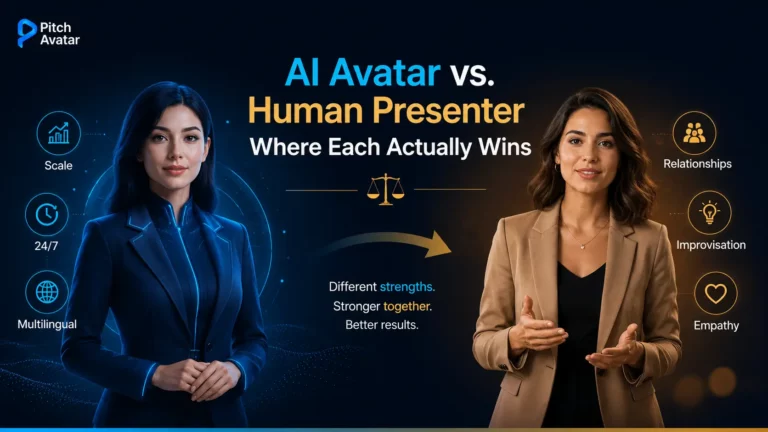
TL;DR: Are AI avatars better than humans for business video? It depends on the task. Avatars outperform human presenters at consistency, 24/7 availability, multilingual delivery, production speed, cost at volume, and error-free delivery – all in repetitive work that depends on scale. Humans still win wherever improvisation, deep relationships, emotional complexity, or genuinely original thinking are required. The smart approach isn’t to choose one over the other: it’s to have a division of labor where avatars handle initial demos, training, and routine support, while humans handle introductory calls, corporate relations, conflict resolution, and strategy development. The solution table below matches ten common B2B use cases with suitable solutions.
This article takes a detailed look at specific scenarios where AI avatars have a distinct advantage over human presenters, where humans still win, and how to decide which approach fits your use case. No hype, just a practical comparison based on the real results of B2B teams.
What We Mean by "AI Avatar" In a Business Context
Before we compare, let’s clarify. When we say “AI avatar” in a business context, we’re not talking about science fiction or movie characters. We’re talking about realistic digital presenters (generated from uploaded images, text scripts, and with cloned voices) that can deliver video content, host presentations, and interact with audiences in a conversational format.
Think of them as virtual versions of your best sales rep, mentor, or support agent – available 24/7, in multiple languages, without scheduling conflicts or bad hair days.
Pitch Avatar helps you create these conversational AI assistants in minutes: choose an appearance, clone a voice, upload a knowledge base, and share. The avatar is responsible for message delivery. You retain control over the message.
Where AI Avatars Outperform Human Presenters

Let’s start with scenarios where an avatar has clear, measurable advantages over a human presenter.
1. Consistency at Scale
A human presenter delivers the same presentation slightly differently every time. Tone changes, key moments are missed, energy varies from hour to hour. An AI avatar delivers your script with the same quality on the 1st play and the 1,000th.
Why it matters: For sales enablement and corporate learning, consistency directly impacts conversion rates and knowledge acquisition. When every prospect or trainee receives the same quality presentation, you’re removing a major source of variability from your funnel.
2. 24/7 Availability
Your best AE sleeps. Your AI avatar doesn’t. For global teams running outbound across EMEA, APAC, and the Americas, a demo or product walkthrough with an avatar is available the moment a prospect clicks a link – no scheduling or time zone considerations required.
The impact: AI-powered customer support and pre-sales workflows see measurable lifts in response time and engagement when avatars handle the first touch. The volume argument is real: organizations have reported reductions of up to 70% in call, chat, and email inquiries after deploying virtual assistants (Gartner, 2018), and routine cases needing fast, straightforward answers are commonly estimated at 70–80% of all requests.
3. Multilingual Delivery Without Extra Headcount
Recording a human presenter in six languages means hiring six presenters – or one very patient polyglot doing multiple takes. An AI avatar delivers the same script in multiple languages with natural intonation and lip sync.
For global teams: This is where content localization and international go-to-market get dramatically cheaper. One script, many markets – without the production overhead.
4. Speed of Production
Recording a human video involves scheduling, lighting, audio setup, retakes, and editing. Minimum turnaround: days. A video with an AI avatar can be produced from a text script or PowerPoint in minutes. Need to update a stat or swap a CTA? Change the text and regenerate without reshoots.
Real-world use: SDR teams using AI avatar videos for personalized email outreach can produce hundreds of personalized videos per week. Try that with a human on camera.
5. Cost Efficiency at Volume
The math is straightforward. A single human-recorded video costs time and production resources each time you create one. Videos with AI avatars have a near-zero marginal cost per additional video once the avatar is set up. For teams producing high volumes of training content, product demos, or marketing videos, the cost curve quickly diverges.
6. Error-Free Delivery
An AI avatar delivers lectures and presentations without mistakes, slips of the tongue, or awkward pauses. For HR onboarding, compliance training, and standardized product demos, this flawless delivery removes risk. No “ums”, no deviations from the script, no unfortunate remarks.
Where Humans Still Win

Now for the honest part. Because any fair comparison between an avatar and a human must take into account the shortcomings of AI. For a deeper exploration of this side, see our founder’s analysis on what makes a human better than a robot.
1. Creative and Spontaneous Communication
AI avatars follow scripts. Humans improvise. In live discovery calls, negotiation, or any conversation where it is necessary to sense the situation and quickly change direction, an experienced person is indispensable. AI systems are still far from truly original creative thinking – they compile from known examples, but creating something fundamentally new and unconventional is not yet within their competence.
2. Building Deep Relationships
In corporate sales cycles with six-figure deals, trust, rapport and genuine human contact are critical. An AI avatar can warm up a lead and facilitate the initial interaction, but building the relationships needed to close complex deals still requires a real person.
3. Handling Edge Cases and Emotional Complexity
When a customer is frustrated, confused, or facing a complex issue that doesn’t fit into any knowledge base, human empathy and judgment are crucial. AI avatars can handle the majority of routine cases, but they need to escalate the complex, emotionally charged situations to a human.
4. Task Switching and Universality
Humans are amazingly versatile. One person can switch between presenting a product demo, training a new employee, and brainstorming campaign ideas – all in the same afternoon. An AI avatar configured for one task requires reconfiguration for another. A human only needs the rules explained to him.
Practical Basis: When to Use Which Method

Stop thinking about this as “AI avatar vs. human” and start thinking about it as a division of labor. Here’s a practical decision framework:
| Use case | Best fit | Why |
|---|---|---|
| First-contact product demos | AI avatar | Available 24/7, consistent, eliminates planning difficulties |
| Personalized outbound video at scale | AI avatar | Hundreds of personalized videos a week - people can't handle that volume. |
| Multilingual training content | AI avatar | One script, many languages, no extra headcount |
| SDR/AE onboarding modules | AI avatar | Consistent delivery, easy to update, always available |
| Customer support (routine queries) | AI avatar | Handles most of the routine requests, freeing people to solve complex problems. |
| Live discovery and negotiation calls | Human | Requires improvisation, ability to sense the situation, establish contact |
| Enterprise relationship management | Human | Trust and emotional connection drive large deals |
| Creative brainstorming and strategy | Human | Original thinking, not just copying existing patterns. |
| Escalated support (angry/confused customer) | Human | Empathy and judgment for emotionally complex situations |
| Webinar or event hosting (with live Q&A) | Human + AI avatar | Human hosts the live discussion; avatar is responsible for the structured presentation |
How B2B Teams Are Using This in Practice
The teams getting the most value from AI avatars aren’t replacing their employees – they’re expanding their reach. Here’s the pattern we observe:
- Sales teams use AI avatars for topof-funnel demo delivery and personalized outreach at scale, then hand off qualified leads to human agents for direct calls.
- HR and L&D teams use avatars for standardized onboarding and training modules across regions and languages, freeing trainers to focus on mentorship and coaching.
- Marketing teams create localized video content at a fraction of the cost and in a fraction of the time, then attract subject matter experts to provide insight and host events.
- Support teams use AI-powered avatars to handle routine requests, while human agents focus on complex situations and relationship repair.
The general idea: avatars perform repetitive, scalable tasks so humans focus on high-value work that requires judgment, creativity, and empathy.
The Bottom Line: AI Avatars Are Better at Scale, Humans Are Better at Depth

Are AI avatars better than humans? At delivering consistent, multilingual, always-available video content at scale – yes, measurably so. At building relationships, improvising in live conversations, and producing genuinely creative work – no, and that’s not the point.
It’s smartest not to choose just one thing. The key is to use AI avatars to do the tasks they do best (repetitive, high-volume, and precision-driven tasks) and freeing your team from routine work, allowing them to focus on the tasks that truly require human interaction: closing deals, building relationships, and generating ideas that AI can’t generate on its own.
To explore the full range of what AI avatars can do in business today, see our comprehensive guide to AI avatars.
Ready to compare how an AI avatar performs in a video you recorded yourself? Try Pitch Avatar with a live demo and see the results firsthand.

Maryna Akishenko
Frequently Asked Questions
It depends on the task. AI avatars outperform humans at consistency, 24/7 availability, multilingual delivery, production speed, and cost at high volumes – that is, for repetitive, scale-dependent tasks. Humans win wherever improvisation, relationship building, emotional validation, or genuinely original thinking are required. The practical answer is a division of labor, not a replacement.
First contact product demos, personalized outbound videos at scale, multilingual training content, onboarding modules, and routine customer support. All of this is united by the same profile: high volume, high repetition rate, and a priority on stability – avatar delivers the same quality at both the 1000th and first view, in multiple languages, with virtually zero marginal costs for each additional video.
Wherever interactions occur in real time and are unpredictable: discovery calls, negotiations, corporate relationship management, escalated support for dissatisfied customers, and creative or strategic work. They don’t know how to sense the situation, change the subject mid-conversation, or generate fundamentally new ideas – in this regard, people remain irreplaceable.
No – and teams that get the most value aren’t even trying. The process works like this: avatars provide product demonstrations at the beginning of the sales funnel and provide personalized interactions at scale, then pass qualified, interested leads on to sales agents for direct calls. Deals are still made based on trust and mutual understanding, which requires a real person.
It can handle the routine part – which is most of the volume. The design requirement: the avatar must escalate complex, emotionally charged situations to the person, providing complete information in the context of what is happening.
Recording with a human requires planning, lighting, retakes and editing – at least several days. Video with an AI avatar can be generated from a text script or PowerPoint in minutes, and updates don’t require reshoots: simply change the text and regenerate the video. This is how SDR teams create hundreds of personalized videos per week.