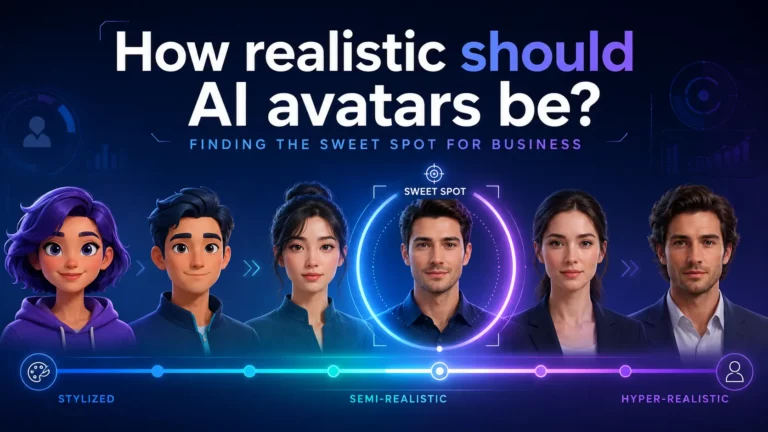
TL;DR: The right level of realism for an AI avatar depends primarily on the tasks it has to do – not on a “more realistic is always better” rule. For high-trust business content (webinars, sales, consultations, compliance training), realistic AI avatars are a safe default because they are perceived as professional and authoritative. For engagement-focused contexts (children’s content, branded mascots, onboarding, social), animated avatars can perform better – they avoid the “uncanny valley” and openly display their artificial nature. The decision comes down to four parameters: target audience, business objective, budget and scalability, and context of use. This guide provides managers with a practical basis for making choices and also shows what the research has actually concluded about avatars and human presenters.
If we answer the main question as simply as possible: the realism of an AI avatar depends first and foremost on the purpose for which it was created.
In the corporate environment, choosing the right level of realism for an AI avatar directly impacts the effectiveness of communications, audience trust, and the final ROI of projects. The optimal solution is not determined by the formula “the more realistic, the better”. It depends on the business objective, the profile of the target audience, and the context of use.
In some cases (content for children or branded presentations), animated avatars that drive a high level of engagement may be the optimal solution. In others (webinars, sales, and consultations), high realism is required, because it creates a sense of authoritative professionalism. The golden mean, which ensures maximum return and minimum costs when solving a problem, must be determined individually in each specific case.
Animated Avatars: Engagement and Brand Recognition
Using “drawn” digital characters is not a compromise or a “budget option”. This is a deliberate choice, especially in cases where it is necessary to quickly remove psychological barriers and create a memorable image of a company or project.
Such characters can prove highly effective both in marketing campaigns and in supporting internal communications with a high level of trust.
A good example is the use of AI avatars based on branded mascots. They can act as hosts for product presentations, virtual tours, client onboarding, and various online events. These avatars are themselves part of the corporate identity and can be easily scaled across the company’s entire content library. Their creation generally does not require working with real human prototypes, which reduces costs and speeds up production – especially important for campaigns with tight deadlines.
A similar approach works in corporate onboarding. Basic educational and introductory internal materials delivered through animated AI avatars help new employees integrate without unnecessary psychological stress. A stylized digital character, especially one executed with gentle humor, lowers stress levels and lets people focus on the content.
It’s worth noting that some B2B platforms demonstrate higher view conversion rates and better audience retention when using AI animated avatars – thanks to the absence of the “uncanny valley” effect.

This phenomenon, first described in 1970 by Japanese professor Masahiro Mori, occurs when an avatar looks almost human but displays barely noticeable inconsistencies in facial expressions, gestures, or gaze, triggering subconscious discomfort and associations with deception. In B2B, where audiences are already at a higher level of critical perception, the uncanny valley effect is particularly costly. In this light, a major advantage of an animated character is that its very appearance immediately indicates its artificial nature – eliminating any hints of deception and increasing the comfort of interaction.
A number of companies are already using this approach to bring traditional mascots to life and transform them into interactive AI avatars, maintaining brand recognition while increasing audience engagement.
As Real As People: The Standard for Most Business Tasks
As of today, AI avatars with a high degree of realism are in greatest demand in the corporate segment – a market projected to reach $258 billion by 2030. The reason is their versatility and their ability to build trust in high-stakes scenarios. Realistic AI avatars look natural in almost any classic business content and don’t create a sense of frivolity or artificiality.
They’re ideal for traditional webinars, presentations, video tutorials, and documentary materials. A well-designed realistic AI avatar is subconsciously perceived as a professional and an expert.

How does that perception hold up against an actual human on camera? The honest answer from the research is reassuring for the realistic-avatar case: independent studies from 2024 to 2026 (including research at the University of South Florida and UCL) find no significant difference in engagement, retention, or trust between a realistic AI avatar and a human presenter for standard informational and training content. The use of AI avatars has demonstrated a clear increase in engagement compared to text-based alternatives. The practical takeaway for the realism question: a well-designed, realistic avatar performs about as well on-screen as a human when interacting with typical business content, making it a safe default choice for webinars, training, and documentation. It also avoids a common problem with filming real people – most business speakers haven’t been trained in public speaking, so they stutter and make mistakes in facial expression, emotion, and intonation. An AI avatar is free from these drawbacks.
Realistic avatars are in particular demand in three areas:
- Digital twins of specialists. Financial consultants, lawyers, HR managers, support engineers, and other experts create a digital twin available 24/7. Interaction helps maintain personalization and loyalty. In B2B, this allows for scaling expertise without increasing staff.
- High-level corporate communications. Employee training, compliance training, internal strategy updates. In this case, animation may be perceived as not being serious enough, while a realistic avatar creates a professional atmosphere and emphasizes the importance of the message.
- Digital employees based on agentic AI. Highly autonomous systems capable of performing complex step-by-step actions are gaining popularity, and they’re ideally suited to be “dressed” in the image of a highly realistic avatar. This provides the most convenient and comfortable interaction with the AI agent.
Two enterprise examples show realistic avatars at work. Zoom adopted AI Avatars for internal sales-enablement training videos: content production accelerated by roughly 90%, with monthly cost savings of $1,000-1,500 per employee previously spent on creating training videos. And at PwC’s Tax Leadership Conference 2025, three interactive AI avatars developed by RAVATAR acted as live holographic interfaces for large-scale tax and compliance training, answering participant questions in real time and bringing consistency and depth to enterprise-level learning.
Modern technology makes it possible to reach high realism without high cost: lip and micro-expression synchronization with speech, natural gestures, and adaptation to emotional context. Peer-reviewed research confirms that engagement gains peak when both voice and avatar are AI-generated. At the same time, full hyper-realism isn’t always required. Many companies choose “stylized realism” – a lifelike appearance with light artistic processing. This minimizes uncanny-valley risk while keeping a professional look.
For a deeper look at what technically makes an avatar realistic (and the ethics of hyperrealism) see our guide on the quest for the realistic AI avatar.
Practical Checklist for Choosing The Level of Realism
Managers responsible for implementing AI avatars should evaluate four key parameters.
- Target audience. For employees aged 25-45 in a B2B environment, realism is usually preferable. For a broad consumer audience or internal entry-level programs, stylization and animation may be more effective.
- Business objective. Engage your audience and increase brand awareness with lean animation. Trust, sales, and learning complex skills are based on realism.
- Budget and scalability. Animated avatars require fewer resources to create and update. Realistic ones pay for themselves through repeated use in sales and training.
- Application context. Internal platforms, webinars, presentations, and online events prioritize high levels of realism. Initial company introductions for clients and employees, image projects, social media, and short videos are all good places to experiment with stylization and animation.
Prospects: Adaptive Solutions and New Level of Flexibility
The main conclusion is the same one we started with: managers should not regard maximum realism as an end in itself. What matters is that the avatar accurately matches the task and doesn’t create additional barriers. Choosing the level of realism is a tool for increasing the effectiveness of communication, reducing costs and strengthening competitive position. In some cases, the optimal choice is an animated mascot, in others a stylized human figure, and in others a digital twin of a key expert.
It’s also worth considering that technological progress is getting ever closer to a new type of AI avatars – universal ones capable of adapting to various circumstances. These are essentially hybrids of an AI avatar and an AI agent that, by command or automatically, change their appearance and communication style depending on the assigned task, target audience, and other factors. In different situations, such an avatar can be either an animated character or a “digital human” with varying levels of detail. In other words, in the near future, most specialists may stop creating several different AI avatars for different tasks and start using a single, advanced AI avatar with a high level of adaptability.
This flexibility is likely to lead to a new surge in the popularity of AI avatars and further expand their applications.
Frequently Asked Questions (FAQ)
For standard informational and training content, the research finds roughly equal levels of engagement, with no clear advantage for either side. Independent studies from 2024 to 2026 (including University of South Florida and UCL research) found no significant difference in engagement, attention retention, or trust between a well-designed, realistic avatar and a human presenter. Humans retain a clear advantage for emotional, brand-defining, and valuable content (founder stories, crisis communications, testimonials). The largest measurable increase in engagement for avatars is seen when compared to text-based content like PowerPoint presentations, rather than videos featuring people.
When engagement and brand recognition matter more than authoritative trust, and when you want to eliminate uncanny-valley risk entirely. Branded mascots, customer and employee onboarding, image campaigns, social media, and short-form video are good choices. Animated avatars are also cheaper to create and update, and they scale easily across a content library as part of corporate identity.
Stylized realism is a lifelike avatar appearance with light artistic processing – recognizably human, but not striving for complete photorealism. It minimizes uncanny-valley risk while keeping a professional look, which is why many companies choose it for business content instead of full hyperrealism.
The uncanny valley, first described in 1970 by Masahiro Mori, is the discomfort people feel when an avatar looks almost human but has subtle inconsistencies in expression, gesture, or gaze. In B2B, where audiences are already critical of the information they receive, that discomfort can undermine trust. Animated avatars avoid this effect by openly indicating their artificial nature; realistic avatars achieve it through high production quality or stylized realism.