History records numerous cases where language barriers and the resulting misunderstandings turned interactions between representatives of different nations into anecdotal or, at times, truly tragic situations. It is no coincidence that the topic of translation has always received significant attention in both business and politics, and professional translators enjoy well-deserved respect.
TL;DR: Accessible, translated content is no longer optional – it’s a legal requirement under WCAG, the ADA, the European Accessibility Act, GDPR, and the EU AI Act, with penalties reaching €20 million or 4% of global turnover. 94.8% of the top one million website homepages still do not comply with WCAG (WebAIM, 2025), and 40% of consumers will not buy from websites in another language (CSA Research). Traditional translation cannot cope with the volume, speed, and 100+ languages regulators and users now expect. AI translation closes the gap: it localizes content in minutes, automatically generates accessibility layers (subtitles, alt text, transcripts, plain language versions), and keeps terminology consistent – most reliably in a hybrid model where AI handles speed and scalability and humans make edits for sensitive materials (legal, medical, privacy content). The practical way: choose tools that meet the requirements, add human verification where it matters, audit regularly, and document everything.
The problem today is that globalization and digitalization have multiplied the volume of content that requires translation many times over – and not just high-quality translation, but fast translation as well. Naturally, a situation has arisen in which professional translators simply cannot cope with the sharply increased workload. Many companies and organizations also cannot afford their services in the required volume.
At the same time, high-quality, adequate translation has largely stopped being an optional matter left to the discretion of management and has become a mandatory requirement. Failure to comply with standards requiring a company to provide high-quality translations can result in reputational and market losses, license revocation, litigation, and substantial fines. Modern examples include the EU’s GDPR regulation or the international web content accessibility standard WCAG.
What is AI translation for compliance and accessibility?
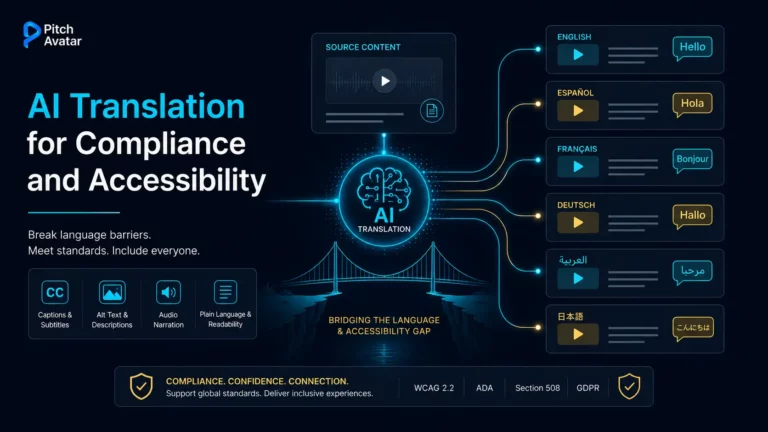
AI translation for compliance and accessibility is the use of AI localization to make content accessible, accurate, and understandable in every language your audience and regulators require. It includes fast multilingual translation, as well as accessibility features (subtitles, alt text, audio versions, and plain language formats) that are increasingly required by laws such as WCAG, ADA, the European Accessibility Act, GDPR, and the EU AI Act.
Why This Matters: The Accessibility and Language Gap
The scale of the gap is striking. In the 2025 WebAIM Million analysis, 94.8% of the top one million home pages had detectable WCAG violations – most commonly low-contrast text and missing alt text. Language plays an equally crucial role in audience reach and revenue: CSA Research found that 76% of consumers prefer to buy products with information presented in their native language, and 40% will not buy from websites in other languages.

Communicating with people in their language (communication in an accessible way) is not just a matter of politeness. It determines who can use your content and who buys from you. This is why AI translation has proven to be the optimal solution in several areas at once:
- It helps quickly and effectively adapt content for multiple languages.
- It simplifies converting text to speech and creating corresponding subtitles, alternative texts, and simplified or extended versions.
- It saves on the cost of professional translator services.
- It helps meet regulatory requirements and promote products, services and ideas – a strategic tool for ensuring compliance and accessibility.
In other words, this is a solution that serves the interests of both companies, organizations, and content creators and their clients and audiences at the same time. Let’s take a closer look at the advantages of AI translation in light of the above.
Regulations AI Translation Helps You Comply With

| Regulation | Region | What it requires | Status / deadline |
|---|---|---|---|
| WCAG 2.1 / 2.2 Level AA | International standard | Text alternatives for images, quality subtitles, clear language, navigable content | A standard reference for most laws |
| ADA Title II | USA (state & local governments) | WCAG 2.1 AA for websites and mobile apps | The deadline has been extended until April 26, 2027 (for large organizations) and until 2028 (for smaller ones) |
| European Accessibility Act (EAA) | EU | Accessible digital products and services, including content in national languages | Effective from June 28, 2025 (for existing services - by 2030) |
| GDPR | EU | Clear, accessible language when processing personal data | In force |
| EU AI Act | EU | Transparency and explainability for AI systems, including automatic translation tools | Article 50 of the Transparency Rules, effective from 2 August 2026 |
A note on the ADA: the original April 2026 deadline was extended by the Department of Justice, but the requirement itself (WCAG 2.1 AA for public sector web and mobile content) remains in effect, and the clock is still running.
The Limits of Traditional Translation for Compliance

Companies operating in international markets must provide information in the user’s language (accurately, with cultural nuance, in full, and in an accessible format with subtitles, audio versions, and clear text), all without loss of meaning or discrepancies with the source. Relying solely on professional translators makes doing this quickly and at scale increasingly difficult and expensive. Traditional translation has several critical limitations that are most acutely felt in a regulatory compliance context:
- High cost and long timelines. Translating large volumes of content (websites, documentation, training materials, legal texts) usually requires translators, proofreaders and editors. Their work is expensive, and quality localization can take weeks or months – critical under strict regulatory deadlines.
- Difficulty of scaling. When you need 50-100 or more languages simultaneously, a shortage of human resources is inevitable. Keeping that many specialists on staff is unrealistic, and contractors may already be busy with other projects. Fast and high-quality translation into many languages using traditional methods is practically impossible.
- Risk of human error and inconsistency in terminology. Even experienced translators make inaccuracies, especially in legal, medical, or technical texts. Without a strict glossary system, terminology “spreads” from document to document – and specialists in specific fields are even more difficult to find than generalists.
- Difficulties in ensuring accessibility. High-quality subtitles, alternative texts, simplified versions for people with cognitive disabilities, and audio versions require the involvement of editors and specialists whose work is paid separately from the translation. As a result, both time and costs increase.
In practice, these problems often turn into an “information flow” of translations into dozens or even more than a hundred languages, in which even a large corporation can drown – to say nothing of small and medium-sized companies.
How AI Translation Helps Meet International Standards
Of course, regulations requiring high-quality localization didn’t appear out of nowhere. Nor did user expectations of receiving content in their native language. Modern AI translation systems enable companies and organizations to address the challenges related to speed, quality, accessibility, legal compliance, and user expectations at the same time. This is especially relevant for platforms that operate in a hybrid mode (with human intervention) and use specialized models with customizable glossaries.

Here are five key areas where AI translation provides a real advantage in the international market:
- Speed and scalability. AI can translate and adapt huge volumes of content in minutes and hours instead of weeks and months. Under tight deadlines, speed becomes the decisive factor – ensuring both legal compliance and a competitive advantage. Without hiring a staff of translators, even a small company can support translation, adaptation, and updates in 100+ languages.
- Automatic accessibility. One of the strongest advantages of modern AI platforms is their built-in accessibility tools. They can automatically generate high-quality subtitles, alternative text for images, audio transcriptions, simplified text versions for people with cognitive disabilities, and other formats – satisfying a significant portion of WCAG 2.1/2.2 Level AA requirements without hiring expensive specialists.
- Terminology consistency and legal accuracy. In the case of normative, legal and medical texts, even minor inaccuracies can have serious consequences. AI translation with properly configured glossaries and custom models ensures consistent terminology across all your content. That significantly reduces the risk of non-compliance and simplifies audits and certification.
- Multilingual support without compromises. Businesses can no longer be limited to 5-10 key languages; regulators and users expect accessibility in national languages. Modern AI systems localize materials into 100+ languages with a single click while preserving meaning, cultural adaptation, and correct style – and quality, approaching the standards of professional human work, especially when using post-editing.
- Risk and cost reduction. Companies that have switched to AI-powered hybrid translation report reduced costs and a predictable localization budget. Instead of constantly “catching up” with regulatory changes and paying for urgent revisions, they receive a tool that makes it easy to scale and adapt all their content to new requirements. Pitch Avatar integrates translation, dubbing, and accessibility into a single workflow.
What Non-Compliance Costs

The fines are not theoretical. Under GDPR, fines can reach €20 million or 4% of global annual turnover. The EU AI Act adds fines of up to €15 million or 3% of turnover for breaches of transparency principles. In the United States, complaints and lawsuits related to digital accessibility under the Americans with Disabilities Act (ADA) have become commonplace, with government agencies facing enforcement pressure after Title II deadlines expire.
Beyond fines, there’s a more complex problem that’s harder to solve: the loss of trust from customers and citizens who find they can’t use (or don’t understand) your content. For content that people rely on to make decisions about money, health, or their rights, that failure also has real human consequences.
Practical Recommendations: How to Implement AI Translation and Avoid Fines
For AI translation to become a reliable assistant in compliance and accessibility, implement it thoughtfully and systematically. Four key recommendations will help you achieve maximum returns with minimal risk.
- Choose platforms with built-in compliance features. Not all AI translation tools are equally useful from a regulatory perspective. Look for solutions built with compliance in mind: they automatically generate high-quality subtitles, alternative texts, audio transcriptions, and simplified text versions. Built-in glossaries and the ability to create custom models for your industry terminology are also important. Such platforms can meet a significant portion of WCAG, ADA, and EAA requirements from the start without manual post-translation rework.
- Use a hybrid approach: AI + mandatory human post-editing. Fully automatic translation isn’t suitable for every material. For critical documents (legal texts, privacy policies, medical information, contracts, crisis communications), apply the “AI + post-editing” scheme. A human reviewer checks accuracy, cultural appropriateness, and legal meaning. This combines the speed and scalability of AI with the reliability and responsibility of a human.
- Conduct regular translation quality audits. Don’t rely solely on built-in AI metrics. Perform periodic independent audits against WCAG 2.2 Level AA, local regulations, and your internal standards – internally with checklists, or with external accessibility experts. Regular audits identify weaknesses before regulators notice them.
- Document all processes and decisions. During a regulatory audit, systematic documentation is one of your strongest arguments. Record which AI platforms you use, how glossaries are configured, which materials undergo post-editing, how often you conduct audits, and who is responsible for them. This transparency simplifies communication with inspectors and shows you take compliance and accessibility seriously.
Quick Self-Check: Is Your Multilingual Content Compliant?
A quick way to assess where you stand is to ask yourself: Can you answer “Yes” to each of these questions?
- Coverage: Is your content available in every language your users and regulators expect, not just the top 5-10?
- Accessibility maintained: Are subtitles, alt text, transcripts, and captions preserved across each language translation?
- Plain language: Are there clear, simplified versions for readers with cognitive disabilities?
- Terminology: Do you use a glossary so legal and technical terms stay consistent across languages?
- Human review: Are sensitive documents (legal, medical, privacy) reviewed by specialists before publication?
- Documentation: Can you specify which tools, glossaries, audits, and responsible persons confirm your process?
Any “No” is a gap that should be addressed before a regulator (or a customer) finds it.
Summary: New Standards of Global Communication
AI translation has become a strategic tool across many fields, almost instantly by historical standards. It’s not just about complying with strict international regulations, ensuring genuine content accessibility and reducing localization costs. AI translation tools help humanity realize its deep desire to overcome linguistic and semantic barriers.
Public organizations, educational and governmental institutions, NGOs, and individual authors alike now have the chance to be heard and understood by a much wider audience. AI translation carries commercial offers, social initiatives, educational programs, and important messages more effectively – letting you speak to a person in their native language, in a convenient format, and personalized to their individual needs, without losing meaning, emotional coloring, or legal accuracy.
Organizations that consciously implement AI translation as part of their compliance and accessibility strategy gain a real competitive advantage. They enter new markets faster, meet regulatory requirements more easily, and (most importantly) actually make their content accessible to millions of people around the world.
Frequently Asked Questions
It’s about using AI-powered localization to ensure content is accessible, accurate, and understandable in all the languages your audience and regulators require – combining fast, multilingual translation with accessibility features like subtitles, alternative text, audio versions, and plain language formats.
The key standards include WCAG 2.1/2.2 Level AA (International Core Level), Title II of the Americans with Disabilities Act (ADA) in the US, the European Accessibility Act in the EU, the GDPR, and the EU Artificial Intelligence Act transparency rules.
For sensitive content, this is not the only option. The reliable model is hybrid: AI handles speed and scale, and a human reviewer performs post-editing of sensitive materials (legal, medical, privacy) for accuracy and legal compliance. Regular accessibility audits close the loop.
ADA Title II makes WCAG 2.1 Level AA the standard for state and local government web and mobile content. The original April 2026 deadline was extended by the DOJ to 26 April 2027 for large public entities and 2028 for smaller ones.
Modern AI platforms can automatically generate subtitles, alternative text for images, audio transcriptions, and simplified text versions in multiple languages – covering a large portion of WCAG 2.1/2.2 Level AA requirements without the need for specialized teams.