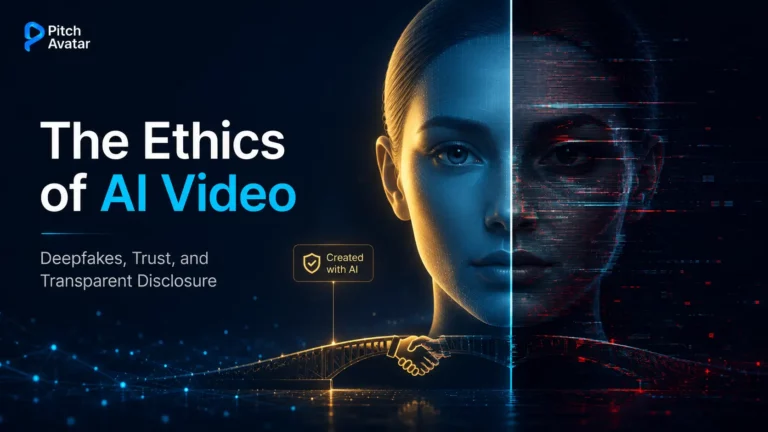
We’re explaining why, when creating videos, presentations, films, and any other video content, it’s crucial to clearly let viewers know that you’re using artificial intelligence in your work – and how to do it the right way.
What is AI Video Ethics?
AI-generated video ethics is about the responsible creation and disclosure of AI-generated or AI-modified videos. It is based on two principles: never use a real person’s image without consent and never present AI-generated content as real. In practice, this means getting permission to use any real person or voice you recreate, and clearly disclosing anything that was created or modified by AI so that the viewer is never deceived.
To delve deeper, let’s go back to 1897. That’s when Georges Méliès, one of the pioneers of cinema (often called the “father of special effects”), founded his studio, Star Film. There he made stunt films, adventure stories, and fantasy movies. In addition, Méliès’s studio also produced short films that “reconstructed” current events: for example, the Dreyfus trial, the volcanic eruption in Martinique on May 8, 1902, the coronation of Edward VII, and many others.
Méliès himself never claimed that these films were documentaries, but unscrupulous distributors often presented the works as real newsreels. And many of his followers were much less scrupulous. Naturally, every time such deception was exposed, scandals erupted – especially when the pseudo-documentaries touched on sensitive topics like wars and disasters. So many of these early “deepfakes” were made that they still mislead viewers today, often appearing in films and TV programs as “real footage”. Of course, this is helped by the generally poor preservation of the original material.
As you can see, the problem of deepfakes and the abuse of viewers’ trust in what they see on screen didn’t appear yesterday. But it must be acknowledged that the development of artificial intelligence technologies has taken it to a completely new level. Thanks to AI tools, it’s now possible to create studio-quality artificial visual images “at home” that are indistinguishable from real things. That has made deepfake risks one of the most discussed topics of our time.
How Big is the Deepfake Problem?
Deepfakes are no longer a novelty and have become a real business risk. Deloitte’s Center for Financial Services predicts that generative AI could increase fraud losses in the US to $40 billion by 2027, up from $12.3 billion in 2023 – a 32% compound annual growth rate. These tools are cheap, fast, and require almost no technical skill. That’s exactly why disclosure and verification are now important for every organization, not just media companies.

When Deepfakes Go Wrong: The $25 Million Arup Scam
Using the Image Of a Real Person
This is, without a doubt, the most acute issue related to AI video ethics and responsible management of AI video content.
We’re talking, of course, about whether it’s acceptable to use an AI-generated image of a real person without their permission or knowledge. Leaving aside outright insults and the malicious desire to humiliate or damage someone’s reputation, here are the most common motives for this: creating entertainment content, commercial advertising, clickbait and… “what’s the problem?”.

Entertainment content
Let’s start with the temptation to play a joke. Judging by the huge amount of similar content on the Internet, not everyone can resist it. Even though in our information age such entertainment is usually viewed… let’s say, indulgently, even this kind of AI content is unethical. At least because what seems funny to one person may be offensive to another.
Commercial advertising
Everything is simple and obvious here. The idea is the same as in traditional advertising: using the image of a famous person to increase sales of a product or service, or to promote and monetize a blog. If the person in question didn’t give consent, creating and using their AI-generated image is a direct violation of the laws of most countries.
Clickbait (attracting attention to a topic)
This is really just advertising of a slightly different kind. AI-generated images of famous people are used to boost video views and add weight to the ideas presented. Many creators don’t realize that even if these videos don’t have a direct commercial purpose, they are still advertising. And even if they pursue the noble goal of drawing public attention to an important problem, that doesn’t cancel the violation of both laws and ethical norms.
“What’s the problem?”
This is the standard answer you hear when someone uses an image of a friend, colleague, or random person to create an AI character. For example, a presentation required a speaker who looked like a typical businessman, so the author took the first suitable photo he could find – say, of a colleague speaking at a seminar. If he is later caught doing this, the author will most likely be genuinely puzzled. After all, he did not insult or humiliate his colleague – on the contrary, he put into his mouth a speech that was useful for the company.
So what’s the real problem? It is exactly the same as in the case of unauthorized use of images of famous people: the author acts without the knowledge or consent of the person whose image is used. The degree of fame or popularity is fundamentally irrelevant here.
Summary
Using an AI-generated image of a real person must be agreed upon with the owner of that image – or with the copyright holders. For example, copyright may protect a specific image of a specific character embodied by a specific actor. And even if we’re talking about a person who has already passed away, ethical norms (and in many cases the law) require that the use of their image be agreed upon with relatives or even with a specific state.
Using Artificial Images Passing Them Off As Real
Now let’s switch the focus to viewers’ rights. The ethics of using AI in video content are based on the audience’s right not to be deceived. Creators, in turn, must be transparent about the content they create using AI. If we boil it down to the simplest possible definition – the viewer should always know when what’s on screen is a product of artificial intelligence.
Unfortunately, the attitude towards this problem has become even more frivolous than toward the use of AI avatars of real people. The irresponsible use of AI blurs the line between reality and fiction. We can roughly divide it into three categories.

Using artificial people and creatures presented as real
You see this approach in clickbait videos, business content, and synthetic media. Someone doesn’t bother to mention that the cute cat in the funny video is performing physically impossible tricks only thanks to artificial intelligence. Someone doesn’t warn you that the plesiosaur sticking its head out of Loch Ness or the megalodon jumping out of the sea are also AI creations. Some people wouldn’t think to add a watermark indicating that the “news footage” on the screen is actually an AI reconstruction. And someone “forgets” to include a caption stating that the perfectly sculpted trainer demonstrating “the amazing capabilities of the human body” exists only as an AI avatar.
Many creators of such content don’t even realize they can cause real harm. What kind of harm? For example, someone who takes an AI video literally might try to force their pet to perform the same tricks as in the funny video – which clearly won’t do the pet any good. Or someone, having believed a very realistic video, begins to prove that long-extinct animals still exist, thereby making a fool of themselves. Someone might think they’ve seen a friend or relative in an AI “news” reconstruction of an accident or disaster. And someone else will try to achieve an impossible physical condition by copying a completely fictional AI avatar.
Predicting the consequences (and their severity) of such deception (especially when a fictional AI character is passed off as a real person) is always extremely difficult. The truly ethical approach is obvious: play fair with the viewer and don’t try to mislead them, even in small things.
Using fictional landscapes, objects, and interiors
This is a very popular topic when creating AI videos that advertise real estate, travel destinations, hotels, restaurants, and so on. And right away, let’s note: there’s nothing wrong with this in itself. AI tools make it possible to show a potential client what a house will look like after construction is finished, how an apartment or office can be furnished, how a campus will fit into the landscape in which they are being offered to invest, and so on – a great opportunity. The main thing is to clearly indicate that this is a hypothetical, non-existent image, so that the viewer doesn’t get the false impression that they are being offered, for example, an already furnished apartment.
It’s also clear that “beautifying reality” with AI is outright deception. A good example is adding trees and bushes to the park around a resort hotel, or dolphins frolicking right off the beach. This kind of “beautification of reality” is sometimes practiced by unscrupulous travel agents. Simply put, they and others like them are lying to their clients. Naturally, such lies can damage a company’s reputation and lead to legal proceedings.
Summary
Any deception, even one that seems completely harmless at first glance, can lead to unpleasant consequences for the viewer and provoke ethical and legal claims against the person who created or showed it.
AI Disclosure is Becoming Mandatory - Worldwide
For a long time, disclosing information about AI was purely an ethical choice. That’s changing fast, in every major market.

European Union
Under the EU AI Act’s Article 50, transparency obligations took effect on 2 August 2026: anyone using AI to create deepfakes must clearly disclose that the content is artificial, and AI-generated content must be machine-readable. This rule applies even if there is no intent to commit fraud, and non-compliance can result in fines of up to €15 million or 3% of the company’s annual worldwide turnover.
United States
There’s no single federal rule yet, but states are moving in that direction. California’s AI Transparency Act (SB 942) takes effect in 2026 and requires large AI systems to provide disclosure and threat detection tools, and other states have passed or proposed deepfake disclosure laws.
The direction is clear: labeling AI-generated content is moving from a matter of basic decency to a legal obligation. For anyone publishing AI video to a global audience, ethics and law now point in the same direction.
China
China’s labeling rules for AI-generated content took effect on 1 September 2025. They require all publicly accessible AI-generated content (text, images, audio, and video) to be labeled both explicitly (via a visible notice) and implicitly (in the file’s metadata).
Platform Rules: How YouTube, TikTok, and Meta Regulate AI Content
Even where legislation does not yet meet modern requirements, platforms are already requiring disclosure of information:
- YouTube requires creators to label realistically altered or synthetic content (cloned voices, edited visuals, or fictional events) with a disclosure toggle when uploading.
- TikTok has the broadest coverage: it labels all realistic images, audio, and videos created with AI. It also auto-labels uploads that contain C2PA Content Credentials and provides clear guidance: when in doubt, disclose the information.
- Meta (Instagram and Facebook) uses “AI information” labels based on C2PA metadata and requires disclosure about the realistic use of AI in political and socio-political advertising.
Compliance on one platform does not automatically mean compliance on another, so please check each platform’s policies before publishing.
Deepfakes vs. Responsible AI Video

It’s important to draw a clear line here. Deepfakes become a problem when they impersonate someone without consent, or pass off AI-generated content as real. This is a completely different level from the responsible AI usage in a video where a person has agreed to having their avatar created and viewers are told that the content is AI-generated.
The same underlying technology can power a $25 million fraud or a consented, clearly labeled AI presenter that translates a training video into 30 languages. Consent and disclosure are exactly what separate these two concepts. Pitch Avatar is built on this principle: consent-based avatars and clear labeling are part of the workflow, not an afterthought.
AI Video Ethics: Key Rules
Below are a few simple rules for the safest and most responsible use of AI video.
- Before using the image of a real person as an AI avatar (whether for presentations, ads, or personal video messages), be sure to obtain their permission. Agree with them both the video script and the final result.
- When using images of famous people from the past, make sure you have the legal right to do so. If these images have copyright holders, coordinate all questions with them.
- Use images of famous people (both living and historical) with caution, remembering that you may offend their fans and families.
- When using interiors, buildings, or other objects created with AI in your videos, it’s recommended to first show the actual state of the place, object, or building before adding the AI-generated elements.
- Always clearly warn viewers that the video, its characters, and/or objects in it were created with artificial intelligence. The best approach is to use both a general watermark (“This video was created with an AI tool”) and captions indicating which characters and objects are artificial. Where possible, also embed a machine-readable credential using the C2PA / Content Credentials standard.
- If your content reaches audiences in regulated markets like the EU, China, or parts of the US, consider disclosure as a legal obligation, not just a best practice.
How to Disclose AI In Your Video: A Checklist
Disclosure doesn’t have to be complicated. A practical five-step checklist covers both ethical considerations and emerging legislation:
- Add a visible caption – a watermark or on-screen annotation, such as “Created with AI”.
- Provide specific details – say which characters, voices, or objects are AI-generated.
- Add machine-readable credentials – use the C2PA / Content Credentials standard so platforms can detect and label the content automatically.
- Use the platform’s AI toggle – enable the AI content disclosure setting on YouTube, TikTok, or Meta when uploading.
- Maintain proof of consent – store written permission for any real person’s likeness or voice you use.
Remember that one of the common goals of all AI video creators is to maintain audience trust. Even a small “harmless” deception damages the reputation of all AI-generated content, so honesty towards the viewer should always be more important than short-term gain.
Why This Matters Right Now
Let’s look at the bigger picture. Today AI video is no longer just a fun addition for TikTok or a way to spruce up a presentation. It’s a tool used daily by millions of people – from beginner bloggers to big brands and news agencies. And the more such content surrounds us, the faster viewers learn to doubt everything they see on screen.
Imagine: you’re watching a video where your favorite actor supposedly recommends a new gadget. Or “documentary” footage that shows a “real” event. If you find yourself being fed AI-generated content without warning (content where the words “real” and “documentary” are in quotation marks) you’ll start to be skeptical of even regular videos. And then a chain reaction begins: trust is destroyed not only in this particular video, but in all video content in general.
That’s exactly why AI video ethics and responsible use of AI in video are not just pretty words for the “About Us” page on a website. They are an investment in the future. When we honestly say, “This was created with AI,” we don’t lose the audience – on the contrary, we earn their respect. People start seeing us not as clever manipulators, but as those who play by the rules. And in the long run, it’s exactly these creators who win: their content is watched, trusted, and returned to.
In the end, it all comes down to one simple thing: AI gives us an unprecedented “superpower” to create incredibly high-quality and realistic videos. But using that power requires “ultra responsibility”. Only we can decide whether this “superpower” becomes a tool of trust or a source of constant doubt.
Frequently Asked Questions
AI video ethics is the responsible creation and disclosure of AI-generated or AI-modified video. It comes down to two rules: obtain consent before recreating a real person’s face or voice, and clearly disclose anything created or changed by AI so viewers are never deceived.
Not without their consent. Creating and using a person’s AI image without permission is illegal in most countries, regardless of whether that person is a celebrity or not. Even for someone who has passed away, you typically need agreement from copyright holders or relatives.
The number of such cases is growing rapidly. Deloitte predicts that losses from generative AI fraud in the US could reach $40 billion by 2027, up from $12.3 billion in 2023. In one 2024 case, Arup lost ~$25 million after an employee joined a video call in which all the “colleagues” were deepfakes.
Yes. YouTube requires a disclosure option for realistic synthetic or modified content, TikTok asks creators to label all realistic AI-generated video (and automatically tags uploaded files with C2PA tags), and Meta applies “AI Info” labels using content credentials. Rules vary by platform, so check each platform’s rules before posting.
The EU AI Act (Article 50, effective 2 August 2026), China’s AI content labeling rules (effective 1 September 2025), and a growing set of US state laws such as California’s SB 942. All point the same way: realistic AI-generated content must be disclosed.
Use a visible watermark such as “Created with an AI tool”, add captions indicating which characters or objects are artificial, embed machine-readable C2PA credentials, and turn on the AI disclosure toggle on the platform where you publish the content. Retain written consent for the use of any images of real people.