TL;DR: An AI onboarding agent is an autonomous, LLM-powered system that runs the full onboarding process within your systems. Unlike a chatbot, it’s proactive rather than reactive: it pursues goals and coordinates the steps to achieve them. A single platform can serve four use cases (employee, customer, user, and partner onboarding using AI), making it a complete platform rather than a standalone tool. The ROI is real – strong onboarding improves new hire retention by 82% and productivity by over 70% – and the best solutions involve human involvement, with an agent handling administrative matters and employees responsible for mentoring and engagement.
The first impression an organization makes to a new employee or customer is a powerful leading indicator of future success. However, the traditional onboarding process is often ineffective: it is fragmented across systems, requires a lot of manual work, and is inconsistent across different people. A shift is underway that goes beyond simple automation and toward true operational autonomy, and the discussion has shifted from virtual assistants to a more advanced class of technology – AI onboarding agents. The choice of timing is not accidental. Gartner predicts that 40% of enterprise applications will include task-specific AI agents by the end of 2026, up from less than 5% in 2025, and onboarding is one of the first workflows that teams outsource.
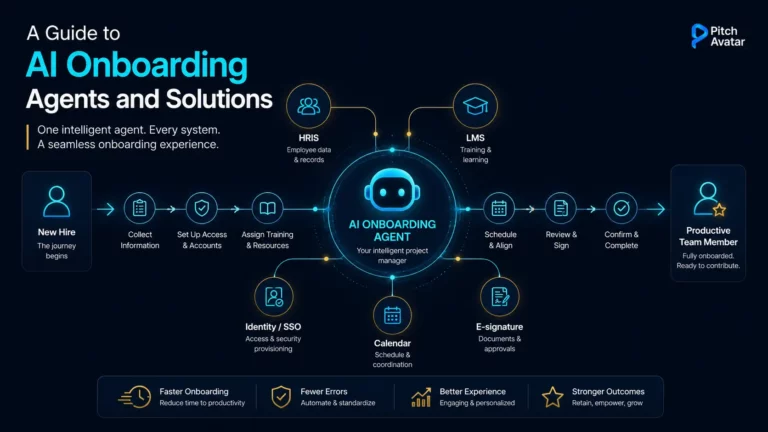
An AI onboarding agent is an autonomous, LLM-based system that plans, decides, and executes multi-step onboarding tasks for a new employee, client, user, or partner – integrating with your core systems to manage the entire process instead of just answering a single question. These are not chatbots with extensive knowledge bases. They are intelligent systems designed to interpret needs, choose the best course of action, and perform complex tasks within the tools you already use.
The key difference is between proactivity and reactivity. A traditional chatbot or rule-based workflow is reactive – it waits for a user to ask a question or initiate a predefined, linear sequence. An AI onboarding agent is proactive and goal-oriented. You give it the objective (for example, “new hire is fully productive by day 30”), and it works backward, organizing the entire process. It triggers actions across multiple systems without a direct request, acting as an intelligent project manager assigned to each new employee, client, or user. This ability to connect disparate departments and systems addresses a real weakness in most organizations, turning a chaotic adaptation process into a streamlined strategic asset.

Key Capabilities of a True AI Onboarding Agent
The power of an AI onboarding agent comes from a set of capabilities that go far beyond standard automation tools. These features enable the agent to manage complex, multi-step processes across multiple departments and software systems, creating a single interface that defines a modern onboarding solution.
Goal-oriented Guidance and Planning
Unlike simple task automation, an AI agent works to achieve a strategic goal. You give it the desired end state, and it plans, analyzes and takes steps to achieve it. For new employees, the agent can create a personalized onboarding roadmap based on their role, skills, and experience to ensure they receive the most relevant information and training at the right time. It doesn’t just answer individual questions – it takes the entire process through to the end, offering a structured route from start to finish.
Dynamic Workflow Automation and Orchestration
A true AI agent can coordinate actions and move data between disparate systems, and the value of this capability is hard to overstate – it’s the key differentiator that separates a simple tool from a strategic platform.
For example, when a new employee signs a job offer in an e-signature system, an agent can initiate a full workflow: creating their profile in the HRIS, creating accounts in identity systems such as Okta or Azure AD, assigning the first module in LMS, sending a welcome email from the CEO, and instructing the manager to schedule a 1:1 meeting. This interconnected organization eliminates manual information transfer, data fragmentation, and transforms a series of disparate tasks into a single, coordinated process.
Intelligent Document Processing (IDP)
The main cause of errors and delays in the traditional hiring process is manual data entry. Advanced agents use AI for Intelligent Document Processing, effectively “reading” and understanding unstructured documents like job offers, contracts, or ID cards. They identify and extract key information (a name, start date, job title, or contract terms) and use this data to automatically populate forms in other systems.
Real-time Conversational Intelligence
The agent also provides users with a 24/7 conversational interface while managing workflows in the background. It answers contextual questions such as “What is our PTO policy?” or “Has my laptop been shipped yet?” Most importantly, the system understands limitations and can escalate requests to specialists if they are outside their area of expertise, ensuring smooth processing and never leaving users stuck. New employees and clients receive immediate and reliable support when they need it.
| Capability | Description | Business impact |
|---|---|---|
| Goal-focused guidance | The agent understands the end goal (e.g. "fully onboard a new salesperson") and proactively guides the user through every step and milestone. | A complete, successful onboarding process, with less chance of missed steps, incomplete training, or early disengagement. |
| Dynamic workflow automation | The agent triggers actions and moves data across many disparate systems (HRIS, LMS, CRM, calendar) to run a complete end-to-end workflow. | Far less manual work for HR and IT, no data silos, and one process that accelerates time to productivity. |
| Intelligent document processing | The agent "reads" unstructured documents like job offers or contracts and extracts key information to populate forms or initiate next steps. | No manual data entry, fewer human mistakes, and faster processing - with compliance and accuracy from day one. |
| Real-time conversational support | The agent gives instant, contextual support throughout the process and escalates to human experts when needed. | A better experience through immediate help, raising engagement, satisfaction, and confidence. |
A Spectrum of Solutions: AI Onboarding Use Cases in Action
One of the strongest aspects of a comprehensive AI onboarding agent is its versatility. A single platform can be configured for a wide range of use cases across the business, creating consistency and efficiency at an enterprise level. This platform model allows an organization to solve a key operational problem once and apply the solution across multiple departments, greatly increasing the return on investment.

AI Employee Onboarding
This is the most common use case. AI employee onboarding covers the entire period from the hiring date. The agent manages everything from the moment the job offer is signed.
- Pre-boarding: agent automates document collection, sends personalized welcome messages, and provides onboarding materials to engage new employees before day one.
- Day-one readiness: on the first day, the agent confirms all systems are ready, troubleshoots common login issues, assists employees with benefits program enrollment, and sends reminders for mandatory compliance training.
- Role-specific tracks: the platform delivers personalized plans. An AI sales onboarding workflow prioritizes access to the CRM and sales enablement content; for a software engineer, the agent prioritizes code repositories and development environments. This specialization accelerates the time to productivity.
AI Client Onboarding
For B2B companies, particularly in SaaS and professional services, onboarding a new customer is critical to long-term success. An AI agent can manage the entire process to reduce Time to Value (TTV) and prevent early churn. AI client onboarding automation can send welcome kits, schedule onboarding calls, assist clients with product setup and implementation checklists, and provide personalized training. A smooth onboarding process for new clients is the key to their satisfaction and retention.
AI User Onboarding
Inside a software product, an AI agent can provide new users with in-app instructions. It offers interactive tutorials, highlights key features based on the user’s role or stated goals, and provides contextual assistance as they navigate through the platform. AI user onboarding accelerates adoption and proficiency, reduces the workload on the support team, and helps users quickly realize the product’s benefits.
AI Partner and Vendor Onboarding
An often overlooked but critical function is onboarding new partners, suppliers, or vendors. An AI agent can streamline verification, automate the collection of compliance documents (W-9 forms, security questionnaires), and provide access to necessary portals and systems. This ensures alignment, compliance, and efficiency across the organization’s supply chain and partner ecosystem.
Building The Business Case For Onboarding Automation
Investing in a complex AI agent solution provides a rationale for investment that goes beyond simply automating tasks. The benefits are strategic, quantifiable (AI could generate $150–$200 billion in annual HR value), and impact the entire organization’s efficiency, compliance, and ability to scale. A compelling rationale is provided by both the direct cost savings and the “hidden costs” associated with manually onboarding: loss of productivity, costly errors, and turnover.
Efficiency Improvement
The first benefit is increased operational efficiency. Automating entire workflows can save thousands of hours of manual administrative work over the course of a year. Creating accounts, which previously required contacting support and manual configuration, now takes just a few seconds. These hours translate directly into salary savings and can be redirected to higher value work.
Consistency and Compliance
An AI agent guides every user (employee or customer) through the same approved process every time. This eliminates variability and missed manual steps, which is critical for compliance with regulations such as GDPR and internal quality control. Agent creates an automatic audit trail, so every required step is completed and documented, reducing the financial and legal risk of non-compliance.
Productivity and Retention
This is where the greatest financial benefit is concentrated. According to Brandon Hall Group, high-quality onboarding for new employees increases retention by 82% and productivity by more than 70%. Since employee turnover can cost 1.5 to 2 times an employee’s annual salary (a problem that Gallup estimates costs American businesses approximately $1 trillion annually), the financial implications of retaining talented employees are enormous. By more quickly moving revenue-generating employees like salespeople into a more productive phase, the agent gets them to contribute to profits faster and engineers to deliver value faster.
Scalability For Growth
For growing companies, manual onboarding is a direct barrier to expansion. Hiring more people to handle the onboarding process for new employees is expensive and ineffective. An AI agent solution is designed for scalability, handling large volumes of new hires or clients without a corresponding increase in administrative staff – which supports rapid, cost-effective growth.
Ready to move faster on this? Start with Pitch Avatar and build your first onboarding experience.
Steps To Choose the Right AI Onboarding Platform
The market for AI onboarding solutions can be difficult to navigate. The best platform is not the one with the most features – it is the one you can customize to fit your organization’s unique and complex processes. A good evaluation focuses on flexibility, deep integration, and the ability to solve specific, identified problems.
Step 1: Map your current process and identify problems. Before considering any software, map out your existing onboarding processes for employees, customers, and other groups. Find the barriers, the most time-consuming manual tasks, and moments where new hires or customers get confused or frustrated. This people-first approach to AI implementation becomes the basis for your evaluation criteria.
Step 2: Set clear, measurable goals. Set specific goals for the project. Is your goal to cut time to productivity for new sales reps by 30%? Increase new employee satisfaction by 15% in the first 90 days? Reduce client churn in the first six months by 10%? Measurable goals will allow you to evaluate the results of implementation and demonstrate ROI.

Step 3: Evaluate the platform’s key features. Use a structured checklist to evaluate vendors based on your needs. Prioritize content over appearance and focus on technical features that will benefit your business.
| Evaluation criteria | What to look for | Key questions to ask the vendor |
|---|---|---|
| Integration depth & breadth | Pre-built connectors with minimal coding for your core systems (HRIS, CRM, identity management, LMS). Support for APIs and tools like Zapier for custom integrations. | Can you demonstrate a full workflow with our technology platform (e.g. Workday, Salesforce, Okta)? How do you work with custom or legacy systems? |
| Workflow customization | A flexible, visual builder that allows non-technical users to design and manage complex, multi-step interaction scenarios based on conditions. | How easily can our HR or operations teams change their workflow without developer support? Can it handle parallel approvals and role-based logic? |
| Personalization features | Dynamic, role-specific content and learning paths that adapt to user characteristics such as department, location, or seniority. | How does the platform adapt the user experience based on role? Can it deliver personalized content, such as a welcome video that addresses the new hire by name? |
| Analytics & reporting | Informative dashboards to track task completion rates, engagement, time spent on each step, and feedback. Predictive indicators for at-risk users. | What insights come from the analytics? Can it identify bottlenecks or predict which new employees are losing motivation? |
The Complete AI Onboarding Solution
Buyers of AI onboarding solutions typically consider three categories: all-in-one HR systems with built-in AI (like Workday or Rippling), specialized onboarding platforms, and specialized content and communications layers that make the onboarding process engaging. The most effective approach combines autonomous process management with powerful, personalized content creation. A complete AI onboarding system should coordinate the workflow (the “when” and “what”) and help create engaging content used inside it (the “how”).

This is where Pitch Avatar comes in. While the workflow management system manages the entire process (delivering the right information at the right time), Pitch Avatar provides the content layer, allowing managers and HR specialists to create personalized video presentations that form the basis of this communication. Instead of competing with your HRIS system, it complements it.
Pitch Avatar functions as an autonomous agent for presentation-based communication and training. This allows us to move away from static content and offer an interactive, personalized, and measurable onboarding process for new employees, customers or partners:
- Interactive AI Chat-Avatar: a visual, conversational assistant presents content and answers questions in multiple languages, 24/7 – so new hires and clients get consistent answers whenever they need them.
- Multilingual by default: voice cloning, dubbing, and context-sensitive translation ensure a consistent onboarding for a distributed team in each member’s native language.
- Per slide engagement analytics: see who watched, how far they went, and where they dropped off – this will help you improve content for new users.
- Workflow integration: connect to systems, including Salesforce and HubSpot, or hundreds of other apps via Zapier, to automate onboarding workflows end to end.
Implementing Pitch Avatar isn’t just about purchasing a tool – it’s about adding a complete, autonomous content layer that can transform onboarding across your entire organization.
Ready to see how an AI agent can transform your onboarding? Book a demo.
Frequently Asked Questions (FAQ)
The main difference is between proactivity and reactivity. A chatbot is reactive – it waits for a question and answers from its knowledge base. An AI agent is proactive and autonomous – it manages and executes an entire multi-step workflow across different applications, often without a direct request. The agent understands the end goal and coordinates every step to achieve it.
Intelligent document processing is an AI system’s ability to “read” and understand the content and context of documents like job offers, invoices, or contracts. It identifies and extracts key information (a name, start date, or contract terms) and uses that data to populate forms in other systems or initiate the next step in a workflow, eliminating manual data entry and reducing human error.
Measure it three ways: cost savings through increased efficiency and reduced administrative time for HR and IT departments; value creation from improved retention (preventing high turnover costs) and accelerating time to productivity; and risk reduction from consistent compliance with required procedures, avoiding potential fines.
Start by mapping your current process and problems, then set measurable goals, and then evaluate vendors against a structured checklist: integration depth, workflow customization, personalization, analytics, security and compliance, scalability, and support. The best option will be a platform that models your specific processes, not the one with the longest feature list.
Pricing varies by vendor, volume, and the number of workflows and integrations, so make your decision based on ROI rather than the listed price. Weigh the subscription and implementation cost against the administrative hours saved, reduced turnover, and the faster time to productivity for revenue-generating roles. For most medium and large teams, retention and productivity gains outweigh the platform pricing.
Yes. A powerful AI agent platform is versatile and works across a variety of use cases. For B2B companies, AI client onboarding is a highly effective application that reduces time to value, improves customer satisfaction, and reduces early churn.
Best practice is to work with human participation. Use AI to automate routine administrative tasks (paperwork, account setup, scheduling) so HR professionals and managers can focus on important human interactions like personalized training, mentoring, and team integration. AI supports human communication, not replaces it.
Completion times depend on the task’s complexity, and a step-by-step approach is most effective. A pilot project focused on a single specific case can often be launched within a few weeks. A full enterprise-wide implementation, covering multiple workflows and integrations, can take several months and is typically a joint project between the vendor and your internal teams.
Complex AI agent solutions are often targeted at medium and large companies due to the complexity of their workflows, but some scalable platforms deliver value to small businesses too. The deciding factor is whether the volume and complexity of your onboarding justify the investment. Small businesses with simpler processes may find that simpler automation tools meet their needs.